

Spamhaus blacklist removal is free. First identify the exact list, fix the underlying cause, then follow the official Spamhaus process or Customer Portal instructions, because a request without genuine remediation can be denied or followed by relisting.
A blocked sender usually discovers the problem through a rejected message, an SMTP error, or a sudden delivery failure. Sending should pause while the incident is investigated, especially when a compromised account, server, domain, or sending process could still be active.
The fastest recovery sequence is straightforward: identify the listing, confirm the affected IP or domain, fix the cause, submit the correct request, verify the result, and tighten monitoring so the same problem doesn't return. The right removal path depends on whether the listing is SBL, XBL, PBL, DBL, or CSS.
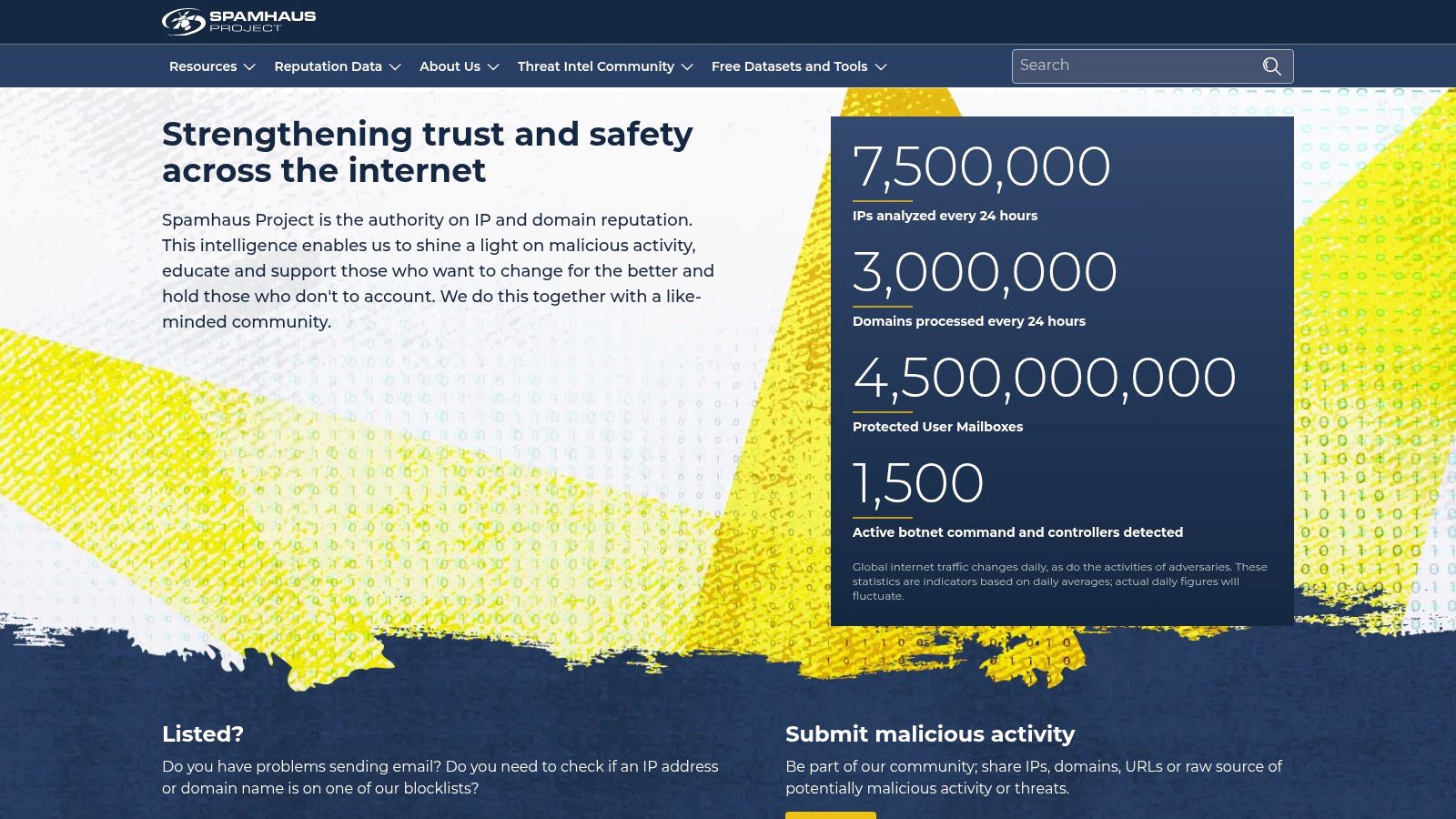
1. Spamhaus IP and Domain Reputation Checker
A rejected message or sudden delivery failure can point to a Spamhaus listing, but the first task is to identify the exact list and affected asset. The official Spamhaus IP and Domain Reputation Checker shows whether an IP address or domain appears on SBL, CSS, XBL, PBL, or DBL, then displays the listing context and applicable removal route. Spamhaus replaced its former Removal Center with this checker in 2021, bringing lookup and removal workflows together. Spamhaus remains the authoritative source for status and next steps.
Use the result to separate diagnosis from remediation. The checker does not remove a listing by itself. The underlying abuse must stop first, and the request should explain the investigation, corrective action, and controls added afterward. “The issue is fixed” provides less useful evidence than a concise account of what happened and how recurrence will be prevented.
What the official route handles
- Listing diagnosis: Results distinguish SBL, CSS, XBL, PBL, and DBL cases.
- Remediation guidance: The listing explains the relevant policy and required action.
- Request management: Eligible cases proceed through the checker, Customer Portal, email verification, or a review ticket.
- Status visibility: Senders can follow the request without relying on an intermediary.
The removal path depends on the list. SBL requests must come from the ISP controlling the listed IP. CSS can permit request-based removal after the cause is corrected. PBL may support self-service removal for a static IP used as an outbound mail server, with forward and reverse DNS configured.
For a second opinion, senders can check if your domain is blacklisted. Treat that lookup as supplementary. Spamhaus remains the decision point for a Spamhaus case, and the exact listing instructions should guide remediation and submission.
2. Word to the Wise
Word to the Wise suits senders whose listing is a symptom of a wider deliverability incident rather than an isolated lookup problem. The consultancy works across authentication, infrastructure, policy, and data quality, which matters when the sender can't confidently explain why an IP or domain was listed.
Its value is investigative depth. A difficult case may involve a compromised mailbox, an exploited web form, poor list acquisition, weak access controls, or sending behavior spread across multiple systems. In those situations, submitting a removal request before understanding the source can waste time and leave the abuse active.
Where the consultancy helps
Word to the Wise provides direct guidance for Spamhaus listings and broader email incident management. Its work can include root-cause investigation, remediation planning, communication with infrastructure providers, and longer-term monitoring. That combination is useful for agencies, businesses, and email teams that have technical staff but need an experienced outside review.
The trade-off is involvement. This isn't a self-service dashboard that produces an instant answer. The client must provide logs, DNS records, sending details, account information, and access to the people responsible for the mail infrastructure. The consultancy model also brings higher cost and limited availability compared with a free lookup.
A delisting request is strongest when the sender can show what happened, what changed, and why the same abuse can't continue.
Word to the Wise is a practical option for complex incidents, especially when the sending organization needs both immediate recovery advice and a durable deliverability program. It isn't the right fit for a simple PBL policy issue where the sender only needs to move outbound mail through an appropriate relay.
3. Postmastery
Postmastery combines deliverability consulting with monitoring through the Postmastery Console. That combination gives teams a way to watch IP and domain reputation across Spamhaus and other DNSBLs while working with specialists on the cause of the listing.
The platform is more useful for ongoing operations than for a sender looking for a single form. Reputation monitoring can reveal repeat problems across infrastructure, while an audit can connect those signals to authentication, message practices, traffic patterns, and mailbox-provider expectations. The human support matters because monitoring alone doesn't remove a listing.
Console plus expert intervention
Postmastery can support blacklist monitoring, deliverability audits, managed remediation, alerts, and program optimization. Its European perspective can also be useful for senders working across multiple providers and regions, where a single Spamhaus result may be only one part of a broader delivery problem.
The main limitation is access and commercial fit. Pricing and plans require engagement, and the service isn't positioned as a fully public self-service product. A team also needs to reserve time for remediation. No console can compensate for an active compromise, poor data practices, or an infrastructure owner that hasn't closed the abuse.
For an organization with recurring deliverability responsibilities, Postmastery is a strong choice when reputation visibility and expert support need to operate together. For a one-off lookup, the official Spamhaus checker is faster and free.
4. Sinch Mailgun Deliverability Services and Blocklist Monitoring
Sinch Mailgun is most relevant when the sender already uses Mailgun or needs an email service provider with deliverability support around an active incident. Its services include blocklist monitoring, alerts for major DNSBLs such as Spamhaus, and access to deliverability engineers for recovery guidance.
The practical advantage is integration. A Mailgun customer may be able to connect the listing to account activity, sending configuration, authentication checks, seed testing, or spam trap insights without coordinating several unrelated vendors. That can shorten the path from detection to investigation, provided the sender's team responds quickly.
Where Mailgun fits
Mailgun's deliverability services can help assess a blocklist incident, guide remediation, and support communication with blocklist operators. This is particularly useful when the listed IP belongs to the provider and the customer doesn't control the relevant abuse process. In an SBL case, that distinction is critical because the ISP controlling the IP must submit the request on the sender's behalf.
The trade-off is platform dependence. Some monitoring and advanced capabilities are limited to Mailgun customers, while professional services and specific pricing require a sales conversation. Monitoring can identify the problem, but it won't remove a listing while spam, malware, compromised credentials, or unsafe sending practices remain.
Teams comparing providers may also want to choose the right email security provider based on infrastructure ownership, incident support, and authentication controls. Sinch Mailgun does well when a sender wants those deliverability services connected to its sending platform.
5. Twilio SendGrid Expert Services
Twilio SendGrid's Expert Services team is a sensible option for senders already operating on SendGrid. The team can provide guidance for third-party denylist incidents, including Spamhaus-related remediation and delisting, while the sender continues working within the platform's support and documentation ecosystem.
SendGrid's strength is operational familiarity. A provider-side team can review the sending program, identify configuration or policy weaknesses, and create a remediation plan rather than treating the listing as an isolated DNS event. That context is valuable when the sender has multiple campaigns, several domains, or a history of inconsistent traffic.
Useful for SendGrid customers
Expert Services can support program audits, corrective plans, coaching, and platform-specific deliverability questions. The team may guide the sender through the relevant request, but some removal requests still need to be submitted by the customer or the infrastructure owner. The sender remains responsible for correcting the root cause.
The service is less suitable for someone who wants an independent, low-cost blacklist lookup. Assistance is generally tied to SendGrid customers, and pricing is handled through sales. A sender using another provider may get more direct value from Spamhaus itself or from a specialist consultancy that doesn't depend on platform membership.
Senders rebuilding their broader outreach process can review best email warmup tools, but warmup shouldn't be used to mask an active incident. Twilio SendGrid is strongest when the delivery infrastructure, support relationship, and remediation work all sit within the same provider.
6. MXToolbox
MXToolbox is useful for fast visibility across multiple DNS-based blocklists. Its interface can show whether an IP or domain appears on Spamhaus and other lists, provide operator guidance, and help a sender organize the first stage of an incident.
The free lookup is valuable for diagnosis, but diagnosis isn't remediation. A sender still needs to inspect logs, secure accounts, correct server behavior, clean the list, and follow the operator's own removal rules. MXToolbox can point to the right form, but it doesn't replace the ISP or abuse team that Spamhaus authorizes in an SBL case.
Monitoring versus hands-on help
Paid subscribers can receive expanded monitoring and delisting support, while the free tier is more limited. That distinction matters for teams deciding whether they need a recurring alerting system or only a quick answer during an incident. A monitoring platform is most useful when someone is assigned to act on the alert.
MXToolbox works well as a broad screening layer because it can surface listings beyond Spamhaus. It also gives senders an accessible place to organize operator links and knowledgebase material. It doesn't, however, prove that the underlying problem is closed, and it can't force a blocklist operator to approve a request.
A sender can pair the lookup with Mailwarm's spam checker to investigate broader content and deliverability risks. MXToolbox is a practical monitoring choice, while Spamhaus remains the source of truth for a Spamhaus-specific removal decision.
7. Validity Everest and Professional Services
Validity's Everest platform and Professional Services offering are aimed at organizations that need reputation analysis, monitoring, and consulting at program level. The platform can help teams assess blocklist impact, connect reputation signals with postmaster data, and prioritize remediation work.
That focus makes Everest more appropriate for high-volume senders and larger email operations than for a small sender facing a single unexplained rejection. An executive team may need to understand which domains, IPs, programs, or providers are affected before assigning remediation resources. Consulting can then turn that information into a program fix rather than a narrow delisting attempt.
Enterprise visibility has limits
Validity's consultants can help create remediation plans and identify weaknesses in the broader sending program. The platform can support reporting and monitoring, but actual Spamhaus removal still follows Spamhaus rules. A dashboard won't bypass the requirement that the responsible ISP submit an SBL request or that a sender explain how the issue was permanently resolved.
The trade-off is commercial and operational. Enterprise pricing requires sales engagement, and teams need enough sending complexity to justify a platform-focused offering. Smaller senders may get a faster result from the official checker, their hosting provider, or a targeted deliverability consultant.
Validity is best considered a strategic monitoring and consulting option. It can add structure to a large deliverability program, but the immediate rescue sequence remains the same: identify the list, stop the abuse, fix the cause, and follow the authorized removal path.
Spamhaus Blacklist Removal: 7-Service Comparison
| Service | Implementation complexity | Resource requirements | Expected outcomes | Ideal use cases | Key advantages |
|---|---|---|---|---|---|
| Spamhaus IP & Domain Reputation Checker (official removal path) | Low for using portal; remediation can be technically involved | Minimal tools; needs remediation evidence and sometimes ISP/host cooperation | Authoritative delisting if underlying issue is fixed; tracked status | Direct removal for IP/domain listings on Spamhaus | Direct, authoritative guidance; no intermediaries; free to use |
| Word to the Wise | High, bespoke investigations and multi-month engagements | Paid consultancy; client engagement and internal implementation resources | Root-cause fixes, delisting, and long-term prevention programs | Complex or recurring blacklist incidents requiring expert hands-on work | Senior practitioner expertise and structured remediation programs |
| Postmastery | Moderate–high, audit + managed remediation with console | Paid service plus monitoring console and ongoing expert time | Managed delisting, root-cause analysis, and ongoing reputation alerts | Organizations wanting tooling plus expert-managed deliverability | Combines monitoring console with hands-on deliverability experts |
| Sinch Mailgun – Deliverability Services and Blocklist Monitoring | Low–moderate when using Mailgun; requires provider coordination | Mailgun account for full features; paid deliverability services | Assisted delisting, incident response, and monitoring | Customers sending via Mailgun or needing integrated provider support | Integrated monitoring with deliverability engineering support |
| Twilio SendGrid – Expert Services | Low–moderate; advisory and platform-integrated assistance | Best for SendGrid customers; paid expert services via sales | Delisting guidance, remediation plans, and coaching | SendGrid senders needing audits, coaching, and delist support | Expert team plus extensive platform documentation |
| MXToolbox | Low, self-service monitoring and lookups | Free lookups; paid plans for expanded monitoring and support | Fast visibility into listings; paid support may assist delisting steps | Quick checks and continuous monitoring for small/medium senders | Broad blacklist coverage and easy-to-use interface |
| Validity (Everest + Professional Services) | Moderate–high, enterprise platform with consulting | Enterprise subscription and professional services; integrations | Blocklist impact analysis, prioritized remediation, executive reporting | High-volume senders needing enterprise insights and program fixes | Enterprise-grade analytics combined with professional consulting |
Which Spamhaus list are you on
Spamhaus blacklist removal starts with list identification because each list represents a different problem and assigns different authority for removal.
SBL
The Spamhaus Blocklist identifies IP addresses associated with spam activity. SBL removal isn't self-service. The ISP responsible for the listed IP must verify that the abuse has been permanently fixed and submit the request on the sender's behalf. Spamhaus also states that an IP must be removed from SBL before removal from additional related lists can be completed.
XBL
The Exploits Blocklist concerns compromised infrastructure, such as a system affected by malware or another exploit. The sender should investigate hosts, credentials, software, and outbound activity before using the checker-based removal route.
PBL
The Policy Blocklist identifies IP space that shouldn't send mail directly to external servers. A PBL entry isn't automatically an accusation of spam. Self-service removal is limited to an IP that is static, used as an outbound mail server, and configured with forward and reverse DNS. A consumer or unsuitable IP should normally send through an authorized relay instead.
DBL
The Domain Blocklist applies to domains associated with spam or harmful content. This may involve a compromised website, unsafe links, or a domain used in abusive messages. Domain removal is managed through the reputation checker and Customer Portal.
CSS
The Composite Snowshoe list addresses distributed sending patterns associated with snowshoe spam. CSS entries are usually short-lived and normally expire about three days after the last spam detection, but the underlying sending behavior still needs to stop. Spamhaus says the CSS subset commonly contains between 2 and 4 million listings, with roughly 300,000 to 400,000 new listings added every 24 hours. Spamhaus explains CSS and IP-space management.
How to check
Start with the bounce message, but don't assume that the word “Spamhaus” identifies the actual list. The message may identify an IP, a domain, or a combined DNSBL result. Copy the exact sending IP and any domain named in the error, then enter each one into the official Spamhaus checker.
A second lookup through Mailwarm's blacklist checker can help identify wider reputation issues. That secondary view is useful for context, but it shouldn't replace the Spamhaus result or its removal instructions.
Lookup sequence
- Capture the exact identifier: Use the public sending IP, envelope domain, link domain, and visible sending domain where relevant.
- Run the official lookup: Check the IP and domain separately because an IP listing and a DBL listing follow different paths.
- Record the list name: Note SBL, XBL, PBL, DBL, or CSS.
- Read the reason: Save the listing explanation and any remediation requirements.
- Identify the authorized requester: Determine whether the request must come from the ISP, host, provider, or sender.
- Pause risky traffic: Stop campaigns and investigate before sending again.
Spamhaus requires requests to come from an IP address associated with the listed IP or domain, and it warns against using a VPN. That verification step can prevent an otherwise valid request from entering the wrong workflow. Spamhaus's general FAQ explains the requester association requirement.
Fix the root cause first
A removal request is not a substitute for incident response. If the sender asks for removal while a compromised mailbox, infected server, abused form, open relay, unsafe domain, or unwanted campaign remains active, the listing can persist or return.
The investigation should follow the path of the affected asset:
- Compromised mailbox: Reset credentials, revoke suspicious sessions, review forwarding rules, inspect sent-mail activity, and secure multi-factor authentication.
- Infected server: Check outbound logs, running processes, scheduled tasks, web applications, and relay configuration. Remove malware before restoring normal traffic.
- Bad list: Stop sending to purchased, scraped, stale, or unconfirmed contacts. Suppress hard bounces, complaints, and recipients who no longer engage.
- Spam-like sending: Review sudden volume changes, rapid IP or domain rotation, repetitive content, misleading links, and recipient expectations.
- Misconfigured infrastructure: Validate SPF, DKIM, DMARC, forward DNS, reverse DNS, SMTP authentication, and access controls.
Requesting removal before the cause is closed can create a repeat incident, not a recovery.
The sender should preserve evidence for the request. A useful explanation names the source of the abuse, the corrective actions, the date or state of closure without inventing unsupported timing, and the safeguards that prevent recurrence. SBL cases require the ISP to verify and permanently fix the issue, so the customer should contact the hosting provider or mail service's abuse team immediately.
The removal request step by step
Once the cause is closed, the request should follow the exact list-specific route shown by Spamhaus. The process is free, but approval depends on eligibility, evidence, and the operator's verification.
- Open the listing result: Use the Spamhaus IP and Domain Reputation Checker rather than an unofficial removal form.
- Confirm the asset: Make sure the result refers to the actual sending IP or domain, not a shared host, old server, or unrelated DNS record.
- Complete the remediation: Don't submit while logs show continuing abuse or while a compromised system remains online.
- Use the authorized channel: For SBL, contact the ISP controlling the listed IP. For eligible PBL, CSS, XBL, or DBL cases, use the checker or Customer Portal instructions.
- Explain the permanent fix: Describe what caused the listing and what changed. Avoid vague claims or unsupported promises.
- Complete email verification: Spamhaus states that some requests are removed immediately after verification, while others become review tickets.
- Track the result: Keep the ticket or confirmation details and recheck the affected asset afterward.
- Resume cautiously: Restore sending only after the abuse is closed and the listing status has been verified.
PBL removal has a specific technical threshold. Spamhaus says the IP must be static, serve as an outbound mail server, and have correct forward and reverse DNS. Removed PBL entries usually disappear from the zone within minutes, with DNS propagation around 15 minutes, according to Spamhaus's PBL guidance.
How long delisting takes
There isn't one reliable Spamhaus delisting time for every case. CSS entries normally expire about three days after the last spam detection, while eligible checker-based requests can be processed after verification. Review tickets, SBL involvement, DNS caching, provider response time, and the quality of the remediation evidence can all change the operational timeline.
SBL cases often take longer from the sender's perspective because the ISP must investigate, correct the abuse, and submit the request. The sender can't complete that request directly through the checker. PBL can be much faster when the IP meets the eligibility requirements, but a removal from PBL doesn't make an unsuitable consumer IP appropriate for direct mail delivery.
What delays recovery
- Active abuse: New spam detections can keep the listing current.
- Wrong requester: An end user can't replace the ISP in an SBL workflow.
- Incomplete evidence: Spamhaus expects a clear explanation of the permanent fix.
- Unrelated listing: Removing one entry won't resolve a separate DBL or XBL problem.
- Cached DNS data: Some receiving systems may continue using an earlier result temporarily.
- Unsafe resumption: Sending again before monitoring is stable can trigger another detection.
Spamhaus's scale explains why a removal request is treated as a verification process rather than a simple form submission. Its systems analyze 7.5 million IPs every 24 hours, process 3 million domains every 24 hours, protect 4.5 billion mailboxes, and detect about 1,500 active botnet controllers, according to Spamhaus. Those figures shouldn't be used to predict an individual outcome, but they show why precise, credible remediation matters.
How to avoid relisting
Delisting restores a technical path to delivery. It doesn't rebuild sender trust by itself, and it doesn't protect an organization from a second compromise or another poor campaign decision.
The prevention plan should cover infrastructure, data, content, and traffic:
- Authentication checks: Keep SPF, DKIM, and DMARC aligned, and review changes whenever a provider or sending system changes.
- Bounce prevention: Suppress invalid addresses and investigate unusual bounce patterns before they become a campaign-wide problem.
- List hygiene: Remove stale contacts, honor unsubscribes, and avoid purchased or scraped data.
- Volume discipline: Increase traffic gradually, keep sending patterns consistent, and avoid sudden bursts or unexplained IP rotation.
- Account security: Protect mailboxes, forms, servers, and administrative panels with strong credentials and appropriate access controls.
- Reputation monitoring: Check IP and domain status regularly, watch SMTP errors, and review provider-level delivery.
- Content review: Inspect links, domains, tracking, formatting, and recipient expectations before restarting campaigns.
Mailwarm fits after the incident is closed, not instead of fixing it. As a premium email warmup and deliverability platform, Mailwarm helps senders build sender reputation, monitor inbox placement, and reduce spam risk through real inbox engagement, advanced warmup controls, and expert guidance. Its network includes 50,000+ aged real inboxes across Gmail, Outlook, Microsoft 365, Yahoo, and SMTP providers, with signals such as opens, replies, threads, spam removal, important marking, and continuing inbox engagement.
Mailwarm goes beyond basic warmup with spam score monitoring, inbox placement insights, provider-level warmup, B2B and B2C warmup, custom email content warmup, authentication fix tools, bounce prevention, and deliverability analytics. Depending on the plan, warmup emails can receive up to 100% replies, and every plan includes expert deliverability calls. It doesn't require IMAP access or permission to read a private inbox, which gives teams a less intrusive way to manage reputation after a blacklist incident.
Frequently asked questions
Is Spamhaus removal free?
Yes, checking and requesting removal through the Spamhaus process is free. The sender may still incur costs for incident response, infrastructure changes, provider support, or specialist consulting. Free removal doesn't mean automatic approval, because Spamhaus requires the underlying issue to be fixed.
How long does Spamhaus delisting take?
Timing depends on the list, the remediation, the authorized requester, and whether Spamhaus sends the case to review. CSS entries normally expire about three days after the last spam detection, while PBL removals can move quickly when the IP meets the technical requirements. SBL cases can take longer because the responsible ISP must submit the request.
Why do I keep getting relisted?
Relisting usually means the original cause wasn't fully removed or a related system remains exposed. Common possibilities include a compromised mailbox, active malware, an abused form, poor list quality, unsafe sending patterns, or a provider-side issue. The sender should review logs and infrastructure again before submitting another request.
Can an end user remove an SBL listing?
No. Spamhaus says SBL removal requests must come from the ISP that controls the listed IP. The ISP must verify and permanently fix the abuse issue before submitting the request on the sender's behalf.
Can a PBL listing be removed?
Sometimes. Spamhaus allows self-service PBL removal when the IP is static, used as an outbound mail server, and configured with forward and reverse DNS. Consumer or unsuitable IP space should normally use an authorized outbound relay instead.
Does delisting restore inbox placement?
Not necessarily. Delisting can remove a technical rejection source, but mailbox providers continue evaluating sender reputation, authentication, engagement, complaints, content, and sending behavior. Inbox placement should be monitored after the listing is cleared.
How does Mailwarm help after a Spamhaus incident?
Mailwarm helps improve sender reputation and reduce spam risk through real inbox engagement, provider-level warmup, spam score monitoring, inbox placement insights, authentication fix tools, bounce prevention, and deliverability analytics. It doesn't remove a Spamhaus listing, but it can support the reputation and monitoring work that follows remediation.
Spamhaus blacklist removal works best as a controlled recovery process, not a rushed form submission. Verify the exact list, identify who controls the removal request, close the compromise or sending problem, document the permanent fix, and monitor the IP and domain after the status changes.
Use the official checker for the decision, a blacklist checker for broader visibility, and provider or specialist support when the infrastructure isn't under the sender's direct control. After recovery, apply authentication checks, list hygiene, bounce prevention, volume discipline, spam score monitoring, inbox placement insights, and provider-level warmup before scaling activity again.
Mailwarm is a premium email warmup and deliverability platform for teams that want real inbox placement improvement, not just automated warmup activity. It combines aged real inbox engagement, advanced warmup controls, monitoring, authentication tools, and expert guidance to help protect sender reputation after a blacklist incident. A broader email warmup tool can support the prevention phase, but it can't replace root-cause remediation.
If email is important to business growth, Mailwarm provides real inbox engagement, provider-level warmup, spam score monitoring, inbox placement insights, authentication fix tools, bounce prevention, and expert deliverability calls. Visit Mailwarm to build a monitored reputation program that helps reduce the risk of another Spamhaus incident.