
Effective email templates for sales are short, relevant starting points that must be adapted to the recipient, placed correctly in a sequence, tested responsibly, and delivered to the inbox. Personalization can lift open rates by about 26% on average, but strong copy still produces no replies when the message is irrelevant or filtered into spam. (Campaign Monitor personalization data)
The popular advice is to find one “perfect” sales email and send it repeatedly. That approach fails because a template is a framework, not a copy-and-send script. The right structure depends on the prospect's buying signal, role, relationship with the sender, and place in the sequence.
The eight templates below cover personalized cold outreach, problem-led conversations, social proof, curiosity, direct pitches, referrals, follow-ups, and educational nurturing. Each includes a practical example, personalization cues, testing ideas, and deliverability checks.
A polished message still can't create a reply if it never reaches the inbox. Mailwarm is a premium email warmup and deliverability platform that helps senders build reputation, monitor inbox placement, and reduce spam risk through real inbox engagement, advanced warmup controls, and expert guidance.
1. The subject line hook and personalized opening
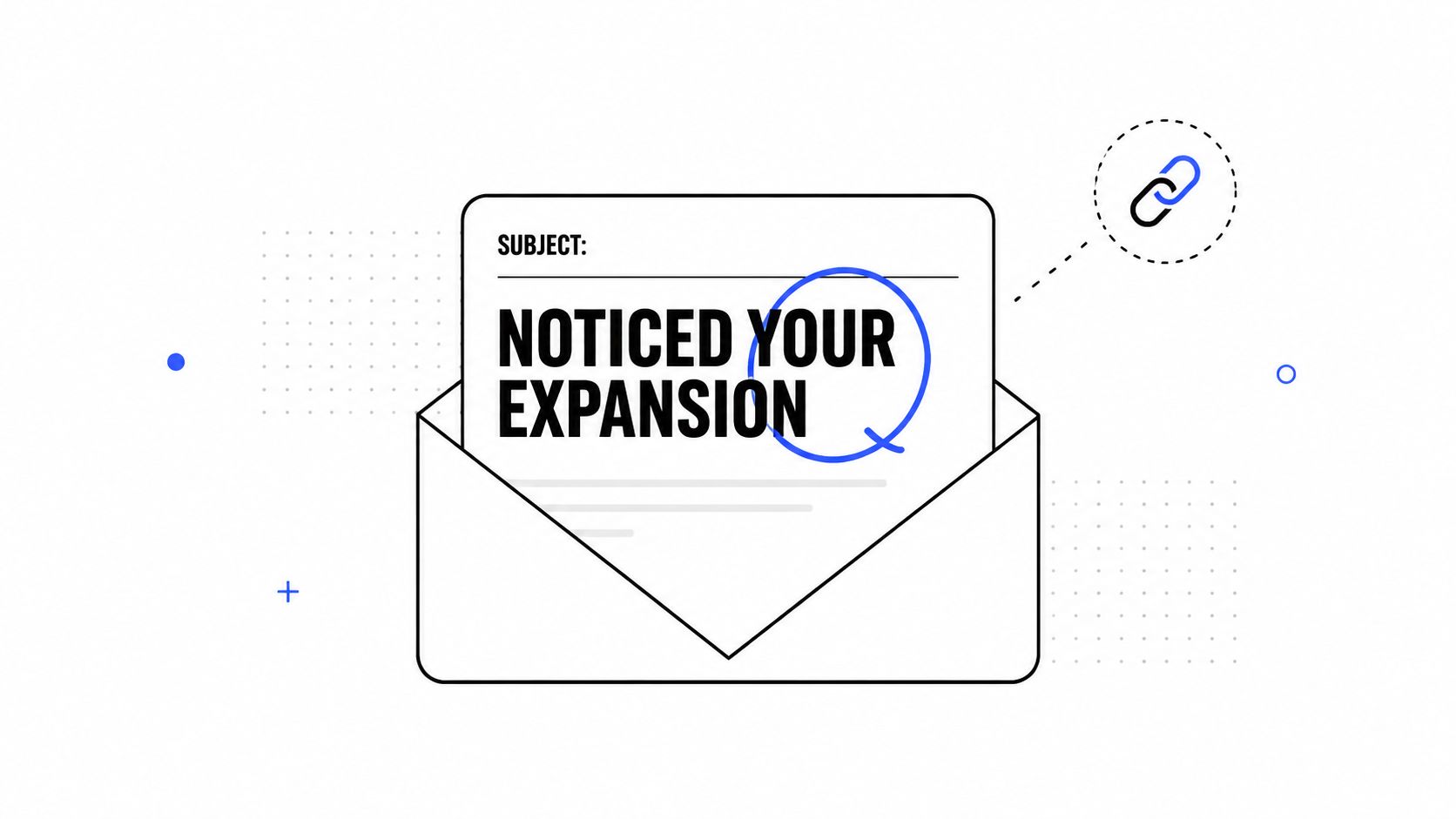
A cold email earns attention by showing a specific reason for contact. Use a trigger the prospect can recognize, such as a funding announcement, expansion, product launch, hiring push, or public comment. The subject line should reflect that trigger without turning it into a generic compliment.
Subject line variants
- Noticed your EMEA expansion
- London hiring and sales growth
- Question about your new market
- Scaling after Series B
Template
Hi [First Name],
I saw that [Company] raised its Series B and opened a new office in London. With the team hiring across EMEA, [specific operational challenge] may be becoming harder to manage.
[Company selling] helps SaaS teams at a similar stage [specific outcome]. Is [challenge] on the roadmap this quarter?
Best,
[Sender Name]
The opening works because it gives the recipient a concrete reason to keep reading. “I noticed your growth” could apply to thousands of companies. “I saw your company opened a London office and is hiring account executives there” connects the message to an observable event.
Personalization should remain proportional. One verified detail signals preparation. Several details can feel intrusive, especially when they come from sources the recipient did not expect you to inspect. Tie the observation to a plausible business issue, then leave room for the prospect to correct your assumption.
Test the subject line and body separately. Compare a problem-focused hook with an opportunity-focused hook while keeping the body unchanged. Judge the result by replies and inbox placement, not opens alone. If opens drop suddenly, check reputation and placement before changing the copy.
Personalization and deliverability checks
- Verify the trigger: Confirm the funding, hiring, news item, or expansion before sending.
- Keep the detail brief: One relevant observation feels researched.
- Test one variable: Change the hook while holding the body constant.
- Protect the sender reputation: Review placement and bounce signals before scaling a winning variant.
Review good subject lines for cold sales email when drafting variants. Mailwarm helps senders monitor reputation and inbox placement, so copy tests are not mistaken for deliverability problems.
2. The value-first problem statement
A problem-led email earns attention by showing a plausible business issue before presenting a product. The observation should be specific enough to invite discussion, while leaving room for the prospect to correct it.
Subject line variants
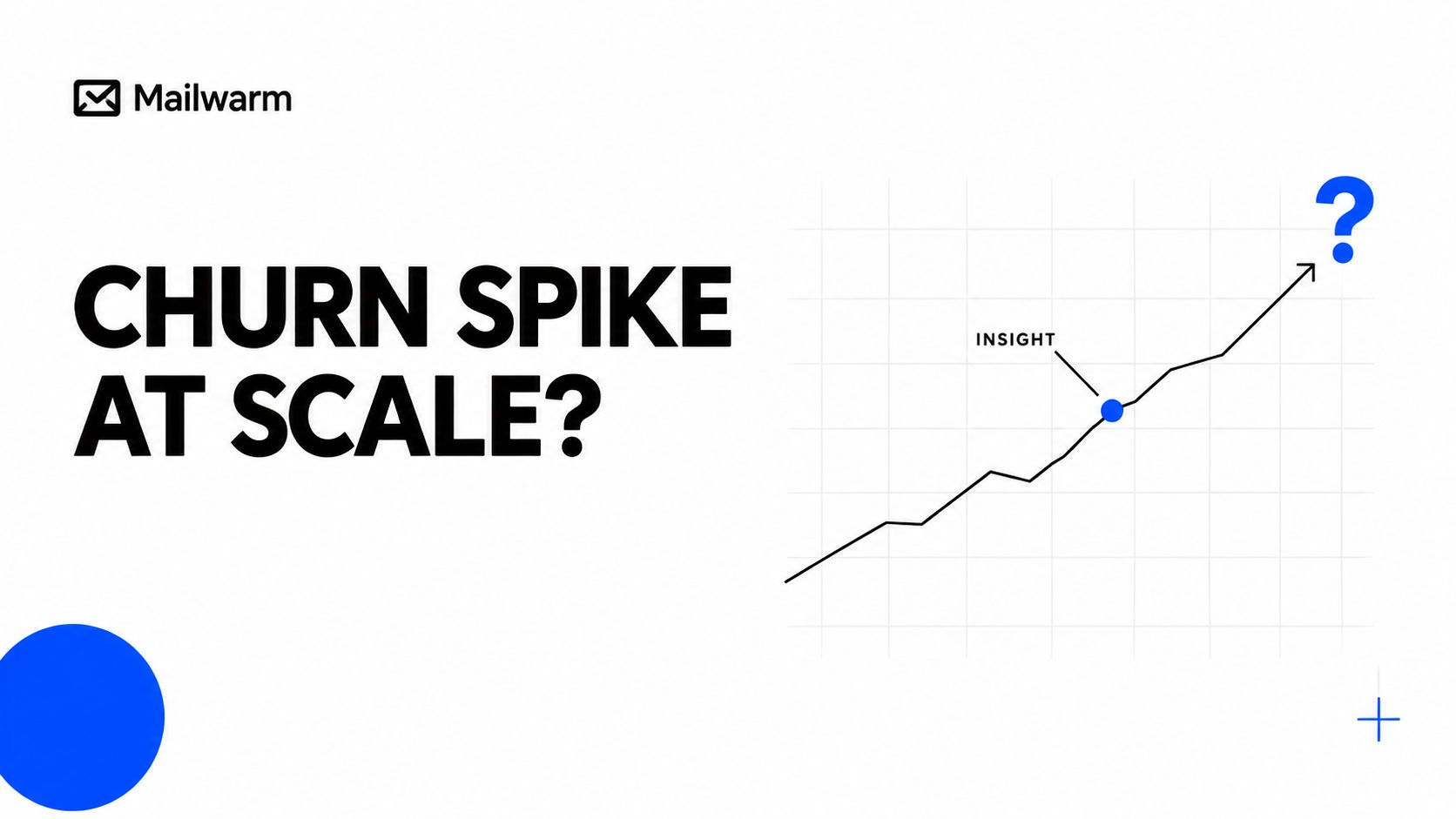
- Managing churn as sales scales
- A question about sales growth
- Churn after team expansion
- Is this showing up at [Company]?
Template
Hi [First Name],
As SaaS companies expand their sales teams, customer churn can become harder to diagnose. Handoffs, product expectations, and customer communication may contribute alongside sales execution.
Is that showing up at [Company], or is churn currently stable?
Best,
[Sender Name]
The open question is the useful part of this format. A recipient may recognize the problem while disagreeing with the diagnosis or timing. Asking for confirmation creates a lower-friction reply and avoids turning the first email into an unsupported pitch.
Adapt the problem statement to the buyer's role. A chief revenue officer may focus on pipeline quality and retention. A sales operations leader may focus on process consistency. A founder may focus on how growth affects customer experience. The product stays the same, but the business consequence and vocabulary should change.
Practical rule: Describe the problem in the prospect's language before describing the product's features.
Test the message and the sending conditions
- Observation versus question: Compare a direct observation with an opening question, using the same body where possible.
- Specificity: Test an industry-level challenge against a verified company-level trigger.
- CTA friction: Request a short reply before asking for a calendar meeting.
- Message length: Keep the problem statement visible on a mobile screen.
- Personalization: Use one relevant detail, then check that it is accurate and appropriate to reference.
- Deliverability: Review placement and bounce signals before treating low replies as a copy problem.
A concise test matrix helps isolate the cause of weak performance. Change one variable at a time, such as the subject line, problem framing, or call to action. Judge replies alongside inbox placement, since an attractive message cannot compensate for spam placement.
Mailwarm's spam score monitoring and inbox placement insights help distinguish weak messaging from delivery problems. Its premium warmup and deliverability capabilities can support reputation checks before a team scales a promising variant.
3. The social proof and mutual connection reference
Social proof earns attention only when the recipient can verify its relevance. A comparable customer or genuine mutual connection gives the email context quickly. An unsupported name-drop can damage trust, especially if the sender inflates the relationship or outcome.
Use subject lines that identify the connection or the practical lesson:
- [Mutual Connection] suggested this
- Similar sales team, different result
- How [Customer] handled [challenge]
- A relevant customer example
Hi [First Name],
[Mutual Connection] mentioned that both teams are working through similar sales-process questions. [Customer Name], a [relevant company description], used [solution] to address [specific challenge].
A short example may help as [Company] evaluates its approach. Would a one-page case study be relevant?
Best,
[Sender Name]
Verify the connection before using it. If that person explicitly introduced you, say so. If you only share a professional network, describe that accurately and avoid implying an endorsement.
The customer example also needs a close match. A large enterprise result may carry little weight with a small agency, and a different market may not demonstrate that the solution applies. The prospect should recognize the problem, operating context, and type of outcome.
Build the proof around four checks:
- Name the problem: State what the customer was trying to solve.
- Use an approved outcome: Confirm the metric, timeframe, and wording with the customer or an internal source.
- Keep the proof narrow: One result is easier to assess than several claims.
- Offer the evidence: Share a short case study, customer conversation, or relevant resource as the next step.
Prospeo summarized a documented personalized case-study campaign that generated a 4.2% reply rate, 14 call bookings, and 3 paid conversions in four weeks. The same source reported 46% open rates for personalized subject lines across 5.5 million emails, compared with 35% without personalization, and recommended placing case-study messages mid-sequence rather than using them as the first touch. (Personalized case-study email template data)
That sequencing choice matters. A case study can support an earlier problem or reply, but it may feel premature as a first contact. Test a customer-specific subject line against a connection-led version, and check whether the sender has permission to reference the connection. Review inbox placement and sender reputation before judging the copy. Mailwarm's spam score monitoring and inbox placement insights can help separate delivery issues from weak messaging, while its premium warmup and deliverability capabilities support reputation checks before scaling a variant.
4. The curiosity-driven question and brief context
A curiosity email should ask a real business question, not manufacture suspense. The best questions reflect a metric, workflow, or decision that the recipient can reasonably answer from their role.
Subject line variants
- Tracking email-to-SQL conversion
- A sales operations question
- Measuring outreach efficiency
- How does [Company] track this?
Template
Hi [First Name],
How does [Company] measure the number of outbound emails sent before a lead becomes sales-qualified?
The question comes up because sales operations teams often track activity and pipeline separately. Is that conversion visible in the current reporting?
Best,
[Sender Name]
The question is specific enough to invite a thoughtful reply, but it doesn't assume the prospect has a problem. That distinction protects credibility. “Are you losing leads because your reporting is broken?” is leading and confrontational. “How does your team measure this?” opens a conversation.
A curiosity-driven message should contain little context. The sender's explanation only needs to answer why the question is relevant. A long product description turns the email into a pitch and removes the reason to respond.
Subject lines and responsible testing
Recent benchmark data reported average open rates of 28% for one to three words, 37% for four to seven words, 31% for eight to twelve words, and 22% for thirteen or more words. The strongest reported band was four to seven words. (Cold email follow-up timing and subject-line data)
That benchmark can guide a test, not dictate a universal rule. A four-word subject line may outperform a longer one for a simple question, while a trigger-based subject may need more context. Compare a short question with a short company-specific reference, then measure replies rather than opens alone.
- Make the question answerable: Avoid questions requiring research before the prospect can respond.
- Explain the reason: Add one sentence of context.
- Avoid false urgency: Curiosity shouldn't depend on exaggerated risk.
- Check placement: A question in spam has no chance to start a conversation.
Mailwarm helps teams monitor whether curiosity-driven messages reach the inbox consistently, rather than assuming low response means the question failed.
5. The one-liner pitch and clear call to action
Some prospects prefer directness. A one-liner pitch states who the sender helps and what the sender does, then gives the recipient an easy way to qualify the conversation.
Subject line variants
- Reduce outreach administration
- Improve cold email placement
- A direct question for [Company]
- Is deliverability a priority?
Template
Hi [First Name],
Mailwarm helps sales teams build sender reputation, monitor inbox placement, and reduce spam risk through real inbox engagement and deliverability insights.
This may not be relevant if [Company] already has stable inbox placement and strong authentication. If not, would a short review of the current setup be useful?
Best,
[Sender Name]
The disqualifier matters. It tells the recipient that the sender isn't trying to force a fit. A direct CTA works best when the prospect already knows the category, has shown intent, or has a trigger that makes the problem plausible. It often performs poorly as a completely context-free first touch.
The sender should make one request, not offer a demo, audit, guide, and newsletter in the same email. A clear CTA lowers the amount of decision-making required from a busy recipient.
Direct doesn't mean aggressive
Use this format when:
- The category is familiar: The prospect has encountered the problem or interacted with related content.
- The value is concrete: The first sentence explains the outcome without vague positioning.
- The CTA is small: Ask for a reply, review, or short conversation.
- The audience is qualified: Broad lists make direct pitches feel like unsolicited advertising.
Before sending, teams can check your email for spam words, then review authentication, links, tracking settings, and bounce prevention. Mailwarm goes beyond basic warmup by combining warmup automation, spam score monitoring, inbox placement insights, authentication fix tools, and expert deliverability guidance.
A direct pitch can be useful, but it can't compensate for weak sender reputation. If the message is missing from the inbox, the prospect never gets to evaluate the clarity of the offer.
6. The referral or introduction hook
A referral changes the job of the first email. The recipient has context, but that context must be accurate. Use this format when a mutual contact has a specific reason to connect both sides, not just because the sender wants a warmer opening.
Subject line variants
- [Referrer] thought this was relevant
- Introduction from [Referrer]
- [Referrer] suggested a conversation
- Connecting through [Referrer]
Template
Hi [First Name],
[Referrer Name] suggested that [Sender Name] reach out because [specific reason]. They mentioned that [Company] is reviewing [relevant initiative], and that [solution] might be useful.
The most relevant question may be [specific question tied to the referral]. Would it be helpful to compare notes?
Best,
[Sender Name]
Name the relationship or the reason for the introduction in the opening sentence. A bare name leaves the prospect unsure whether the referral is current, genuine, or being used as a sales tactic. If the referrer made a direct introduction, include that email thread. If they only suggested outreach, say so plainly.
Confirm permission before naming the referrer. The message should not imply an endorsement that person never gave. This protects the relationship and keeps the recipient's expectations accurate.
A referral is borrowed trust. It shouldn't be spent on an unverified claim or an irrelevant pitch.
Use the referral as a reason to start a relevant conversation, then make the next action easy:
- Connection: Mention the referrer early.
- Context: State why the introduction makes sense.
- Personalization: Tie the question to the initiative or problem the referrer identified.
- Test: Compare a referral-led subject line with a specific reason for contact, while keeping the body and audience consistent.
- Follow-up: If there is no reply, avoid repeated pressure that could reflect poorly on the referrer.
Check whether the referrer's name, company, and links are likely to trigger filtering before sending. Mailwarm supports sender reputation with real inbox engagement, provider-level warmup, inbox placement insights, and expert guidance. It also does not require IMAP access or permission to read a private inbox.
A referral can improve context, not guarantee an answer. Inbox placement remains a prerequisite, because a message that reaches spam spends the referrer's social capital without giving the prospect a chance to assess the offer.
7. The multi-step sequence opener
A first email should create a reason for a later conversation, not attempt to close the entire deal. A sequence opener introduces the sender, connects to a visible buying signal, and asks for a small response.
Email one
Subject: Quick introduction
Hi [First Name],
Saw that [Company] is hiring for a director of sales role. That kind of expansion often creates new pressure around [relevant workflow].
[Company selling] helps teams manage [specific outcome]. Is this worth exploring while the team is scaling?
Best,
[Sender Name]
Email two
Subject: Re: Quick introduction
Hi [First Name],
Following up on the note about your sales hiring. A useful starting point may be [relevant resource or observation], especially if [specific condition] is already appearing in the team.
Worth sending it over?
Best,
[Sender Name]
Email three
Subject: One more thought
Hi [First Name],
One additional angle before closing the loop: [new insight tied to the original trigger]. If this isn't a priority, a quick “not now” is helpful.
Best,
[Sender Name]
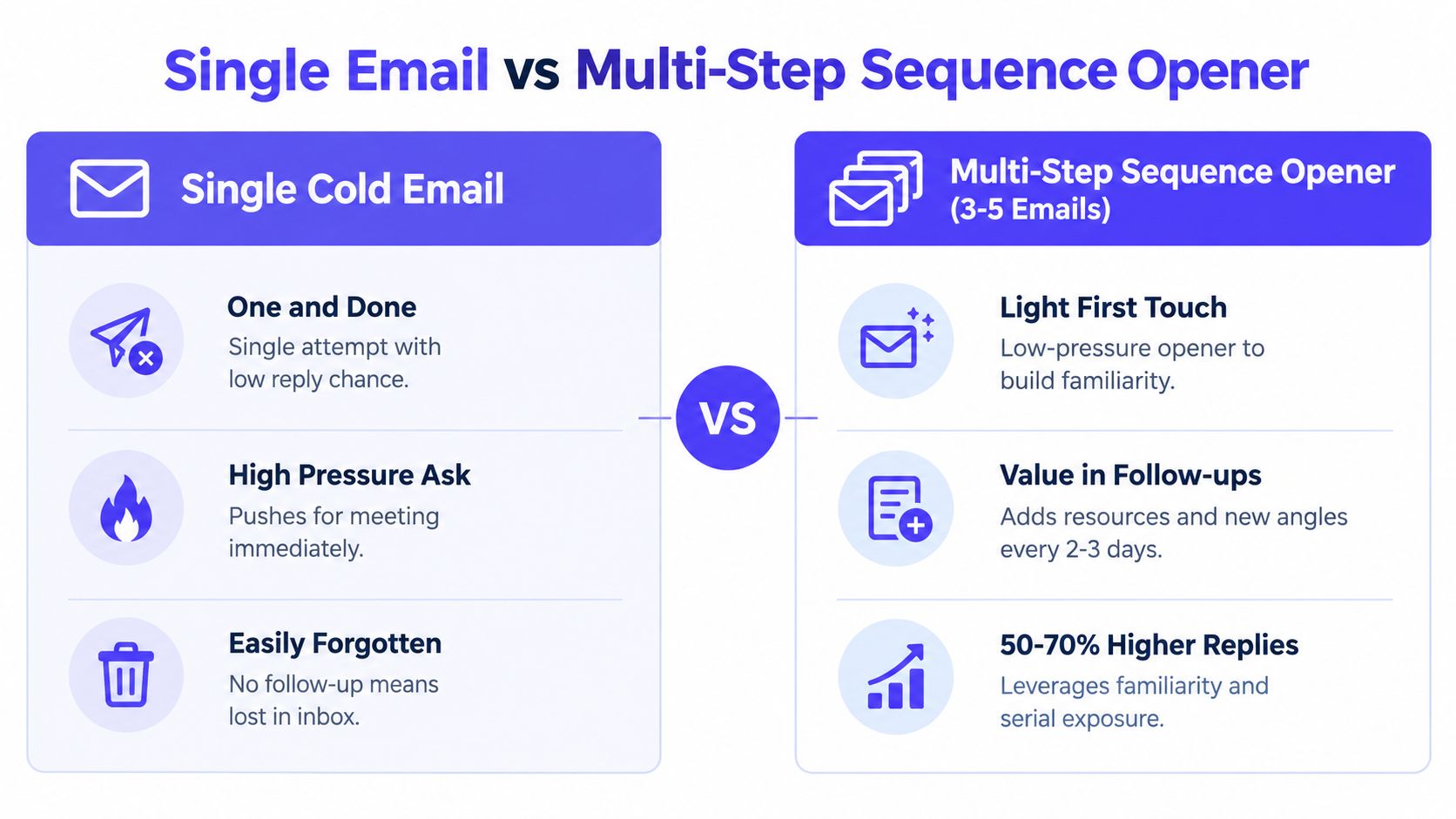
The later emails should add context, not repeat the same request. A new insight, relevant resource, customer example, or changed trigger gives the recipient a reason to reconsider. If there's no engagement, the sender should stop rather than turning persistence into pressure.
Timing and sequence measurement
Cold campaigns with two to three follow-ups can see reply rates increase by 40% to 80% versus single-email sends, and waiting three days before the first follow-up can raise response rates by up to 31%. (Cold email follow-up timing data)
Those figures support a measured sequence, but they don't justify sending identical reminders. The sender should track which email generates replies and whether later touches affect bounce or spam signals.
- Thread related messages: Use consistent subjects when the context continues.
- Change the angle: Add value instead of writing “just following up.”
- Respect timing: Space messages so the sequence feels considered.
- Pause on engagement: A reply, unsubscribe request, or objection should remove the prospect from the automated path.
Mailwarm's inbox placement monitoring can show whether later messages maintain delivery consistency. Teams can also compare available best email warmup tools before selecting a deliverability workflow.
8. The educational resource share and soft ask
A useful resource can start a sales conversation without forcing a meeting. Its value must be clear before the recipient clicks. If the link is only a disguised product pitch, trust drops quickly.
Use a subject line that names the resource or its practical benefit:
- Sales email research for [industry]
- A useful benchmark for [Company]
- Resource for your sales team
- Data for your outreach planning
Editable template
Hi [First Name],
This guide covers [specific topic] for [role or industry]. The section on [specific useful detail] may help while [Company] works on [relevant initiative].
You can access it here: [link]
If the findings raise questions about [specific challenge], a short conversation may be useful. No need to schedule anything unless the topic is relevant.
Best,
[Sender Name]
Choose this format for longer sales cycles, complex purchases, or buyers who need context before discussing a product. Suitable resources include a report, checklist, research summary, template, or practical tool. Mention one or two concrete details from the resource. That gives the recipient a reason to open it and signals that the message was written for their role.
The soft ask keeps control with the recipient while still giving the email a clear next step. “If the findings are relevant, a conversation may help” creates less pressure than “Book a demo now.” The resource remains the main offer, and the conversation stays optional.
Before sending, run these checks:
- Verify the destination. Confirm that the link works and delivers the material promised in the email.
- Limit competing choices. One focused resource is easier to evaluate than several links.
- Check every claim. Metrics and conclusions in the resource should be verifiable.
- Protect the list. Remove invalid addresses and honor opt-outs.
- Test inbox placement. Attachments, links, tracking pixels, and sending patterns can affect delivery and sender reputation.
Personalize the opening around the recipient's initiative, not a generic industry label. Test the resource-led subject line against a company-specific version, then compare clicks and qualified replies rather than opens alone. Stop the sequence when the recipient replies or opts out.
A professional, uncluttered signature can support the message. Teams can try the AiHeadshots signature generator. Mailwarm's custom email content warmup and deliverability analytics help evaluate how message content interacts with reputation and inbox placement.
8-Point Sales Email Template Comparison
| Approach | Implementation Complexity | Resource Requirements | Expected Outcomes | Ideal Use Cases | Key Advantages |
|---|---|---|---|---|---|
| The Subject Line Hook + Personalized Opening | High, time‑intensive per prospect | High, research (LinkedIn, news), personalization tools | Higher open and reply rates, increased credibility | Account‑based marketing, high‑value targets | Strong relevance, trust‑building, inbox standout |
| The Value‑First Problem Statement | Medium‑High, needs domain expertise | Medium, market data, role‑specific insights | Thoughtful replies, positions sender as expert | Consultative sales, mid‑market, complex solutions | Demonstrates expertise, invites dialogue |
| The Social Proof + Mutual Connection Reference | Medium, verify mutuals and case studies | Medium, CRM/network data, up‑to‑date case studies | Elevated trust and reply rates when relevant | Competitive accounts, networked industries | Reduces perceived risk, leverages peer validation |
| The Curiosity‑Driven Question + Brief Context | Low, simple to craft, quick personalization | Low, minimal research, well‑crafted question | High reply rate, fast engagement | Early touchpoints, busy prospects, conversational outreach | Encourages responses, concise and non‑salesy |
| The One‑Liner Pitch + Clear Call‑to‑Action | Low‑Medium, requires clear positioning | Low, concise copy, explicit CTA, basic qualifying info | Fast conversions from active buyers, clear screening | Prospects familiar with category, high‑volume outreach | Direct, time‑efficient, transparent intent |
| The Referral or Introduction Hook | Medium, needs real referrals and coordination | Medium, network access, referrer permission/context | Very high reply rates, higher‑quality conversations | Warm outreach, executive contacts, relationship‑driven sales | Pre‑established trust, lowers cold outreach friction |
| The Multi‑Step Sequence Opener (First Email in Series) | Medium‑High, requires planning and follow‑through | Medium, sequence tools, tracking, multiple content pieces | Higher response over time (50–70% uplift), improved persistence | Long sales cycles, nurture campaigns, scalable outreach | Builds familiarity, layers value across touches |
| The Educational Resource Share + Soft Ask | Medium, create or curate valuable content | Medium‑High, reports, templates, research assets | Higher‑quality leads, authority building, longer cycles | Complex purchases, content‑led strategies, thought leadership | Generates goodwill, demonstrates value before ask |
Turn templates into a tested sales system
The eight templates work because each one matches a different prospect state. The personalized hook fits a visible trigger. The problem statement starts a diagnostic conversation. Social proof adds evidence. The curiosity question invites explanation. The one-liner pitch suits qualified or category-aware prospects. The referral hook uses an existing relationship. The sequence opener creates familiarity over multiple touches. The resource share supports education and nurture.
A team shouldn't place every prospect into the same workflow. Instead, the sender should map each template to a specific use case:
- Personalized cold outreach: Use a verified company event, hiring signal, or market change.
- Problem-led conversation: Lead with an observation the prospect can confirm or correct.
- Referral outreach: Name only genuine connections and explain the context.
- Demo or direct CTA: Use a concise pitch when the prospect understands the category.
- Follow-up sequence: Change the angle across messages instead of repeating the first email.
- Value-led nurture: Share a resource that remains useful even without a sales call.
Cold outreach benchmarks show why reply quality matters more than open rates alone. Industry coverage citing a 2026 benchmark reported an average reply rate of 3.43% across billions of emails analyzed across 2025, while another sales-email source described 15% to 25% open rates as acceptable for cold B2B campaigns in 2025 and 2026. (Cold sales email templates and benchmarks)
A stronger framework starts with delivery, then measures engagement, then improves copy. A low reply rate can result from weak relevance, poor targeting, a vague CTA, or inbox placement failure. Those causes require different fixes.
A practical pre-send checklist
- Choose one audience problem: Don't combine several pains in one message.
- Add one relevant detail: Use a verified trigger, role context, or business initiative.
- Ask for one action: A reply, resource request, or short call is enough.
- Test one variable: Change the subject line, CTA, or opening, not all three at once.
- Protect consent and list quality: Send to appropriate contacts, honor opt-outs, and avoid questionable addresses.
- Prevent bounces: Validate data and remove invalid recipients before scaling.
- Authenticate the domain: Review SPF, DKIM, and DMARC configuration.
- Control sending volume: Ramp activity responsibly and watch provider-level signals.
- Separate copy from delivery: Review inbox placement before judging the message.
Signal-based personalization can materially outperform generic outreach. Autobound reports 18% average response rates for signal-based personalized outreach versus 3.4% for generic cold outreach, with 5% to 15% considered strong for well-targeted B2B sequences and 20% to 30% achievable in warm segments. (Signal-based cold outreach benchmark)
The implication is practical. A template should be selected by buying signal, funnel stage, and prospect state, not by popularity. Teams should also avoid treating every positive result as copy performance. A message with strong replies may have benefited from a warmer segment, a timely trigger, or better list quality.
Mailwarm helps senders build reputation, monitor inbox placement, and improve deliverability through real inbox engagement, advanced warmup controls, and expert guidance. Its network includes 50,000+ aged real inboxes, with engagement signals such as opens, replies, threads, spam removal, and important marking. Depending on the plan, Mailwarm can generate up to 100% replies to warmup emails, while provider-level warmup, spam score monitoring, authentication fix tools, bounce prevention, and deliverability analytics give teams more visibility than basic automated warmup activity.
The platform supports B2B and B2C warmup, custom content warmup, and multiple mailbox providers. It doesn't require IMAP access and doesn't need permission to read a private inbox. Expert deliverability calls are included in every plan, which helps explain why Mailwarm costs more than basic warmup tools. The price reflects real inbox engagement, monitoring, authentication tools, reputation protection, and guidance, not just automated email volume.
Teams can also involve BDRs in the testing process, especially when representatives can report which triggers, objections, and CTAs produce meaningful conversations. The strongest sales system combines that human feedback with clean measurement.
FAQ
What is email warmup?
Email warmup is a controlled process for building sender reputation through positive email activity before or while sending campaigns. The purpose is to help mailbox providers recognize legitimate sending behavior and reduce spam risk.
Does email warmup improve inbox placement?
Warmup can support sender reputation, but it isn't a complete inbox-placement solution. Authentication, bounce prevention, content, sending volume, recipient quality, and provider-specific behavior also affect whether messages reach the inbox.
Why do emails go to spam?
Emails can go to spam because of weak sender reputation, poor authentication, high bounce rates, sudden volume changes, risky content, excessive links, tracking behavior, or low recipient engagement. A delivered message isn't necessarily an inboxed message.
Is warmup alone enough to fix deliverability?
No. Warmup alone can't fix a broken DNS setup, invalid list, poor targeting, or damaging sending behavior. Teams should combine warmup with SPF, DKIM, DMARC, bounce prevention, spam monitoring, and inbox placement checks.
How does Mailwarm help improve sender reputation?
Mailwarm helps senders build reputation through real engagement signals from 50,000+ aged real inboxes, including opens, replies, threads, spam removal, and important marking. It also provides advanced warmup controls, provider-level warmup, spam score monitoring, inbox placement insights, authentication fix tools, bounce prevention, and expert deliverability guidance.
Does Mailwarm need access to a private inbox?
No. Mailwarm doesn't require IMAP access or permission to read a user's private inbox. The platform is designed to provide warmup and deliverability controls without intrusive private-inbox access.
If email is part of a growth strategy, the next step is to choose one audience, one trigger, and one template. Test the subject line or CTA separately, verify authentication and list quality, then review inbox placement before scaling the message that earns genuine replies.
Mailwarm helps sales teams prepare their sending infrastructure with real inbox engagement, provider-level warmup, spam score monitoring, and inbox placement insights. Visit Mailwarm to evaluate a premium deliverability workflow that supports email templates for sales without requiring access to a private inbox.