

Email subject line testing is the fastest way to learn which few words change opens, clicks, and replies. It is a controlled experiment, not a copywriting guess, and it only works when the test design is clean enough to separate subject-line impact from deliverability noise.
That distinction matters because subject lines sit at the intersection of attention and inbox placement. A clever line can lift opens, but aggressive wording, misleading prefixes, or sloppy segmentation can damage trust and confuse the data. The goal is to improve performance without teaching mailbox providers to distrust the sender.
What Email Subject Line Testing Really Is
Email subject line testing is a controlled experiment where two or more subject variants are sent to comparable audience segments so the sender can attribute performance differences to the subject line itself. In practice, that means the marketer changes one thing, keeps the rest stable, and watches how recipients respond.
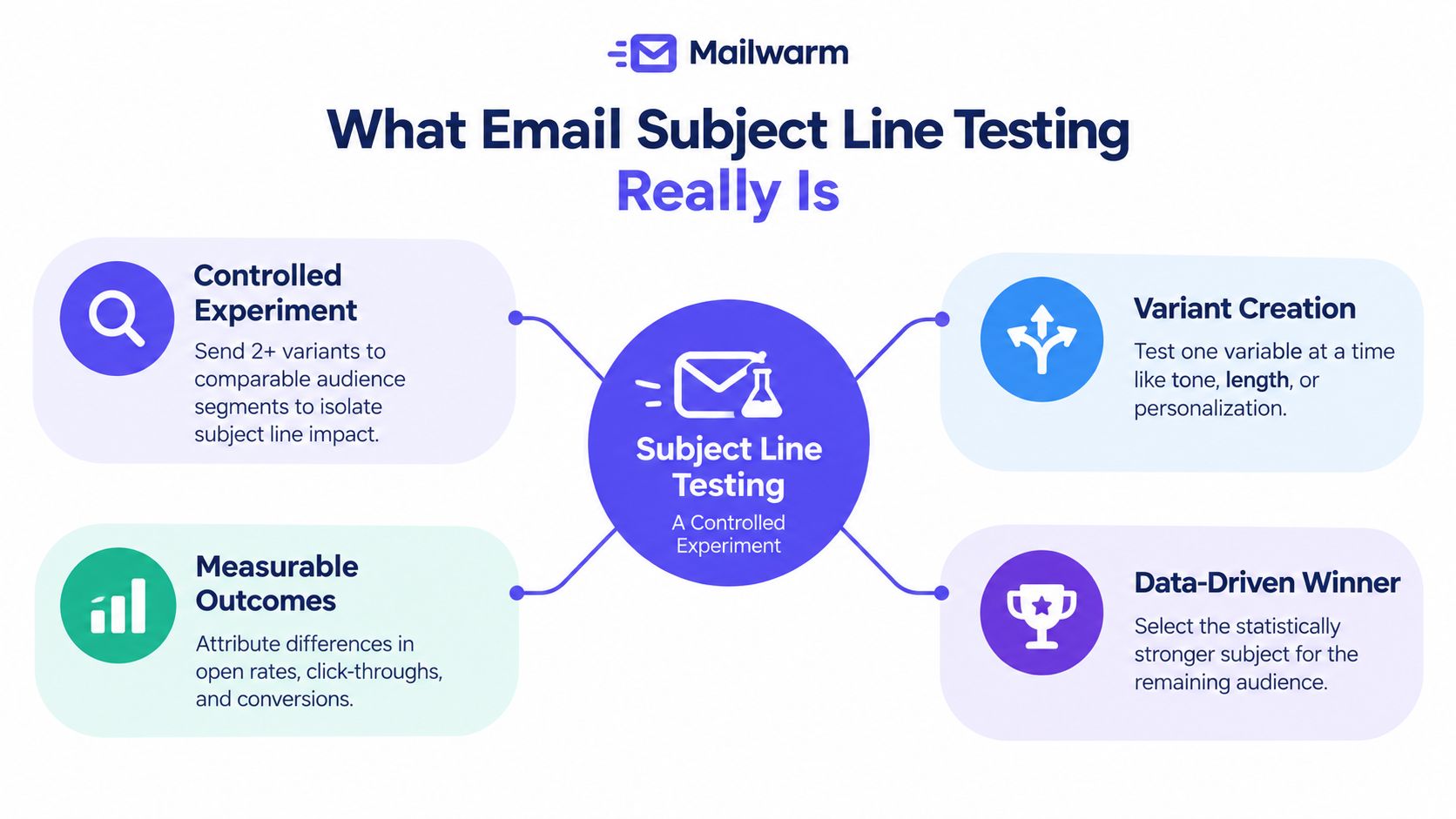
A strong test is part copywriting, part deliverability discipline. The copy needs to earn opens, but the test also has to avoid spammy punctuation, deceptive formatting, and volume spikes that distort inbox placement across the sender domain.
The point is measurement, not creativity
A lot of teams treat subject lines like a brainstorming contest. That's the wrong frame. The best subject lines often come from disciplined iteration, where each variant answers one question, such as whether personalization, length, or a number changes behavior.
A practical example is a test between a direct benefit and a curiosity angle. If the result shows a lift, the team still needs to ask whether the lift came from the wording itself or from a segment that was already more engaged. That's why comparable audiences matter more than clever copy.
Practical rule: if the audience, timing, and sender profile are unstable, the subject line test is unstable too.
A useful supporting layer is preview text. For teams refining the inbox package, the article on email preview text for SDRs is a helpful companion because the subject line and preview text are read together in the inbox.
Choosing a Goal and Metric You Can Defend
The test should start with a business goal, not with copy ideas. Awareness campaigns usually point to open rate, engagement campaigns can use click-to-open rate, cold outreach often needs reply rate, and commerce flows may care more about revenue per recipient.
That choice matters because the “winner” changes depending on what gets measured. A subject line that drives curiosity can win opens and lose replies, which is a weak outcome for sales teams but a decent outcome for newsletter brands. The metric has to match the job.
Write one hypothesis before writing variants
A defendable hypothesis is simple enough to test and specific enough to fail. For example, “Adding a specific number to the subject line will raise open rate versus the generic version” is testable. “Making the line better” is not.
Secondary metrics still matter, especially unsubscribe rate and spam complaints. A subject line can win on opens while damaging sender reputation, which creates a bad trade for the next campaign.
| Campaign Goal | Primary Metric | Guardrail Metrics |
|---|---|---|
| Awareness newsletter | Open rate | Spam complaints, unsubscribes |
| Content engagement | Click-to-open rate | Unsubscribes, spam complaints |
| Cold outreach | Reply rate | Spam complaints, open rate |
| E-commerce promotion | Revenue per recipient | Unsubscribes, spam complaints |
A good subject line test protects the brand as much as it improves performance. If the open win comes with complaint risk, it's a weak win.
Designing a Test You Can Trust
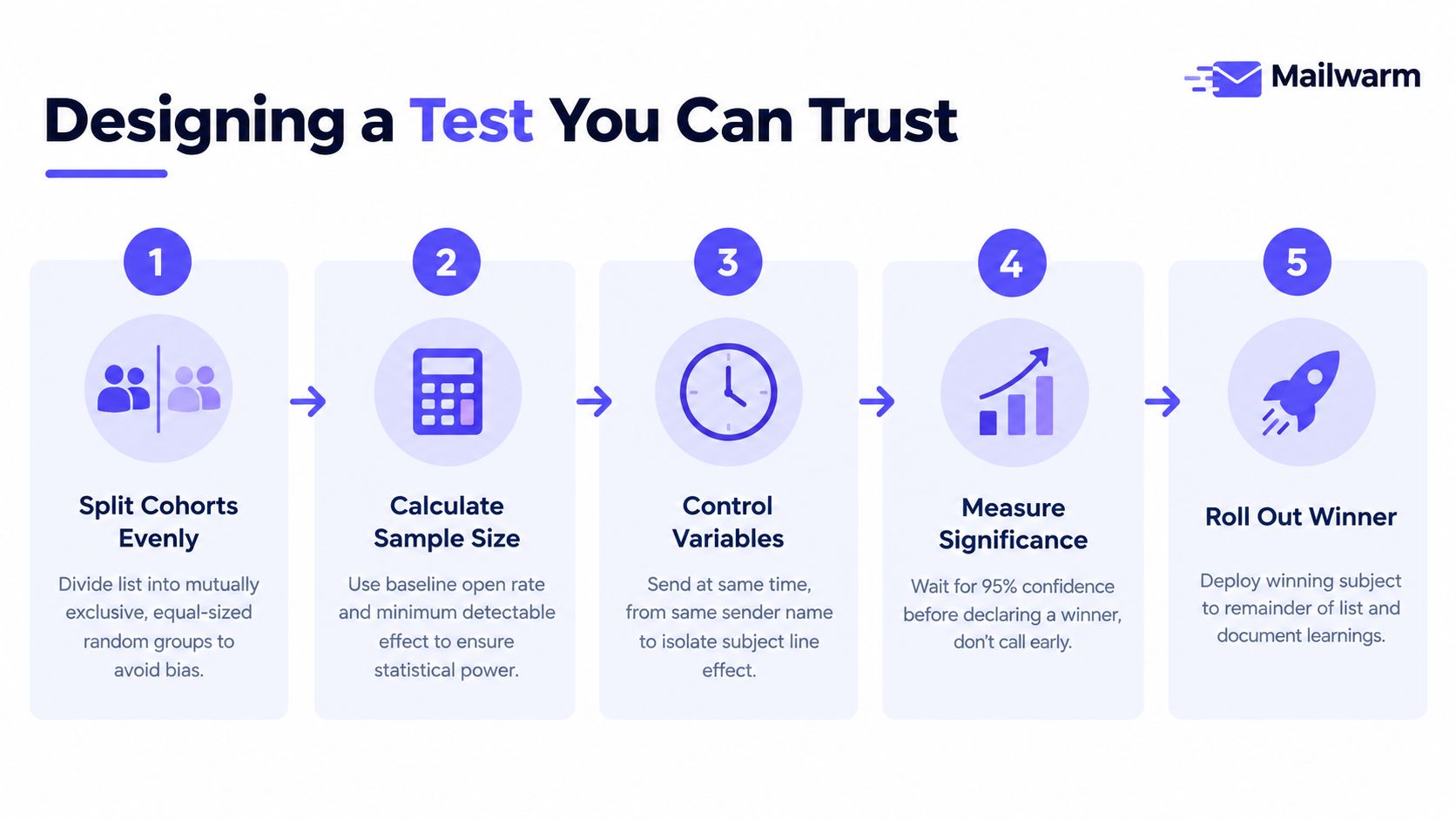
A trustworthy test starts with mutually exclusive cohorts of equal size. If the same contact can land in both variants, the result is broken before the send goes out. Randomization should happen once, with no overlap and no hidden bias from segment quality.
The list also needs enough volume to make the result readable. General benchmark advice says at least 500 sends per version, ideally 1,000, because smaller samples let random variation swamp the effect being tested, while cold outreach guidance often treats 250 contacts per variant as a floor and 500+ as the safer zone for reply-focused work, according to the email subject-line testing guidance at Zeliq. Constant Contact also recommends 1,000 contacts per variant for subject-line A/B tests, which is why small lists are often better left to qualitative judgment than false precision.
Timing and controls decide whether the result is usable
Send both variants at the same time, from the same sender name, to avoid time-of-day bias. Run the test long enough to capture the normal inbox-checking window, but not so long that the audience drifts or external campaigns contaminate the sample.
Common mistakes are easy to spot:
- Holiday timing: inbox behavior changes around holidays, so the test no longer reflects normal conditions.
- Hour gaps between variants: one subject line gets the morning crowd, the other gets the evening crowd.
- Repeated seed audiences: back-to-back tests on the same contacts create carryover effects.
- Multiple changes at once: length, personalization, and tone should not change in the same comparison.
For a newsletter with 50,000 recipients and a 32% baseline open rate, a 5% relative lift means the target effect is only about 1.6 percentage points, so the list needs enough statistical power to separate that from ordinary variance. If the program can't support that level of detection cleanly, the safer move is to test on a larger send or accept a broader decision rule.
Reading Results and Calling Significance
Significance tells the team whether a lift is likely real or just noise. In email testing, that matters because opens are messy data, especially when the audience checks mail across different devices, times, and clients.
Open-rate tests are usually noisier than click tests because an open can happen for reasons unrelated to the subject line, including preview behavior and mailbox rendering. That's why a tiny uplift often isn't worth calling a winner, even if the graph looks exciting.
A simple decision rule beats gut feeling
A pre-registered threshold keeps the team from moving the goalposts after the send. The rule should define the minimum lift, the minimum sends per arm, and the runtime before anyone is allowed to declare a winner.
For practical use, many teams decide like this:
- Ship the winner when the lift clears the preset threshold, the sample size is met, and guardrail metrics stay clean.
- Hold the test when the lift is interesting but the sample is still thin.
- Rerun the test when the result is too small to trust or when the send conditions were inconsistent.
A multi-variant test needs even more restraint. Repeated peeking creates bias because each extra look raises the chance of seeing a false winner, so the team should avoid calling the result early just because one variant leads for a few hours.
Decision rule: don't call a winner on early opens alone. Wait for the runtime window, then compare the result against the pre-set lift and guardrails.
The cleanest mindset is this, a subject line test is not “won” because it looks better in the first report. It is won when it survives time, sample, and sanity checks.
| Baseline open rate | Sends per variant, 95% conf. | Detectable absolute lift |
|---|---|---|
| 20% | 1,000 | 2 percentage points |
| 30% | 1,000 | 3 percentage points |
| 40% | 1,000 | 4 percentage points |
Segmentation, Personalization, and Deliverability
Segmentation changes what the test is measuring. A subject line that works on recent engagers can flop on cold lists, not because the copy got worse, but because the audience context changed.
Personalization does the same thing. Adding a first name, product name, or locale doesn't just alter wording, it shifts the test from “Which subject line is stronger?” to “Which subject line is stronger for this segment and this level of intent?” That's useful, but only if each cell is large enough to clear the sample-size bar.
Deliverability has to stay outside the test noise
Authentication, list hygiene, and complaint rates all shape whether the inbox ever gives the subject line a fair shot. Gmail and Microsoft keep filtering more aggressively, so opens can reflect inbox placement as much as messaging quality.
That's where warmup platforms change the baseline. Mailwarm is a premium email warmup and deliverability platform that helps build sender reputation through real inbox engagement, inbox placement insights, and expert guidance. It also gives teams a way to monitor reputation without requiring IMAP access to a private inbox, which matters when the goal is protecting deliverability rather than just creating automated activity.
The key rule is not to run warmup traffic inside the test audience. Warmup changes the sending profile and can contaminate the subject-line result, so the test should run on a stable audience after the sender has already been warmed.
Mailwarm spam checker is also relevant here because spam-triggering wording can make a “better” subject line look worse than it is, or make a risky subject line look better in opens while hurting deliverability.
If the sender reputation is weak, the subject line test is measuring a deliverability problem as much as a copy problem.
Example Tests, Templates, and a Pre-Send Checklist
The best subject line tests are boring in structure and sharp in purpose. They isolate one question, use a real audience, and tell the team something useful for the next send.
A few patterns show up again and again:
- Curiosity gap vs direct benefit: curiosity can lift opens on broad newsletter audiences, while direct benefit often reads cleaner for performance-driven lists.
- Emoji vs no emoji: emojis can add visual noise and are often better tested only when the audience is already comfortable with informal messaging.
- Question vs statement: questions can work when the topic already has built-in tension, but statements are often clearer for cold outreach.
- First name vs no token: personalization tends to fit better in triggered or high-intent flows than in broad campaigns.
- Short vs long subject line: shorter lines often feel cleaner on mobile, while slightly longer ones can carry more context when the offer needs explanation.
For teams looking at broader messaging tools, email text marketing platforms are a useful reference point because they show how subject-line choices sit inside a larger message system, not in isolation.
Reusable templates
Promotional
- Version A,
Benefit-driven offer - Version B,
Curiosity or urgency angle
Newsletter
- Version A,
Topic plus clear promise - Version B,
Question tied to reader pain
Re-engagement
- Version A,
Direct reminder of value - Version B,
Soft curiosity with low friction
Warm up an SMTP server fits naturally into this workflow for teams sending through SMTP-based infrastructure, especially when the goal is to improve inbox placement before subject-line testing begins.
Pre-send checklist
- Hypothesis defined: one question, one expected outcome.
- Single variable isolated: no hidden changes in preview text, sender name, or timing.
- Sample size calculated: enough volume for the decision rule.
- Runtime fixed: no early calls before the window closes.
- Deliverability health confirmed: spam risk and authentication issues checked.
- Warmup audience excluded: no testing on the same pool used for reputation building.
- Winner rule documented: lift threshold and guardrails written down before launch.
That checklist is what keeps the test honest. A clean subject line test should improve opens without confusing deliverability signals or creating a false winner that fails in the next send.
Email subject line testing works when the test is built around one clear outcome, one controlled variable, and one audience that can support the sample. The strongest teams treat it as a deliverability-aware process, not a copywriting contest, and they only ship winners that survive the guardrails.
If subject lines are part of the growth plan, Mailwarm helps teams protect sender reputation, monitor inbox placement, and reduce spam risk with premium warmup and deliverability controls. Visit Mailwarm to see how real inbox engagement and expert guidance can support cleaner subject line testing.