
The right email send-off depends on the relationship, the action wanted, and the level of urgency. Boomerang's analysis found a 47.5% average response rate across more than 350,000 email threads, with “thanks in advance” reaching 65.7%, “thanks” 63.0%, “thank you” 57.9%, and “best” 51.2%.
The popular advice is to pick one polite phrase and add it to every email. That advice misses the point. An email closing can establish identity, invite a reply, clarify the next step, add useful value, or create honest urgency. It can also make a thoughtful message feel generic when the tone doesn't match the recipient.
This roundup organizes eight adaptable email send offs around response and relationship goals, with practical examples for professional communication, sales, follow-ups, cold outreach, recruiting, and marketing. It also covers personalization boundaries, A/B testing, and deliverability safeguards. Teams looking for broader writing guidance can also review these Claude email marketing tips.
Consistent, credible email practices support sender reputation, but the closing can't rescue a message that never reaches the inbox. Mailwarm helps senders build reputation, monitor inbox placement, and improve deliverability through real inbox engagement, advanced warmup controls, and expert guidance.
1. Professional Closing With Title and Company
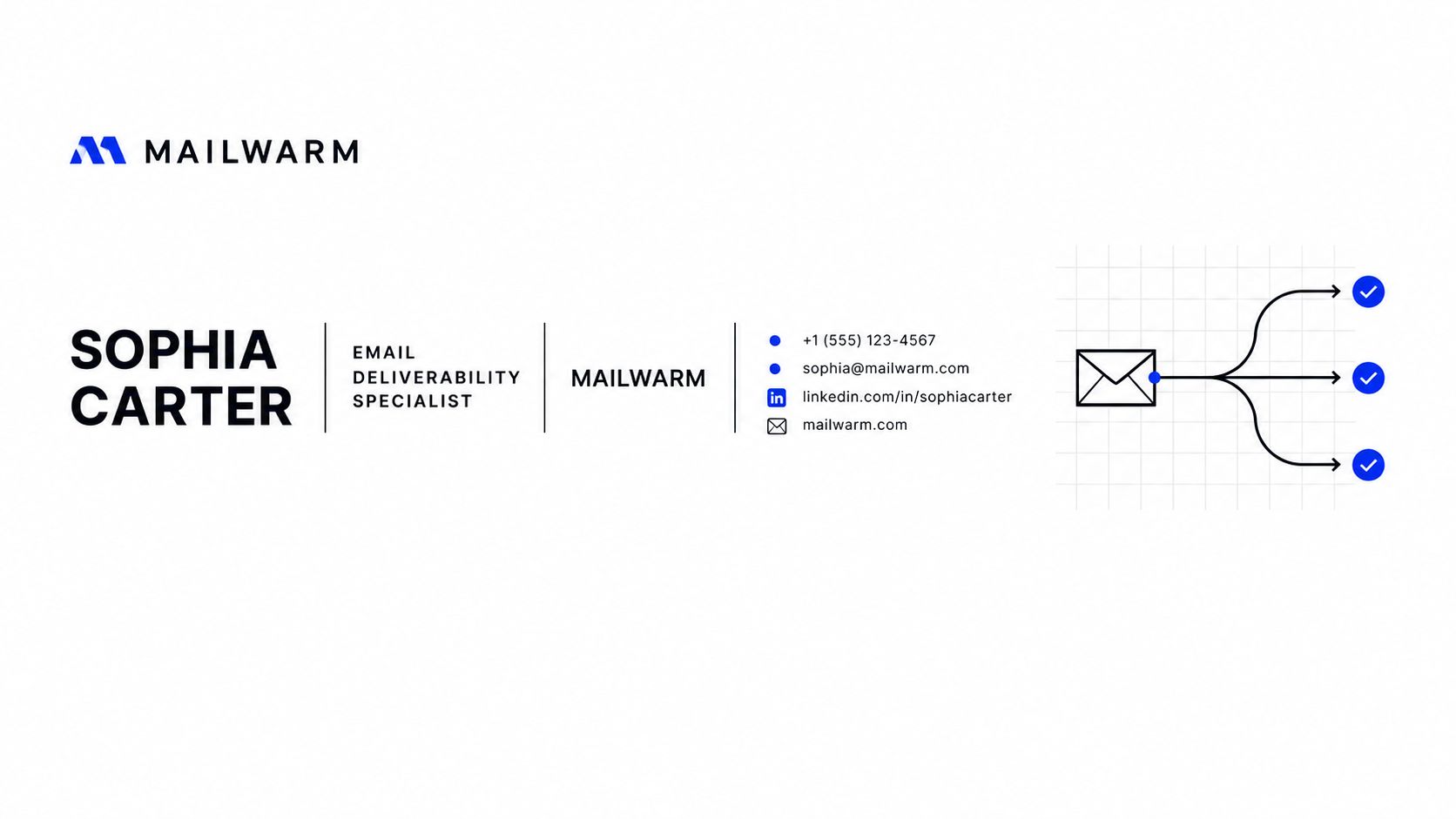
A complete professional identity works when the recipient needs to verify who sent the message. It fits cold prospecting, formal business communication, partnerships, recruiting, and regulated industries where a first name alone may create unnecessary friction.
Use a short sign-off, then provide the information needed for a confident reply:
Professional rule: The signature should make the sender easier to trust, not turn the bottom of the email into a brochure.
A sales representative might write:
Best regards,
Sarah Johnson
Account Executive, Acme Sales
sarah@acme.com
(555) 123-4567
A recruiter could use:
Warm regards,
Marcus Chen
Tech Recruiter, TalentWorks Agency
marcus@talentworks.com
LinkedIn: /in/marcuschen
The sign-off itself should remain concise. Mailchimp defines a sign-off as the final line before the sender's name and recommends keeping it to one to three words, with only the first word capitalized. Suitable choices include “Best regards,” “Sincerely,” and “Thank you.” Robert Half also recommends “Best regards,” “Sincerely,” and “Thank you,” while warning against casual endings such as “Love,” “Tx,” and “TGIF.”
Keep the visible signature compact, consistent, and readable on mobile. A LinkedIn profile can help a recipient verify a new contact, but unnecessary icons, banners, legal text, and multiple links create clutter. The format should also reflect the industry. Finance and legal teams generally need a more formal presentation than technology or creative teams.
For more detail, teams can review these craft stronger email sign offs. Consistent formatting across outreach supports a credible sender identity, while Mailwarm adds reputation monitoring and inbox placement insights around the sending activity.
2. Casual and Conversational Sign-Off
Casual email send offs build warmth after rapport exists. “Cheers,” “Talk soon,” and “Thanks” can sound natural in technology, creative, agency, and startup environments, but they shouldn't appear automatically in the first message to every prospect.
The safest approach is to match the closing to the body. A relaxed email followed by “Sincerely” feels stiff. A formal proposal followed by “Catch you later” feels careless.
Examples include:
- Tech startup: Cheers, Alex
- Marketing agency: Looking forward to connecting, Jamie
- SaaS follow-up: Talk soon, Chris
A first-name-only ending works when the email client already supplies a complete signature or when the recipient knows the sender. It may be too sparse for external communication where the recipient needs contact details. A minimal visible signature can preserve professionalism without overwhelming the message.
The relationship should determine the timing. Casual closings fit best when:
- Rapport already exists: Use a warmer phrase after a conversation, meeting, or meaningful exchange.
- The industry supports informality: Creative and technology teams often tolerate more conversational language.
- The email is a follow-up: A second or later touch can sound less scripted than the initial outreach.
- The message is brief: A short check-in doesn't need a formal block of contact details.
A casual ending still needs a clear purpose. “Talk soon” implies an expected continuation, so it works better when a call, reply, or next interaction is already likely. “Cheers” expresses goodwill, but it doesn't tell the recipient what action to take.
More options appear in this guide to effective sign off phrases. Teams should test tone by audience rather than applying one casual phrase to every campaign.

3. Call-to-Action Focused Send-Off
The call to action usually does more work than the sign-off. A polished “Best regards” won't compensate for a vague ending such as “Let me know what you think.” The closing line should name the next step, reduce effort, and give the recipient a clear way to respond.
A sales email might end with:
Let's schedule 15 minutes next week to explore how this could work for your team. A calendar link or a reply with a suitable time both work.
A marketing email could use:
Reply with the biggest email challenge on the team, and a practical tactic can be sent back.
A recruiter might write:
Interested in the role? A short coffee chat this week could clarify the fit. Which day works best?
The CTA should appear before the sign-off, where it remains part of the message rather than being buried in the signature. It should also match the recipient's likely need. A calendar link makes sense for a qualified sales conversation, while a simple question is usually better for an early cold email.
Make the requested action easy
Strong CTAs remove decisions. They offer a specific action, a reasonable commitment, and an alternative response path.
- Name the action: Ask for a reply, a meeting, feedback, or permission to send information.
- Limit the friction: “A 15-minute call” is clearer than “Let's talk.”
- Offer options: Include a calendar link and allow a direct reply.
- Use honest timing: “By Friday” is more useful than “ASAP” when a real date matters.
- Segment the ask: A founder, recruiter, customer, and existing partner may need different next steps.
A/B tests should change one variable at a time. Compare two CTA lines within the same audience, then measure replies or qualified actions by segment. Open rates and clicks can provide context, but the meaningful outcome is the action the email was designed to produce.

4. Social Proof and Credibility-Based Sign-Off
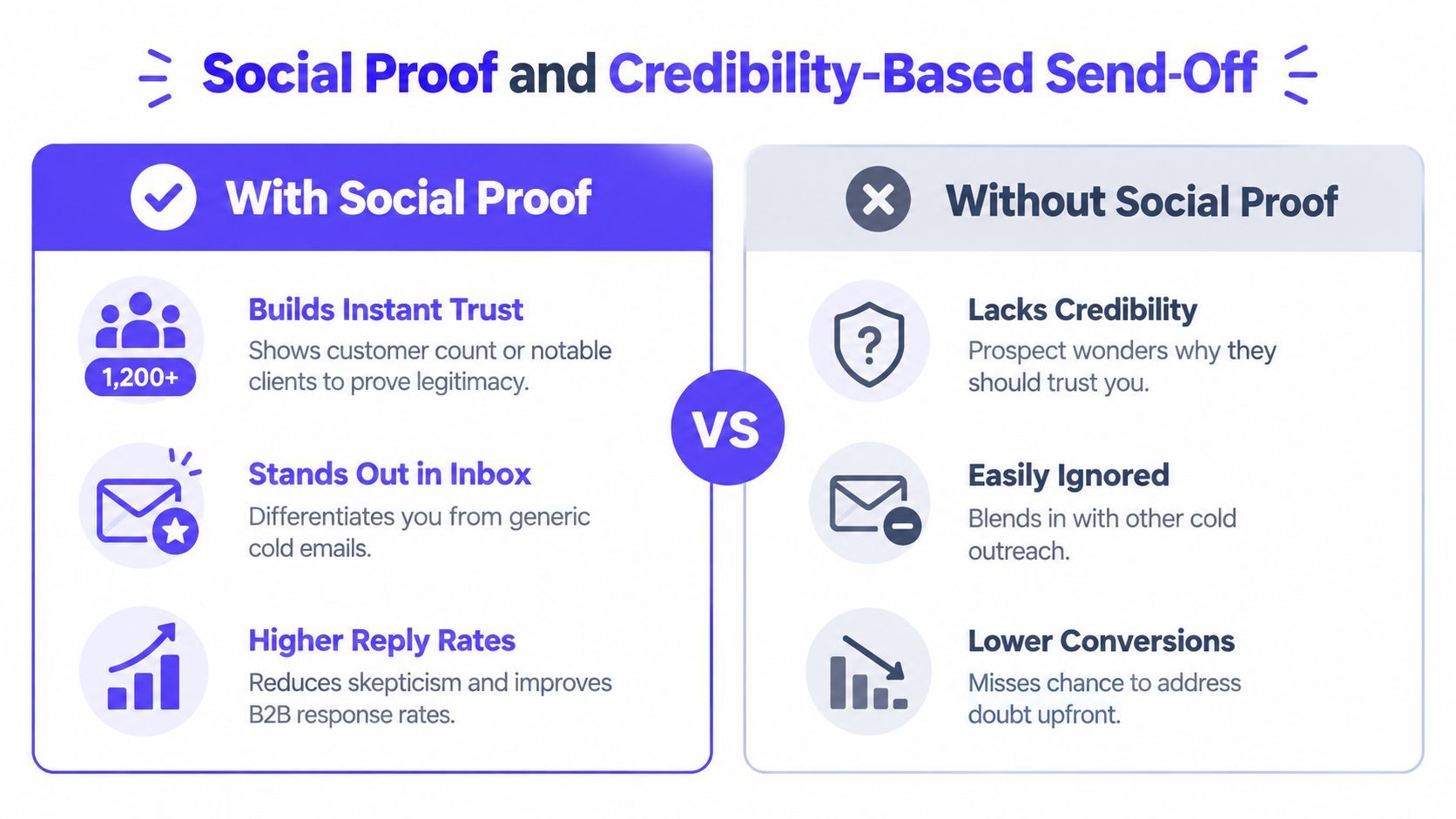
Social proof belongs in the closing when the recipient's main hesitation is trust. A new prospect may understand the offer but still wonder whether the sender has relevant experience, credible customers, or a legitimate business behind the email.
The proof should be specific and defensible. It might mention a verified customer category, a published result, a relevant award, or a customer story. It shouldn't make an unsupported claim just to fill the space above the signature.
Examples include:
Helping established SaaS teams improve inbox placement.
Alex, Mailwarm
Trusted by SaaS companies and agencies that rely on outbound email.
Learn how the process works.
A recruitment partner for technology teams hiring specialized roles.
Jordan
The examples avoid invented counts and performance figures. Any number or customer claim should be supported by current records and linked to evidence where appropriate. If a claim can't survive a direct question from the recipient, it doesn't belong in the send-off.
Pair proof with a reason to care
A credibility line works better when it connects to a concrete benefit. “Used by many companies” is weak because it offers no context. “Helping sales teams monitor provider-level inbox placement” explains both relevance and value.
A useful structure is:
- Credibility signal: Identify the experience or validation.
- Relevant benefit: Connect it to the recipient's problem.
- Low-friction next step: Invite a reply, review, or short conversation.
Proof can also come from the sender's signature. A clean role, company, website, and professional profile may answer basic verification questions without adding promotional language. Teams can use a ChatGPT email signature as a starting point, then edit the result for accuracy and restraint.
Social proof should be updated when the underlying claim changes. It should never create false scarcity, imply endorsement where none exists, or distract from the request.
5. Question-Based Send-Off
A relevant question gives the recipient a natural reply path. It works particularly well in personalized sales outreach, recruiting, customer research, and marketing emails where the recipient's situation matters more than a generic product pitch.
The question should connect directly to the email body. For example:
What's the biggest barrier the team faces when scaling email outreach?
Alex
A recruiter could write:
When was the last time someone approached you about a role that was genuinely relevant?
Marcus
A deliverability marketer might ask:
How is the team currently checking whether cold emails reach the inbox?
Sam
The question should demonstrate context, not demand unpaid consulting. A sender who asks about a company's exact workflow without showing any research sounds automated. A sender who references a relevant hiring change, campaign, or technical issue has a stronger reason for asking.
Keep one question worth answering
One open-ended question is enough. Multiple questions force the recipient to choose where to start, and yes-or-no questions often produce shallow replies. “What changed in the outreach process after the provider issue?” creates more room for useful information than “Are emails reaching the inbox?”
The question should also be easy to understand on a phone. Short wording, one topic, and a clear connection to the recipient's role matter more than clever phrasing.
Before testing questions, teams should protect delivery. Mailwarm supports warmup across major providers with real engagement signals such as opens, replies, threads, spam removal, and important marking. Its provider-level warmup, spam score monitoring, inbox placement insights, and authentication fix tools help teams assess whether a thoughtful question has a reasonable chance of being seen.
Measure which questions generate meaningful replies, not just any response. A positive result is a reply that reveals a need, confirms a hiring situation, or creates a relevant next step.
6. Value-Adding Resource or Offer Sign-Off
A resource-led send-off gives the recipient something useful before asking for a meeting or purchase. It suits early cold outreach, deliverability consulting, recruiting, partnerships, and marketing campaigns where trust needs to develop first.
Examples include:
A quick three-point checklist for SPF and DKIM setup is attached. It can help identify common configuration gaps. Questions are welcome.
A practical template for personalizing cold email at scale is included. The team can adapt it to its own workflow.
A short video showing the email warmup process is available here: [link]. It explains the main steps without requiring a product call.
The resource should solve a narrow problem immediately. A checklist, short template, or focused video is easier to use than a large course or an ungated library. The offer also needs to appear in the body of the email, not only inside the signature, so the recipient understands why it matters.
Give value without creating pressure
A useful resource isn't a disguised demand. The sender should explain what it helps with, provide direct access, and leave the next step optional.
- Make it relevant: Build the asset for the role and problem named in the message.
- Keep it usable: A recipient should understand the first step without a long explanation.
- Avoid excessive gating: Requiring a meeting before access weakens the value exchange.
- Follow up intelligently: If the recipient engages, respond to that signal instead of repeating the original pitch.
- Refresh the asset: Outdated authentication, deliverability, or compliance guidance can damage trust.
Deliverability still matters. An excellent checklist has no practical value if the message lands in spam. Mailwarm helps senders monitor sender reputation, inbox placement, bounce risk, and spam signals while supporting B2B and B2C warmup. It doesn't require IMAP access or permission to read a private inbox, which makes it suitable for teams that need stronger controls without intrusive mailbox access.
7. Personal Connection or Common Ground Sign-Off
Personal context makes an email feel written for one recipient. It works best for high-value prospects, executive outreach, recruiting, partnerships, and founder-to-founder messages where relevance matters more than volume.
A recruiter might write:
Experience leading a team at Stripe before joining TechCo aligns closely with the role. A personal conversation could be worthwhile.
Marcus
A sales sender could write:
The recent post about email authentication raised the same issue many outreach teams face. A short conversation could compare approaches.
Alex
A founder might use:
Shared experience in the Y Combinator community made this company update especially relevant. A brief exchange could be useful.
Sarah
The reference must be accurate and natural. A forced connection is worse than a neutral close because it signals that the sender searched for a token rather than understanding the recipient.
Set a clear personalization boundary
Research should support relevance, not invade privacy. Public professional activity, company pages, published articles, and recent business updates are reasonable sources. Private details, sensitive personal information, and unrelated social activity don't belong in a sales or recruiting email.
A strong personalized closing usually includes three parts:
- Specific observation: Mention a recent professional detail.
- Relevant connection: Explain why it relates to the message.
- Clear action: Ask for a reply, call, or permission to continue.
The reference should be recent enough to matter and specific enough to prove it isn't a mail merge field. It also needs to be checked before sending. Incorrect job titles, outdated company names, and misread posts can erase credibility instantly.
Personalized outreach should be evaluated against batch outreach within comparable segments. The test should measure qualified replies and negative signals, not just total activity. A lower-volume approach may be appropriate when each account has high potential value.
8. Deadline or Scarcity-Driven Send-Off
Scarcity can motivate action only when the limitation is real. A deadline tied to a hiring timeline, project start, appointment window, or genuine offer gives the recipient a reason to decide. Manufactured urgency damages credibility and makes future follow-ups harder.
Examples include:
Outreach is focused on a small group of founders this week. If the topic is relevant, a reply by Friday can secure a conversation.
One role currently matches this background closely, and the hiring process is moving quickly. Is a conversation this week possible?
Free setup and consulting are available for the first five customers who sign up this month. After that, the offer ends.
The sender must be able to explain why the deadline exists. “By Friday” is useful when a team is allocating meetings or a project has a fixed start date. “ASAP” is vague and creates pressure without information.
Use urgency once and explain it
Scarcity should support a clear CTA rather than replace one. The recipient needs to know what action to take and what happens after the deadline.
- State the limit: Name the actual capacity, date, or business constraint.
- Explain the reason: Connect the deadline to scheduling, hiring, inventory, or an offer period.
- Avoid repeated pressure: One honest urgency signal is enough for a prospect.
- Offer a later path: If the deadline passes, invite the recipient to reconnect without pretending the original limit still applies.
- Record the claim: Sales teams should maintain evidence for limited spots, pricing changes, and customer offers.
A sender's reputation includes more than technical metrics. Recipients also judge whether messages are accurate, respectful, and consistent. Mailwarm supports the technical side with real inbox engagement, provider-level warmup, bounce prevention, spam score monitoring, and deliverability analytics, but the sender still owns the truthfulness of every deadline.
8 Email Send-Offs Comparison
| Sign-off style | Implementation complexity | Resource requirements | Expected outcomes | Ideal use cases | Key advantages | Key drawbacks |
|---|---|---|---|---|---|---|
| Professional Closing with Title and Company | Low | Minimal (consistent signature setup) | Clear credibility, easier follow-up | Cold outreach, formal business, recruiting | Builds trust, professional, multiple contact options | Takes space, can feel overly formal |
| Casual and Conversational Sign-Off | Very low | Minimal (first-name only) | Higher responses in casual contexts, more approachable | Warm follow-ups, tech/startup, creative outreach | Human tone, concise, mobile-friendly | Lacks contact info, may seem unprofessional for first touches |
| Call-to-Action Focused Send-Off | Medium | Low–medium (calendar links, buttons) | Increased replies and conversions, clearer next steps | Sales prospecting, conversion-focused campaigns, follow-ups | Removes friction, drives action, measurable | Can seem pushy, needs relevance to avoid pushback |
| Social Proof and Credibility-Based Sign-Off | Medium | Medium (gather/verifiable metrics, links) | Greater trust and differentiation in cold outreach | B2B sales, first-time prospecting, reputation building | Addresses skepticism, boosts legitimacy | Must be truthful, may appear boastful or take space |
| Question-Based Send-Off | Medium–high | Medium (prospect research) | Higher reply rates and conversational replies | Consultative sales, personalized outreach, research-based prospecting | Invites engagement, uncovers info for follow-up | Requires genuine research, may not scale for mass outreach |
| Value-Adding Resource or Offer Sign-Off | Medium–high | High (create useful assets, host links) | Builds goodwill, increases engagement and conversions | Lead magnets, expert positioning, high-value outreach | Generates reciprocity, demonstrates expertise | Time-consuming to create, may attract non-buyers |
| Personal Connection or Common Ground Sign-Off | High | High (individual research per prospect) | Strongly increased reply rates for targeted prospects | High-value B2B, ABM, founder-to-founder outreach | Highly personalized, builds real relationships | Labor-intensive, not scalable, must be authentic |
| Deadline or Scarcity-Driven Send-Off | Medium | Low–medium (timing and truthful constraints) | Faster responses, prompts immediate action | Time-sensitive offers, recruiting, limited promotions | Creates urgency, reduces follow-up cycle | Risky if dishonest, can feel manipulative or off-putting |
Choose the Closing That Matches the Moment
Email send offs should follow the relationship and the desired response, not habit. Use a complete professional identity when trust and verification matter. Choose a conversational ending when rapport already exists. Use a question or direct CTA when a reply is the goal, offer value when generosity leads, add personal context for high-value outreach, and use proof when skepticism is likely.
Scarcity belongs only where the deadline is real. A false limit may produce a short-term click, but it weakens trust and can make later messages look manipulative. A clear, honest reason for urgency helps the recipient make a decision without guessing what “soon” means.
The sign-off should also be separated from the CTA. The CTA asks for the action. The sign-off preserves the relationship and confirms the tone. A useful ending can therefore look like this:
Could the team review the checklist and reply with the main authentication question?
Thanks,
Alex
Boomerang's large-scale email analysis is useful historical evidence that closing language can correlate with replies. Its sample of more than 350,000 email threads reported a 47.5% average response rate, while gratitude-based endings outperformed neutral closings, including “thanks in advance” at 65.7%, “thanks” at 63.0%, “thank you” at 57.9%, and “best” at 51.2% according to the original Boomerang analysis. That evidence supports testing gratitude, but it doesn't make one phrase correct for every recipient or situation.
A separate survey cited in 2026 coverage found that 62% of people typically close with “Thanks,” while 5% preferred “Thanks in advance”; another survey found that 38% preferred “Thank you,” while “Thanks” was used by 41% of people in the reported preference comparison. Usage and preference don't always match, so teams should test language against their own audience.
A practical A/B testing checklist
- Change one variable: Test “Thanks” against “Best regards,” or one CTA against another, without changing the subject, body, segment, or send schedule.
- Separate audiences: Compare results by industry, role, relationship stage, and campaign type.
- Measure the intended action: Track replies, qualified replies, booked meetings, applications, or completed forms.
- Check negative signals: Review complaints, bounces, unsubscribes, and spam placement alongside positive engagement.
- Keep the winner contextual: A phrase that works for warm SaaS prospects may not fit formal recruiting or financial communication.
- Review the full ending: Check the CTA, sign-off, signature length, links, and mobile rendering together.
A sign-off cannot fix poor targeting, weak authentication, excessive volume, or a damaged sender reputation. Independent deliverability benchmarks show why provider-level monitoring matters. GlockApps reported a 49.00% total inbox rate across free providers in H1 2026, compared with 42.98% in H1 2025, and reported Gmail placement of 62.40% for senders with four or more years of history, versus 34.67% for Outlook and 36.35% for Hotmail in its 2026 benchmark report. Another benchmark reported primary inbox placement at 63%, with 33% of tested mail going to spam and 3% to tabs in its deliverability findings.
For ongoing threads, include a sign-off in the first email, then stop repeating it when the exchange becomes rapid and conversational. Forbes recommends that practical approach in its email sign-off guidance. In formal British-style correspondence, use “Yours sincerely” when the recipient's name is known and “Yours faithfully” when it isn't. “Kind regards” and “Best regards” suit everyday business messages under Exclaimer's formal closing rule.
If email is part of a growth strategy, Mailwarm helps teams build sender reputation, monitor inbox placement, and reduce spam risk with expert-guided warmup. It goes beyond basic warmup by combining real engagement signals, advanced controls, authentication fix tools, bounce prevention, spam score monitoring, and deliverability analytics.
Mailwarm helps sales teams, agencies, recruiters, marketers, and founders improve sender reputation through real engagement across 50,000+ aged real inboxes, provider-level warmup, and inbox placement insights. Visit Mailwarm to see how expert-guided deliverability support can help thoughtful email send offs reach more of the inboxes they were written for.