
A recent benchmark puts the overall cold email response rate at 3.43%, while a stricter study of net-new outreach reports an average of just 0.45%. Those figures aren't contradictory. They use different datasets, audiences, and measurement methods, which is why response rate should be treated as a system outcome rather than a copywriting score. Instantly's 2026 benchmark reports that top-quartile campaigns reached 5.5%, while elite campaigns exceeded 10%. Belkins' 2025 analysis measured strict net-new outreach against total sends and found a lower average.
The practical conclusion is simple. A weak cold email response rate can come from poor targeting or a vague offer, but it can also come from spam placement, weak sender reputation, inconsistent volume, or a list that contains too many invalid addresses.
The Current Cold Email Response Rate Benchmarks
58% of replies came from the first email in Instantly's 2026 benchmark, so sequence results should not be judged only by the final campaign total. Use the table below to choose a comparison set that matches your denominator, audience, and delivery conditions before deciding whether performance is weak. The Instantly benchmark report reported an overall average of 3.43%, with the top quartile reaching 5.5% and elite campaigns exceeding 10%.
Belkins measured a stricter form of outreach. Its analysis covered 7.5 million cold emails sent in client campaigns during 2025 and found a 0.45% average reply rate. Results shifted across the year, from 0.54% in February to 0.35% in December. Company size also correlated with performance. Businesses with 11 to 50 employees replied at 0.49%, while enterprises with 10,000 or more employees replied at 0.22%. These figures come from Belkins' cold email response rate study.
The difference between the datasets is the useful finding. Campaign population, audience intent, denominator, and sending conditions can move the benchmark substantially. No single industry average can evaluate every outbound program.
A realistic starting range
Use these tiers as diagnostic reference points, not promises. Compare like with like, then inspect inbox placement and audience fit before rewriting copy.
| Performance tier | Typical reply rate range | Common cause of ceiling |
|---|---|---|
| Strict net-new outreach | Around 0.45% in the Belkins dataset | Broad targeting, difficult segments, or weak inbox placement |
| General benchmark average | Around 3.43% in the Instantly dataset | Mixed campaign quality and audience intent |
| Strong campaign | Around 5.5% or higher | Better targeting, relevant offers, and sound deliverability |
| Elite campaign | Above 10% | Tight segmentation, strong reputation, and highly relevant outreach |
Reply rate isn't open rate
Reply rate counts recipients who respond. Open rate counts reported opens, yet privacy systems and mailbox behavior can distort that signal. Click rate records link activity, which may indicate curiosity without showing buying intent.
High opens with few replies do not automatically justify a new subject line. The message may have reached the inbox but failed to address a relevant problem. It may also have produced inflated open signals while sitting in a less visible folder. Response rate is closer to a commercial outcome, but segment it by provider, audience, campaign, and sender before drawing conclusions.
Practical rule: A benchmark is useful only when its denominator, audience, and delivery conditions match the campaign being evaluated.
Why Cold Email Response Rate Is a Deliverability Problem
A recipient can't reply to a message that never reaches a usable inbox location. The message may land in the primary inbox, promotions, spam, or nowhere at all because a mailbox provider blocks it. The same subject line and body can therefore produce very different results from two sending domains.
Sender reputation is the trust score mailbox providers use when deciding whether messages should reach the inbox, spam, or a block path. It changes with sending history, opens, clicks, replies, and spam complaints, as explained in Mailtester's guide to sender reputation. A sender with a weak history can write relevant copy and still receive fewer replies because fewer recipients see the message in a credible context.
Deliverability describes the outcome. Reputation describes the underlying trust assessment. OneSignal's email deliverability documentation separates these concepts clearly, and that distinction matters when diagnosing performance.
| Concept | What it measures | Why it matters for reply rate |
|---|---|---|
| Sender reputation | Historical trust assigned to the sender | Influences whether future messages are accepted and routed well |
| Deliverability | Where accepted messages arrive, such as inbox, promotions, or spam | Determines whether a recipient can realistically notice and answer |
| Engagement | Recipient actions such as replies, clicks, and spam complaints | Feeds future reputation decisions |
| List quality | Accuracy and relevance of recipient data | Reduces bounces, complaints, and wasted sends |
Why warmup quality matters
Warmup volume alone isn't a reliable health signal. A system can generate activity while failing to create the varied engagement patterns that mailbox providers evaluate. Real replies, threads, opens, spam removal, and important marking provide more useful context than a dashboard that only reports sent messages.
Mailwarm's email spam checker can form part of a pre-send review, but a checker can't repair a damaged reputation by itself. Authentication, sending consistency, list quality, and recipient behavior all influence inbox placement. Mailgun's deliverability guidance also identifies IP and domain reputation, authentication, sending consistency, subscriber behavior, and list quality as major factors.
The operating model is a dependency chain:
- Authentication and sending behavior influence reputation.
- Reputation influences delivery and inbox placement.
- Placement determines visibility.
- Visibility and relevance determine engagement.
- Engagement feeds the next reputation decision.
A copy change addresses only the final part of that chain.
Audience, Volume, and Timing Effects on Response Rate
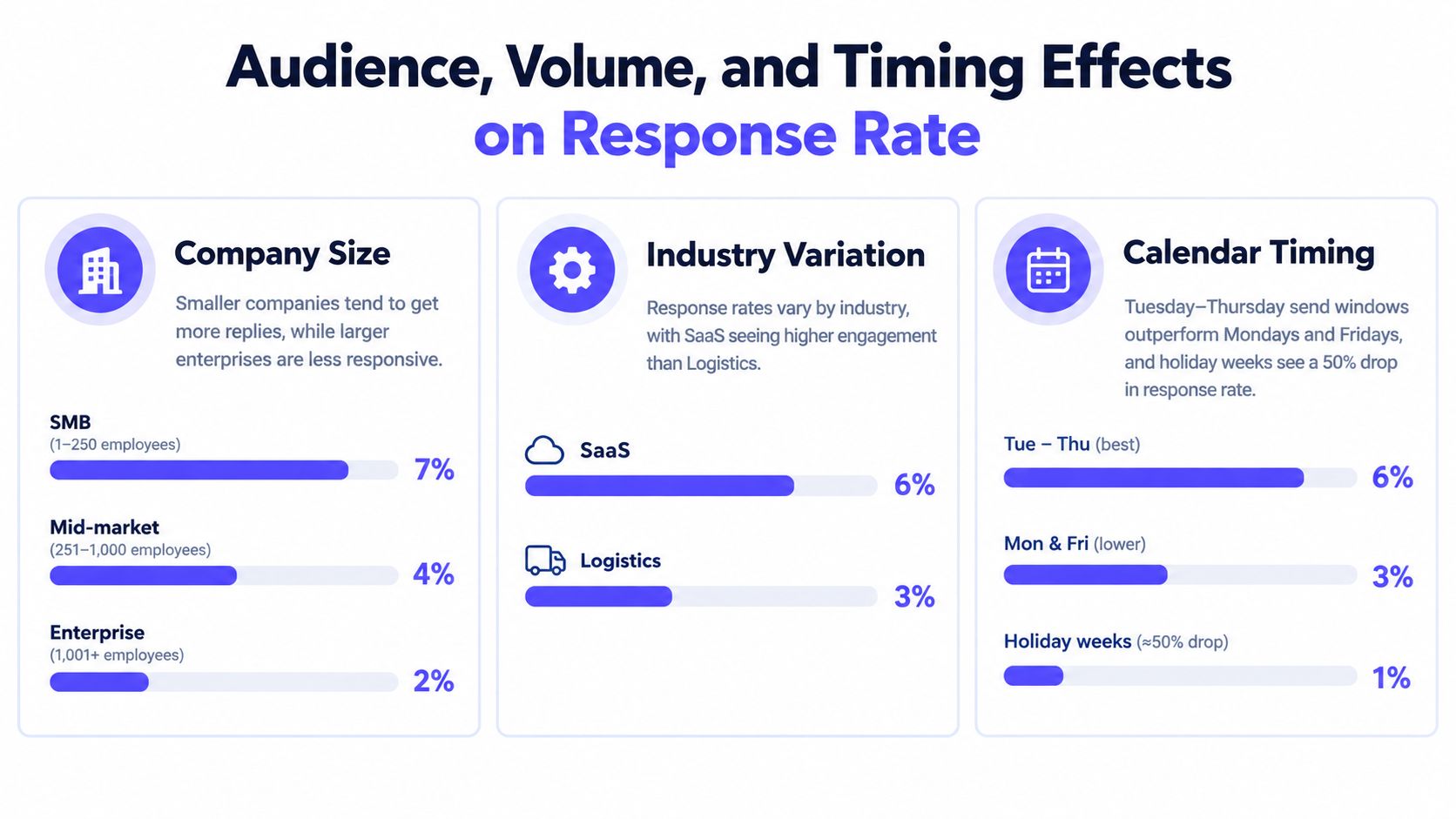
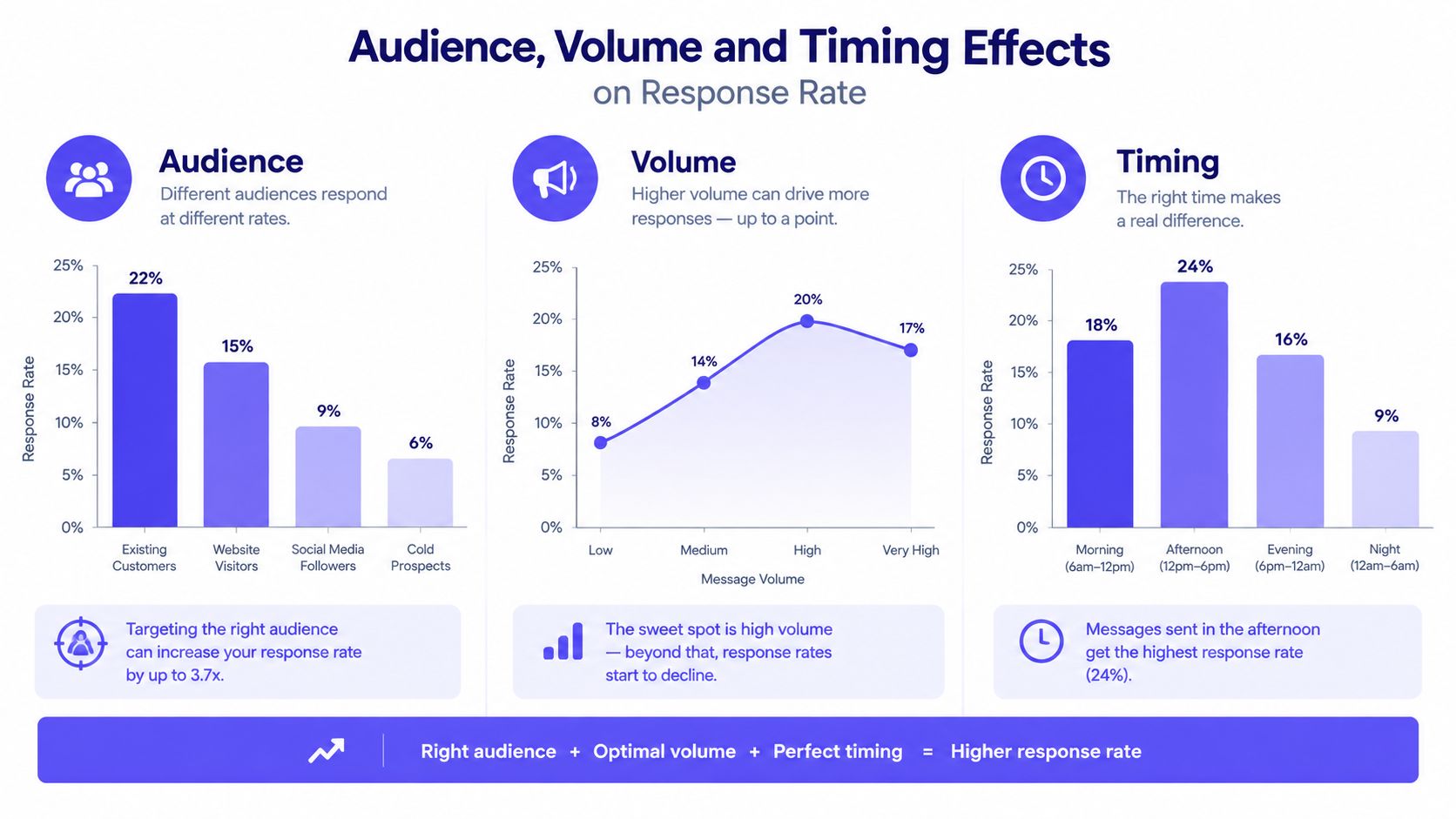
Audience selection sets the baseline before a sales representative writes a single sentence. The company-size breakdown cited in the benchmarks section shows a clear gap between smaller businesses and large enterprises. Larger organizations often add routing layers, competing priorities, and more distance between the recipient and a buying decision. Those conditions can reduce replies even when the message reaches the right company.
Enterprise outreach can still work. The operating model is different. Account research must be more precise, contact selection needs tighter validation, and campaign managers should expect that several stakeholders may need to see the message before a conversation begins.
Industry changes inbox competition as well. A message aimed at a crowded technology segment may compete with a high volume of automated outreach. A message aimed at a less saturated operational niche may receive more attention without having better copy. Compare audiences within the same sending environment, rather than asking for one universal cold email response rate.
Timing is a test variable
The cited dataset also found meaningful variation across calendar months, including weaker results near the end of the year. Treat that pattern as a testing signal, not a universal seasonal rule. Compare similar segments across months, and separate holiday periods from normal operating weeks before changing the offer or the message.
Volume carries a similar trade-off. More sends create more opportunities, but sudden increases can expose weak list quality and inconsistent sender behavior. A campaign may look productive in an automation dashboard while replies decline because a larger share of messages is routed away from the inbox.
| Operating choice | Likely benefit | Main risk |
|---|---|---|
| Smaller, tightly defined audience | More relevant copy and better research | Fewer immediate sends |
| Large, broad audience | More reach and faster data collection | Generic messaging and weaker list control |
| Gradual volume changes | More stable sender behavior | Slower scaling |
| Sudden volume increases | Quick campaign expansion | Reputation stress and more bounces |
| Calendar-based testing | Clearer timing comparisons | Seasonal noise if segments change |
| One fixed send window | Simple operations | Hidden provider or audience bias |
Keep the audience, offer, and sender stable while changing one environmental variable. Otherwise, a timing result may reflect list quality, while a volume result may reflect reputation or placement. Run enterprise and SMB tests on separate senders for two weeks, then compare reply rates by mailbox provider before rewriting copy.
A controlled test makes the result useful. It also shows whether engagement changed because of the recipient group, the sending pattern, or the calendar.
The Hidden Factors Lowering Cold Email Response Rate
Many teams rewrite the first line when response rates fall. That can help when the offer is unclear, but it won't solve an inbox environment problem.
Recent 2026 summaries connect the decline from about 5.1% in 2024 to 3.43% in 2026 with inbox saturation, tighter Gmail and Outlook enforcement, and low-effort AI-generated outreach. Those figures and the accompanying explanation appear in Woodpecker's cold email statistics summary. The important point isn't the exact historical line. It's that more senders are competing for the same attention while mailbox providers are applying stricter controls.
Inbox saturation changes the standard
A short email isn't automatically a good email. When recipients see repeated structures, generic personalization, and familiar automated phrasing, they have less reason to respond. AI-assisted production has made it easier to create large volumes of superficially relevant messages, which raises the quality threshold for both human attention and filtering systems.
Authentication creates another structural layer. SPF, DKIM, and DMARC alignment help mailbox providers evaluate whether a sender is authorized. Authentication isn't a substitute for good targeting, but missing or incorrect authentication can undermine every later improvement.
Sending consistency matters too. A domain that sends sporadically, then spikes, gives providers less stable evidence about normal behavior. List quality affects the same system through bounces, complaints, and irrelevant contacts.
What copy changes can and can't fix
A subject line can improve attention after placement is healthy. It can't make a blocked message visible. Personalization can improve relevance after the recipient sees the email. It can't reverse a poor sender history or an invalid address list.
A practical diagnostic order is:
- Authentication: Confirm that the sending domain has the expected authentication controls.
- Reputation: Review complaints, bounces, engagement, and provider-specific behavior.
- Placement: Check whether test messages reach the inbox, promotions, or spam.
- List quality: Remove invalid, stale, or poorly matched contacts.
- Sending rhythm: Look for sudden spikes, irregular patterns, and excessive repetition.
- Message quality: Rewrite only after the structural checks are stable.
The central lesson is uncomfortable but useful: a campaign can have excellent copy and a poor cold email response rate because the copy never gets a fair chance.
How to Measure Cold Email Response Rate Correctly
The cleanest formula is:
Cold email response rate = qualifying unique replies ÷ delivered campaign emails × 100
The denominator should remain consistent across tests. If one campaign uses total sent emails and another uses opens, the results aren't directly comparable.
Build a clean measurement process
- Separate campaign and warmup traffic. Warmup replies are operational signals. They shouldn't be counted as prospect interest.
- Use delivered campaign emails as the baseline. Exclude bounced messages when the reporting system supports that distinction.
- Count unique qualifying replies. Remove auto-replies, bounce notices, accidental forwards, and unrelated system responses.
- Segment before comparing. Record provider, domain, audience size, industry, geography, sender, offer, and sequence version.
- Review positive and negative replies separately. A high total reply rate can hide poor targeting if many responses are objections or opt-outs.
A simple tracking table can include campaign name, sender domain, audience segment, delivered messages, unique replies, positive replies, negative replies, bounces, complaints, and placement observations. That structure helps teams distinguish a message problem from a delivery problem.
The email engagement metrics guide can support that broader review, but no single metric should replace reply analysis.
| Mistake | What it hides | Correct approach |
|---|---|---|
| Counting warmup replies | Whether prospects engaged | Keep warmup and campaign data separate |
| Using opens as the main success measure | Whether recipients showed intent | Prioritize qualifying replies |
| Counting every automated response | The true human response level | Exclude auto-replies and bounce notices |
| Comparing different audience mixes | Segment difficulty | Compare like with like |
| Reporting only total replies | Campaign efficiency | Track replies against delivered messages |
| Ignoring provider-level results | Placement problems | Segment by mailbox provider and sender |
An open-heavy campaign with few replies may have a relevance issue, but it may also indicate that reported opens aren't translating into meaningful inbox engagement. Measurement should reveal that distinction before the team rewrites the sequence.
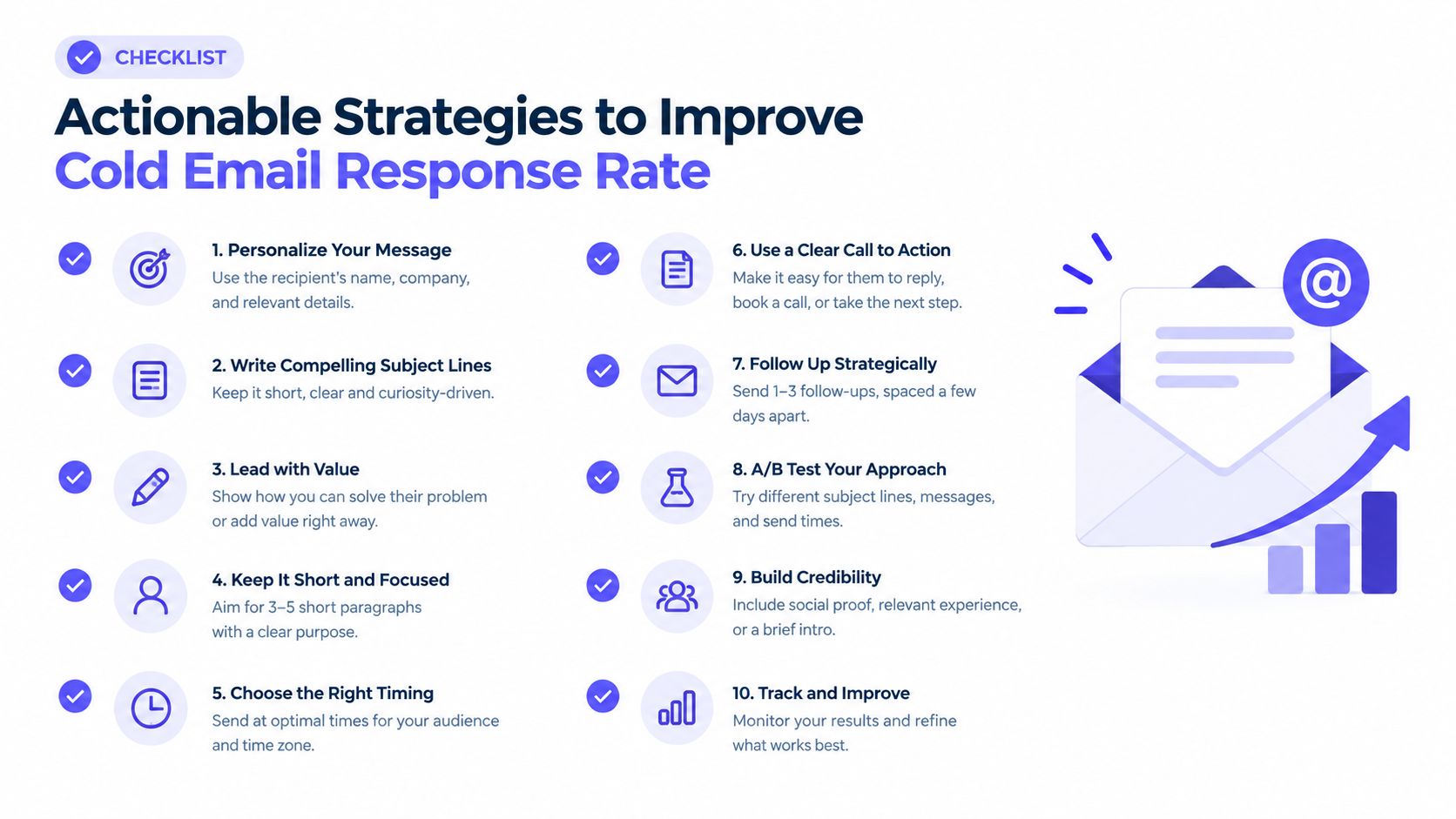
Actionable Strategies to Improve Cold Email Response Rate
Response rate improves when the sending system works before the copy is changed. A sharper subject line cannot compensate for spam placement, weak list quality, or a sender domain with poor history. Run the technical checks first, then refine the audience and message.
Use a prioritized operating checklist
- Fix authentication first. Confirm that the required authentication records pass and align with the sending setup.
- Protect sender reputation. Keep volume changes gradual and sending behavior consistent across the campaign.
- Clean the list. Remove invalid addresses and contacts that do not match the offer.
- Narrow the segment. Group prospects around one problem, industry, company profile, or buying trigger.
- Write a short, specific message. Explain why the recipient was selected and connect the outreach to a relevant problem.
- Use evidence-based personalization. Reference a real public business detail instead of relying on a name merge.
- Keep one clear ask. A single low-friction question gives the recipient one decision to make.
- Sequence follow-ups carefully. Preserve the original context, add a useful reason to respond, and stop when the message no longer fits.
- Monitor placement by provider. Aggregate results can hide poor delivery in one mailbox environment.
- Review results by segment. Scale combinations that produce qualified replies, not simply the combinations that send fastest.
After step 9, log inbox and spam placement separately for Gmail and Outlook using 50 test messages before scaling. This provider-level check can expose a routing problem that aggregate delivery data misses. Record the sender, recipient provider, placement result, and test date so later changes have a reliable comparison.
The summary from Instantly also supports testing follow-up timing and personalization, but those tactics work only when recipients can consistently see the messages. Treat the findings as sequence inputs, not as a reason to skip infrastructure checks.
Choose tools based on the failure mode
A spam checker can flag content risks, while a blacklist checker can identify reputation concerns. An smtp warmup workflow addresses a different issue: building and monitoring sending trust before outreach volume increases.
Mailwarm is an email warmup and deliverability platform with inbox engagement, placement insights, spam score monitoring, provider-level warmup, authentication tools, bounce prevention, and expert guidance. It does not require IMAP access or permission to read a private inbox. Teams that need stronger outbound execution can also review Best place to hire SDRs when delivery repairs must be paired with better prospecting and follow-up discipline.
The trade-off is cost and operational focus. A paid deliverability platform fits teams protecting an important sending domain. A smaller sender may prefer targeted diagnostics and controlled testing before adding another system.
When to Expect Response Rate Improvements
Response rate rarely improves immediately after one technical change. Reputation reflects accumulated sending history, and mailbox providers need consistent evidence before routing behavior changes reliably.
A short test can identify obvious problems. It can't prove long-term sender health. For example, a temporary lift may come from a more receptive audience, a seasonal change, or a small sample that doesn't represent normal performance.
Use a verification loop
A practical improvement loop has four parts:
- Establish a clean baseline. Record delivered emails, qualifying replies, bounces, complaints, provider mix, and audience segment.
- Make one controlled change. Fix authentication, change the segment, adjust volume, or revise the first message, but don't alter everything at once.
- Watch placement and engagement together. A higher reply rate matters more when inbox placement, bounce behavior, and complaint levels remain healthy.
- Repeat across comparable sends. A single strong result is a signal to investigate, not proof that the problem is solved.
Separate short-term wins from durable gains
A campaign may show more replies after a copy change because the new segment is easier to reach. Another may show fewer replies because a seasonal audience is temporarily unavailable. Teams should compare the same sender, provider, audience type, and offer before declaring a deliverability improvement.
The first operational question should be whether messages are reaching the intended inbox. The second should be whether the recipient recognizes a relevant problem. Only after those conditions are stable should a team optimize fine details such as subject-line phrasing or call-to-action wording.
A higher response rate is meaningful when it survives consistent sending conditions, not when it appears for one isolated test.
Teams should escalate when provider-level placement remains poor, authentication issues persist, complaints rise, or response rates stay weak after list and audience corrections. Expert review can identify whether the limiting factor sits in DNS authentication, reputation, volume, content, or recipient selection.
The strongest programs protect sender health between campaigns, keep list quality under control, and treat every response as feedback about both relevance and inbox visibility. That approach takes longer than rewriting one email, but it produces a more reliable cold email response rate.
Cold email response rate FAQ
What is a good cold email response rate?
There isn't one universal target because benchmarks use different audiences and denominators. Recent datasets report averages ranging from 0.45% for strict net-new outreach to 3.43% across a broader benchmark population, so teams should compare campaigns with matching definitions and segments.
Why is the cold email response rate falling?
Inbox saturation, stricter mailbox-provider enforcement, and low-effort automated outreach have made attention harder to earn. Weak authentication, inconsistent sending, poor list quality, and spam placement can lower results even when the message itself is concise.
Does email warmup improve inbox placement?
Warmup can support sender reputation when it creates credible engagement and is combined with sound authentication, list quality, and consistent sending. It isn't a complete fix for spam placement, poor targeting, or high complaint rates.
How should teams calculate response rate?
Divide qualifying unique campaign replies by delivered campaign emails, then multiply by 100. Warmup replies, auto-replies, bounce notifications, and unrelated system responses should remain outside the campaign result.
Do follow-ups improve cold email response rate?
Structured follow-ups can capture replies that don't arrive after the first message. A follow-up should preserve context, use reasonable spacing, and add a relevant point instead of repeating “just checking in.”
How does Mailwarm support deliverability?
Mailwarm provides real inbox engagement, sender reputation support, provider-level warmup, spam score monitoring, inbox placement insights, authentication fix tools, bounce prevention, and expert deliverability guidance. It doesn't require IMAP access or permission to read a private inbox.
Mailwarm helps teams build sender reputation, monitor inbox placement, and reduce spam risk through real inbox engagement and expert-guided deliverability controls. Visit Mailwarm to review a premium approach before scaling cold outreach.