
B2B Sales Email Verification and How It Improves Deliverability and Conversions
B2B deals start with making sure your message actually reaches your audience. Email verification is key to ensuring reliable delivery. It helps filter out inaccurate data, protects your domain reputation, and boosts your chance of getting replies. By avoiding bounced emails, verification saves valuable time and reduces frustration. Treat verification as an ongoing process, not just something to do once and forget.
Effective verification reduces roadblocks at every stage of the sales funnel. Clean, accurate addresses help your emails reach real decision-makers. Proper email authentication establishes credibility with email service providers. When these elements work together, you’ll spark more conversations, and win more deals.
Email Authentication for B2B Sales Verification: SPF, DKIM, DMARC, HELO, and MX Records
Set Up Domain Authentication with SPF, DKIM, and DMARC
Implement SPF by listing only the systems that are authorized to send emails for your domain. Keep the number of lookups under 10. If you use multiple tools or manage many domains, learn how to manage SPF record limits in complex setups. Always sign messages with DKIM to validate their source. Make sure your From address, Return-Path, and d= fields align to satisfy DMARC. Begin with p=none to monitor sources before gradually moving to stricter enforcement.
You can use our free DMARC Check Tool, SPF Checker & Lookup Tool, and DKIM Lookup Tool.
Use the Correct HELO/EHLO Name and Maintain Reverse DNS
Email servers check the SMTP greeting. Use a hostname that matches your reverse DNS entry and resolves correctly. This minor detail can make a big difference in trust. For more, see this guide on how your HELO greeting affects sender reputation.
Confirm MX Records, Postmaster, and Abuse Addresses
Ensure your domain can receive email for responses and technical notices by publishing accurate MX records. Set up functional postmaster@ and abuse@ addresses, these are standard trust indicators and help with important feedback loops.
Data Hygiene Techniques for B2B Sales Email Verification Before Outreach
Start by thoroughly checking your email list. Use a reliable email checker to validate syntax, confirm domains exist, and check mail server responses. Block disposable or temporary email domains. Flag role-based addresses like info@ or sales@ unless they match your target buyer.
- Standardize names and domains. Fix common typos, such as
gamil.com
instead of “gmail.com.” - Run SMTP checks with cautious timeouts, and respect provider rate limits.
- Identify “accept-all” domains and approach them carefully.
- Eliminate addresses that hard bounce, even if it only happens once.
Batch verification can quickly cleanse your CRM before starting outbound sequences. Real-time verification while capturing form leads prevents junk from being added in the first place. Regularly re-verify older records, especially after organizational changes like domain migrations or mergers.
Clean data is a key component of transforming cold outreach into focused outreach, working in conjunction with other verification processes to improve your domain health.
Warm-Up Methods for Verified B2B Sales Domains and Mailboxes
Even perfectly set up domains and mailboxes need gradual introduction. New domains and senders must build a good reputation by starting with low sending volumes and encouraging genuine engagement. This warm-up process creates positive indicators through email opens, brief replies, users moving messages out of spam, and keeping threads consistent. These actions “train” spam filters to trust you before you launch major campaigns. Remember, this phase isn’t about promotion, it’s technical preparation.
One proven option is Mailwarm, which uses a network of more than 50,000 active, well‑maintained inboxes to simulate human‑like interactions that build your sender reputation. As of February 2026, Mailwarm has enhanced its service with centralized management for multiple accounts, advanced monitoring of email reputation, cross-provider warm-up, and detailed spam score tracking for providers like Gmail, Microsoft, and Yahoo, making it ideal for scaling up.
This warm-up traffic isn’t promotional. Its purpose is to fine-tune and improve indicators like email open rates, click rates, and response rates, which influence where your actual outreach emails land in your recipients’ inboxes.
Preflight Verification Checklist for B2B Sales Email Campaigns
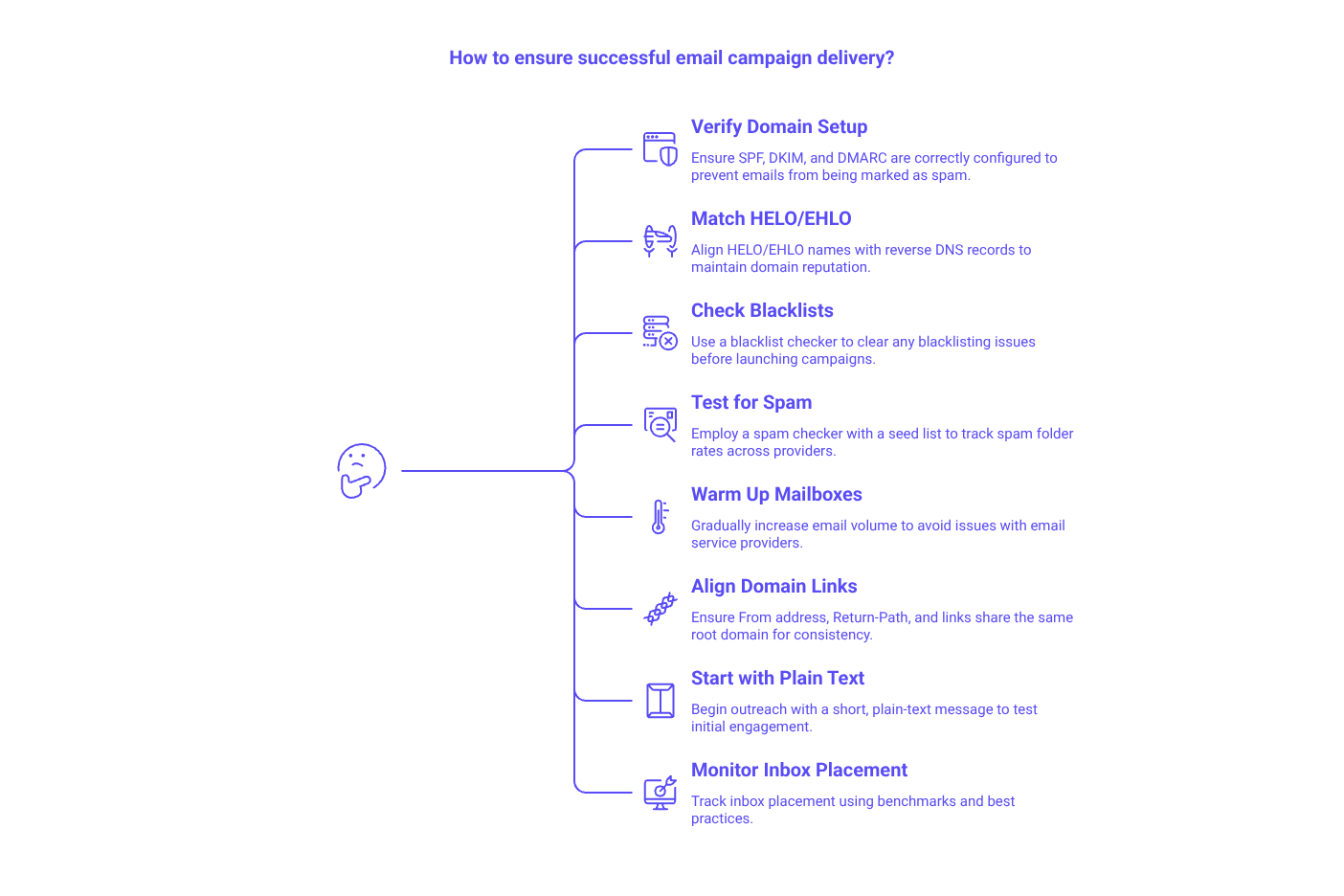
- Check that SPF, DKIM, and DMARC are correctly set up for your sending domain.
- Verify that your HELO/EHLO name matches your reverse DNS records.
- Use a blacklist checker for your domains and IP addresses. Clear any blacklisting before launching campaigns.
- Test your emails with a spam checker using a seed list. Track spam folder rates across different providers.
- Warm up new mailboxes before you start outreach. Gradually increase your daily email volume, ensuring that the increase isn’t too sudden, to avoid any potential issues with email service providers.
- Make sure your From address, Return-Path, and visible links share the same root domain.
- Begin new outreach to a segment with a short, plain-text message.
- Monitor inbox placement with these benchmarks and best practices for inbox placement.
Bounce Handling and Reply-Driven Maintenance for B2B Sales Verification
Not all email failures are the same. Hard bounces mean the address doesn’t exist, remove these right away. Soft bounces typically indicate temporary problems. Retry sending up to three times, spacing out attempts, then pause and re-verify if issues continue.
- Drop hard bounces after a single event.
- For soft bounces, retry up to three times with increasing intervals.
- If soft bounces persist after retries, suspend and re-check the contact.
Honor all unsubscribe requests immediately. Pay attention to complaint notifications and pause outreach to domains that generate frequent issues. Leverage reply detection to prioritize genuine conversations and avoid oversending to large organizations with sensitive email filters.
Compliance and Trust Signals That Influence B2B Sales Email Verification
Align your public-facing information with your behind-the-scenes technical details. Use a real person’s name and a monitored inbox. Keep your From address and clickable links based on the same root domain. Publish a clear company website, ensuring that your domain name system (DNS) records accurately represent your brand. These cues help both spam filters and human recipients decide to deliver and open your emails.
If brand visibility matters, consider implementing BIMI only after DMARC enforcement. While BIMI helps with brand recognition, it won’t solve list or data problems on its own, it supports already strong set-ups.
Measurement Methods to Evaluate B2B Sales Email Verification Impact
Monitor delivery rates and bounce statistics first. Consistent delivery signals that your technical and data strategies are working well. Fewer bounces indicate higher list quality. An increase in positive replies means your messages are landing in the right place and connecting with your audience, even before you look at metrics like clicks or design performance.
- Track changes in delivery rates week by week.
- Monitor hard and soft bounce ratios from each provider.
- Test inbox placement using seed lists before each new outreach wave.
- Check spam folder rates after updating your warm-up or sending strategies.
If you see a drop in placement rates, check your DNS first, then investigate recent list sources, and finally, review your email content for spammy language before rerunning spam checks.
Action Steps to Start B2B Sales Email Verification Today
Set up authentication, clean your list, and warm up new mailboxes. Use the preflight checklist before every campaign. Continuously remove bad data and focus on inbox placement, not vanity metrics. Stay consistent, and you’ll achieve more reliable delivery and stronger sales conversations.
FAQ
Why is email verification essential for B2B sales?
Email verification is crucial because it ensures your outreach reaches the correct audience by eliminating invalid addresses. Without it, you're wasting efforts on addresses that can't engage, weakening your sender reputation and increasing the risk of spam flagging.
How does SPF, DKIM, and DMARC contribute to email deliverability?
These protocols authenticate your emails, signaling to providers that your messages are legitimate. Without them, your emails might be flagged as spam or rejected, harming your domain's reputation and reducing engagement potential.
What are the risks of not maintaining proper email list hygiene?
Poor list hygiene leads to high bounce rates and potential blacklisting, which can severely compromise your sender reputation. Unverified lists also waste resources by targeting non-existent addresses and reduce the ROI of your campaign efforts.
How does Mailwarm assist with email warm-up and deliverability?
Mailwarm simulates human-like interactions that enhance sender reputation, making your emails more likely to land in inboxes rather than spam folders. Without this, new campaigns might be prematurely dismissed by filters, reducing exposure.
Why is monitoring bounce rates critical in email campaigns?
Bounce rates are indicators of list quality and email health; high rates suggest outdated or inaccurate data. Ignoring them accelerates the churn of email deliverability, often unnoticed until it's too late to repair your reputation.
What consequences can occur if DNS records are not set up properly?
Incorrect DNS records can lead to your emails being undelivered or marked as spam. This not only wastes resources but also diminishes trust in your brand, with long-lasting effects on campaign effectiveness.
Is email warm-up necessary if my domain is perfectly set up?
Yes, because a perfect setup doesn't equate to immediate trust from spam filters. Without a gradual warm-up, sudden sending volumes can raise red flags with providers, undermining your ability to reach the target audience effectively.
Should I be concerned about role-based and accept-all email addresses?
Yes, since these addresses often belong to shared mailboxes that rarely engage, skewing campaign metrics. Prioritizing personalized addresses enhances response rates and effectively gauges true interest and potential deals.
How does monitoring spam folder rates improve campaign success?
Tracking how often emails land in spam helps fine-tune your strategies to maximize inbox placement. Ignoring these rates means blindly navigating deliverability challenges, often leading to unseen or ignored outreach efforts.