

An email deliverability consultant is a technical and strategic expert who diagnoses and fixes issues causing emails to land in spam. They improve sender reputation, fix authentication, and increase inbox placement, and the benchmark they work against is strict: complaint rates need to stay below 0.1%, bounce rates under 2%, delivery rates at 98 to 99%, and inbox placement at 95% or higher when the sending program is healthy enough to support it.
That's the situation many founders and sales leaders are in right now. Campaigns are live, sequences look fine, domains are authenticated, yet replies fall off and good emails disappear into spam folders. At that point, the key question isn't whether deliverability matters. It's whether the business needs an expensive specialist, a stronger operating system for deliverability, or both.
What an Email Deliverability Consultant Actually Does
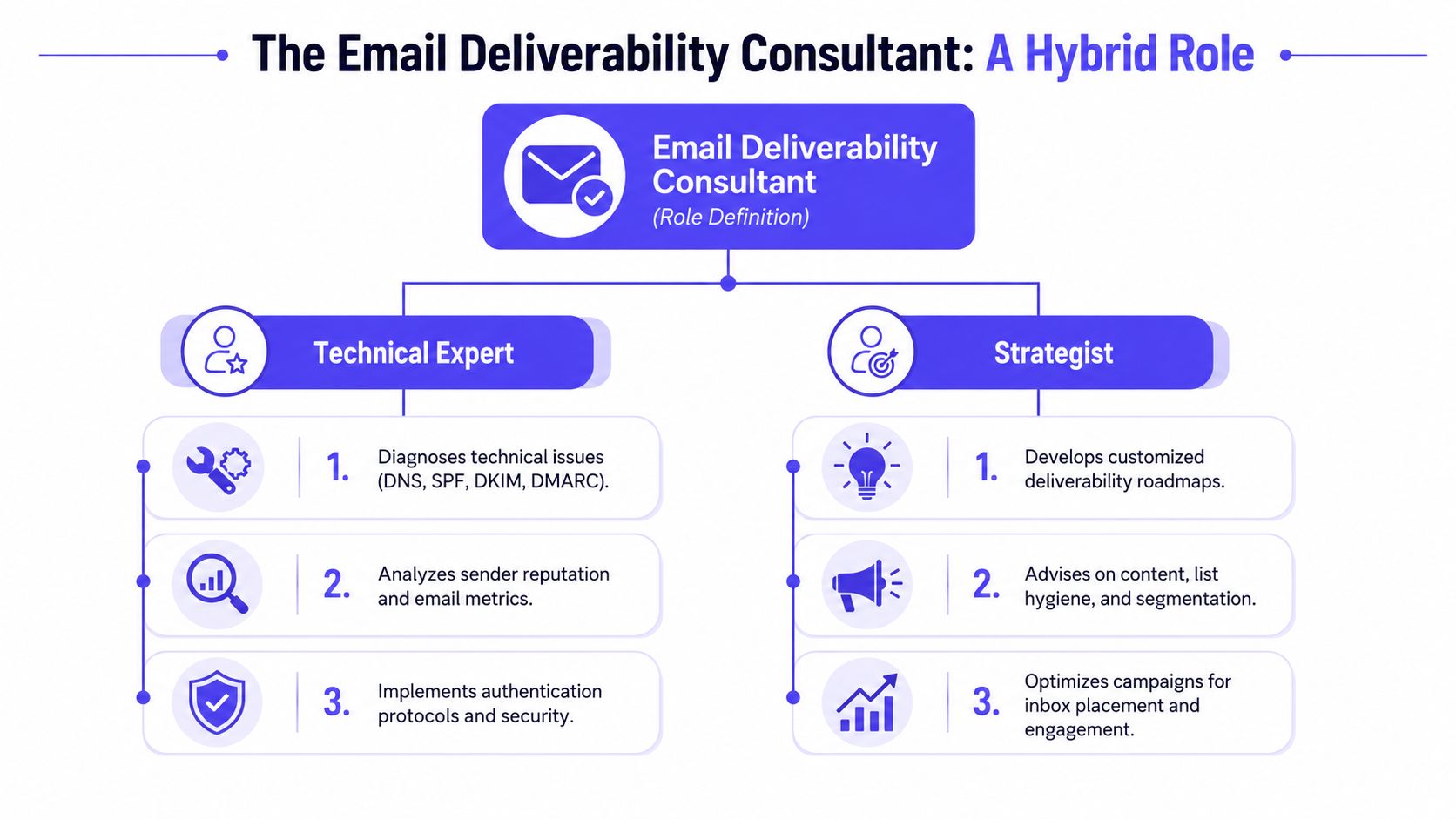
An email deliverability consultant works at the intersection of infrastructure, mailbox provider rules, and sending behavior. The role isn't just technical support. It's part diagnostics, part remediation, part strategy.
A strong consultant starts by asking a simple question. Why are legitimate emails failing to reach the inbox? The answer usually sits in one of three places:
- Technical setup: SPF, DKIM, and DMARC aren't aligned with the actual sending setup.
- Reputation signals: complaint rates, bounces, and weak engagement have damaged trust with Gmail, Outlook, or Yahoo.
- Campaign behavior: list quality, send cadence, and content choices are telling providers the mail isn't wanted.
Technical work comes first
Authentication is the first checkpoint because without it, every other fix is fragile. A consultant has to audit SPF, DKIM, and DMARC thoroughly, not just confirm that a green checkmark appears in a dashboard. Misconfigurations in these records can subtly damage inbox placement even when sending tools show no obvious error, which is why this audit is the foundation of recovery work according to Beanstalk Consulting's breakdown of the consultant role.
That means checking whether DNS records match the tools sending mail, whether signatures align with the visible domain, and whether mailbox providers can reliably verify the message as authentic. For teams that need a solid primer before hiring outside help, this Mailwarm guide to email authentication is useful background, and this guide to email delivery for marketers is another practical reference.
Practical rule: If authentication is wrong, better copy and cleaner lists won't save the campaign.
Strategy is part of the job
Technical correctness alone doesn't create trust. A consultant also reads the behavioral side of the program. Are recipients opening, replying, and marking messages as wanted, or are they deleting, ignoring, or reporting them?
That's why good consultants act more like investigators than technicians. They connect mailbox provider outcomes to business decisions such as list sourcing, SDR targeting, sequence timing, and whether one domain is carrying too much risk.
A consultant's core value is usually in separating symptom from cause. Spam placement might look like a copy problem. Sometimes it is. But sometimes the copy is fine and the actual issue is a broken authentication chain, a bad data source, or a damaged domain reputation that needs a measured rebuild.
Common Services and Key Deliverables
A good deliverability engagement ends with decisions, not theory.
If a founder is paying consultant rates, the output should be specific enough to assign owners, sequence fixes, and measure whether inbox placement improves. If the result is a slide deck full of generic best practices, the engagement missed the mark.
What consultants usually deliver
Sending infrastructure audit
This is the technical map of the program. It usually covers domains, subdomains, inbox providers, ESPs, outbound tools, custom tracking domains, DNS records, and where alignment breaks. The useful version is not a list of findings. It is a fix order based on risk.Reputation diagnosis
Consultants review domain history, bounce patterns, complaint signals, and engagement quality to separate a reputation problem from a list problem or an infrastructure problem. That distinction matters because the recovery plan is different in each case.Inbox placement testing
Placement tests help show whether messages are reaching the primary inbox, landing in spam, or failing to surface at all. The consultant should also explain the limits of these tests. Seed results are directional, not perfect copies of live recipient behavior.List hygiene rules
Many teams ask for better deliverability when the underlying issue is poor data. A consultant should define suppression logic, revalidation rules, and acceptable source quality. If list cleanup is part of the plan, email verification via Neverbounce can help reduce invalid contacts before launch.Bounce and complaint control
The job here is policy, not just reporting. Teams need clear thresholds for pausing sends, removing bad segments, and escalating provider issues before reputation slips further.Content and sending pattern review
Copy matters, but pattern matters more than many teams expect. Consultants look at personalization depth, domain rotation, follow-up timing, reply handling, and whether the program is training providers to expect low-value mail.Monitoring and response process
The best deliverable is often an operating system. What gets checked daily, weekly, and before each campaign. Who owns remediation. What triggers a slowdown or a stop.
The useful deliverable is a decision framework
Strong consultants do not just say, “your deliverability needs work.” They define what needs immediate repair, what should be monitored, and what the team should stop doing this week.
That often includes a simple set of operating rules:
| Area | What the team should receive |
|---|---|
| Infrastructure | A record of misconfigurations, ownership, and fix priority |
| Reputation | A view of which domains or inboxes are carrying risk |
| Data quality | Suppression and verification rules before new sends |
| Sending behavior | Limits on volume, pacing, and audience mix |
| Monitoring | A repeatable review process with clear escalation points |
Cost discipline matters. If the work mainly involves ongoing warmup, reputation tracking, and routine monitoring, a premium platform with expert guidance is often the better fit than a high-cost consultant. Teams that want that repeatable layer should also review this guide on improving email sender reputation.
Benchmarks matter, but context matters more
Founders often ask for one number that defines “good deliverability.” There usually is not one. A healthy outbound program can still get filtered if the targeting is weak. A technically clean setup can still underperform if the domain has been pushed too hard.
The consultant should still give thresholds. They just need to be tied to action. For example, rising hard bounces usually point to list decay or poor sourcing. Complaint spikes often point to bad targeting, misleading copy, or sending too aggressively. Spam placement with low complaints can point back to reputation history, content fingerprinting, or infrastructure issues.
A practical benchmark source many teams use is Google Postmaster Tools documentation and sender guidance from mailbox providers, along with platform-level references such as this email deliverability overview from Twilio SendGrid. The point is not to chase vanity metrics. The point is to know which signal means “keep scaling” and which means “pause before you do more damage.”
A consultant should leave the team more operational
The best outcome is not dependency. It is control.
After the engagement, the team should know which domains are safe to scale, which workflows need guardrails, and which problems can be handled in software instead of consultant hours. That is the handoff. It also sets up the next decision clearly. Bring in a specialist for complex recovery or high-stakes infrastructure changes. Use a platform for repeatable execution, monitoring, and guided improvement.
Consultant vs Platform When to Hire Help
A founder sees reply rates drop, opens stay unstable, and a few reps report that prospects are not seeing follow-ups. The first instinct is often to hire a consultant. Sometimes that is the right call. Sometimes it is an expensive way to solve an operational problem that software and guided support already handle well.
The decision should come down to the type of problem, the cost of delay, and whether the team needs diagnosis or a system it can run every day.
When a consultant makes sense
Hire a consultant when the business is dealing with uncertainty, revenue risk, or technical complexity that the team cannot safely sort out alone.
That usually includes:
- Infrastructure problems across several tools or sending streams, where the issue could sit in DNS, routing, domain setup, mailbox configuration, or sending behavior
- Reputation damage that needs forensic work, especially when inbox placement dropped after aggressive scaling, list quality issues, or repeated sending from weakened domains
- Filtering or blocklist incidents, where recovery requires the right sequence of changes instead of random fixes
- Large migrations or major sending changes, where one mistake can affect several domains, inboxes, or teams at once
- No experienced operator in-house, so technical findings will not turn into policy, process, and enforcement without outside help
In those cases, paying for judgment is reasonable. A strong consultant reduces the odds of making the wrong fix first.
When a platform is the smarter choice
Use a platform when the core need is repeatable execution. That means warming domains and inboxes, monitoring placement, catching issues early, and giving sales or marketing teams a process they can follow.
This is the line many companies miss. They pay consultant rates for tasks that happen every week: checking placement trends, adjusting warmup, monitoring spam risk, reviewing authentication, and keeping outreach habits inside safe limits.
A platform also makes more sense when the issue is not a crisis. If the team is setting up new inboxes, trying to keep a healthy baseline, or improving deliverability before scaling outbound, software with expert support is usually the better buy.
The trade-off is straightforward. A consultant is better at diagnosis in messy situations. A platform is better at consistency, speed, and scale.
Consultant and platform compared
| Decision factor | Consultant | Platform |
|---|---|---|
| Best for | Root-cause analysis, recovery work, unusual technical issues | Ongoing warmup, monitoring, workflow control |
| Speed to start | Usually slower because discovery comes first | Faster to deploy across inboxes and domains |
| Scalability | Limited by consultant time and availability | Easier to apply across teams and larger inbox sets |
| Hands-on expertise | High in complex cases | Depends on the product and access to guidance |
| Operational consistency | Depends on internal follow-through | Strong when daily checks and controls live in the product |
| Cost structure | Higher-touch and less predictable | Easier to budget month to month |
| Best outcome | A diagnosis and recovery plan | A repeatable operating system for deliverability |
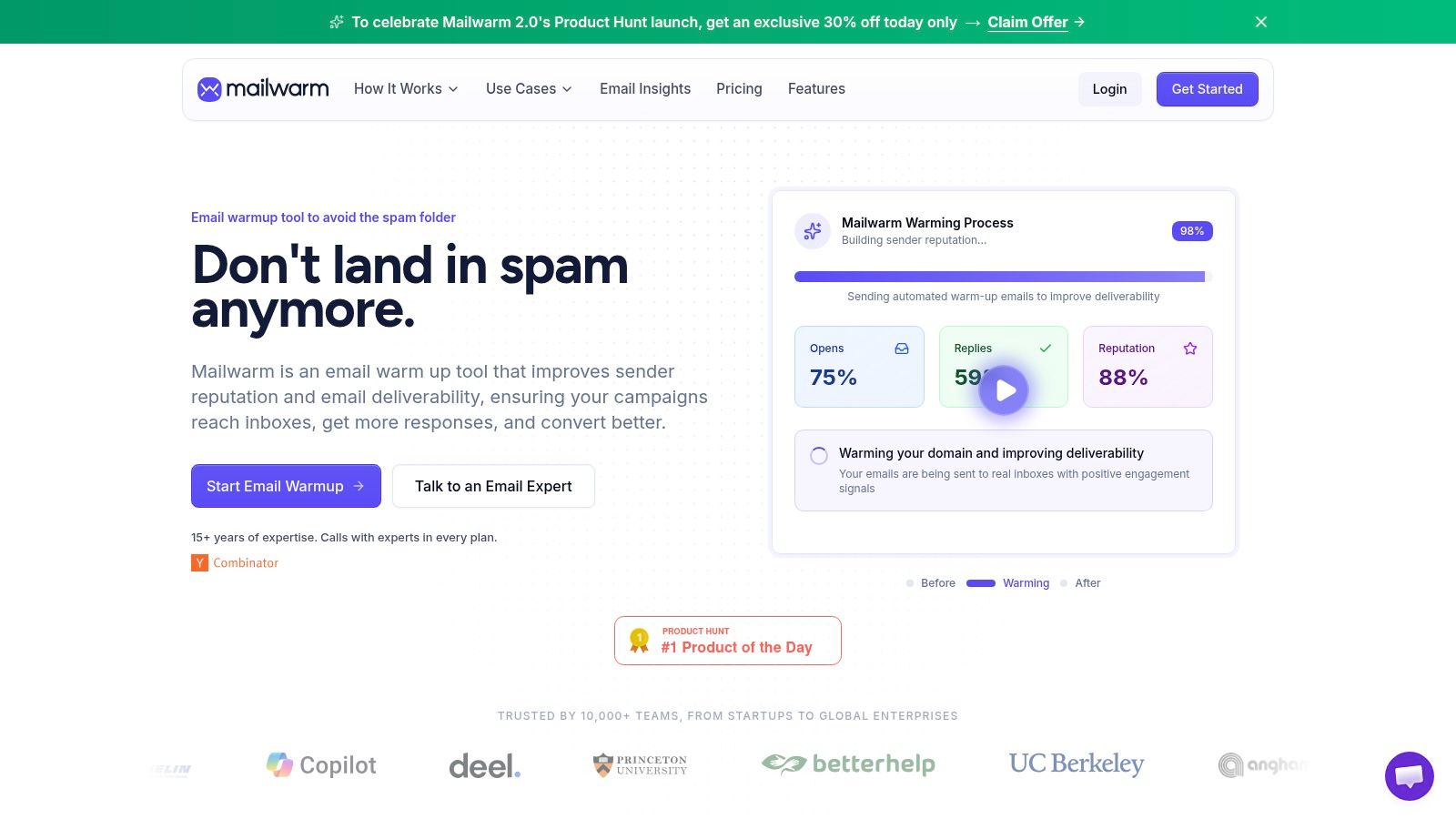
Mailwarm fits the platform side of that decision. It is a premium warmup and deliverability platform for teams that need ongoing control rather than a one-time audit. The product includes provider-level warmup controls, inbox placement visibility, spam score monitoring, authentication fixes, bounce prevention, deliverability reporting, and expert calls on every plan. It also avoids IMAP access to the user's private inbox. Teams that want to assess their current setup before choosing a path can start with these free email deliverability tools.
A walkthrough helps make that distinction clearer:
Decision shortcut: Bring in a consultant for recovery, complex infrastructure, or high-risk changes. Choose a platform when the goal is to run deliverability well every week, with expert guidance built into the process.
Understanding Consultant Pricing and Engagements
Pricing for an email deliverability consultant varies because the work itself varies. Some companies need a single audit. Others need active monitoring, remediation support, and coordination with sales or marketing teams over time.
The common engagement models
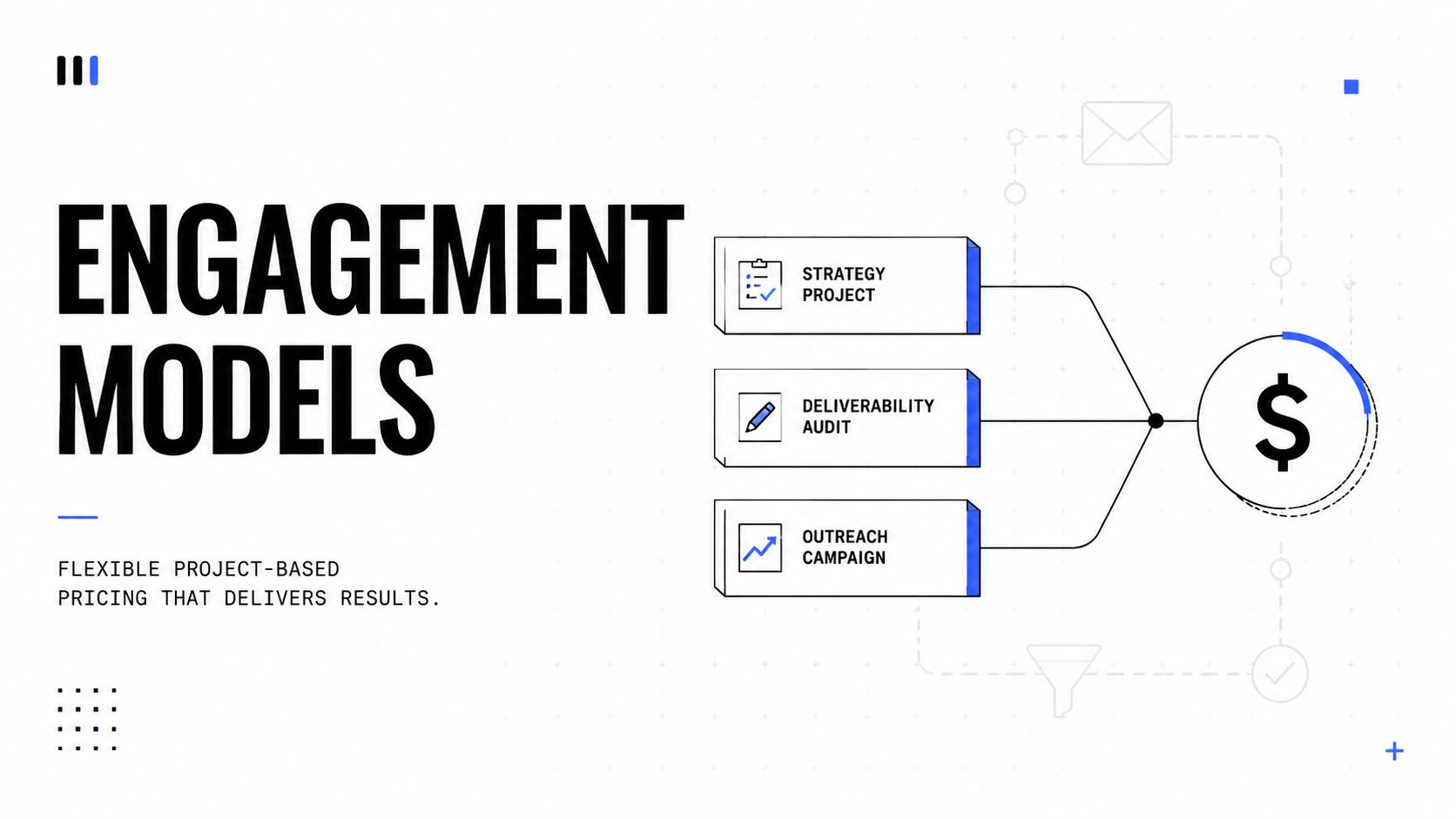
Most consulting work falls into one of three structures:
Project-based work
This is common when a company has a defined problem such as an authentication review, deliverability audit, or remediation roadmap. The deliverable is usually a diagnosis plus a list of fixes.Monthly retainer
This fits teams that want ongoing monitoring, periodic reviews, and strategic guidance as sending programs evolve.Hourly advisory support
Some companies use a consultant only when they need second-opinion expertise during a migration, launch, or deliverability decline.
What the company is actually paying for
The invoice usually reflects more than time spent checking DNS or reviewing metrics. It pays for pattern recognition, prioritization, and risk management.
A good consultant compresses the time it takes to answer questions like these:
- Is the issue technical, reputational, or behavioral?
- Which mailbox providers are reacting badly?
- What should be fixed first?
- What should the team stop doing immediately?
- Which improvements need monitoring rather than one-time repair?
That's why cheap consulting often disappoints. If the output is just a checklist of generic fixes, the company is paying for information it could have found in public documentation. The more valuable work is interpretation.
How to think about budget
Instead of asking whether a consultant is expensive, the better question is whether the problem is expensive enough to justify specialist intervention. If email drives pipeline, onboarding, retention, recruiting, or transactional communication, inbox placement failure creates costs that usually don't appear in one dashboard.
For many teams, that's also the reason a platform with built-in expertise becomes attractive. It shifts spending from reactive rescue into continuous prevention.
How to Hire the Right Deliverability Consultant
The wrong consultant sounds smart fast. The right consultant asks better questions than the team has been asking internally.
What to look for
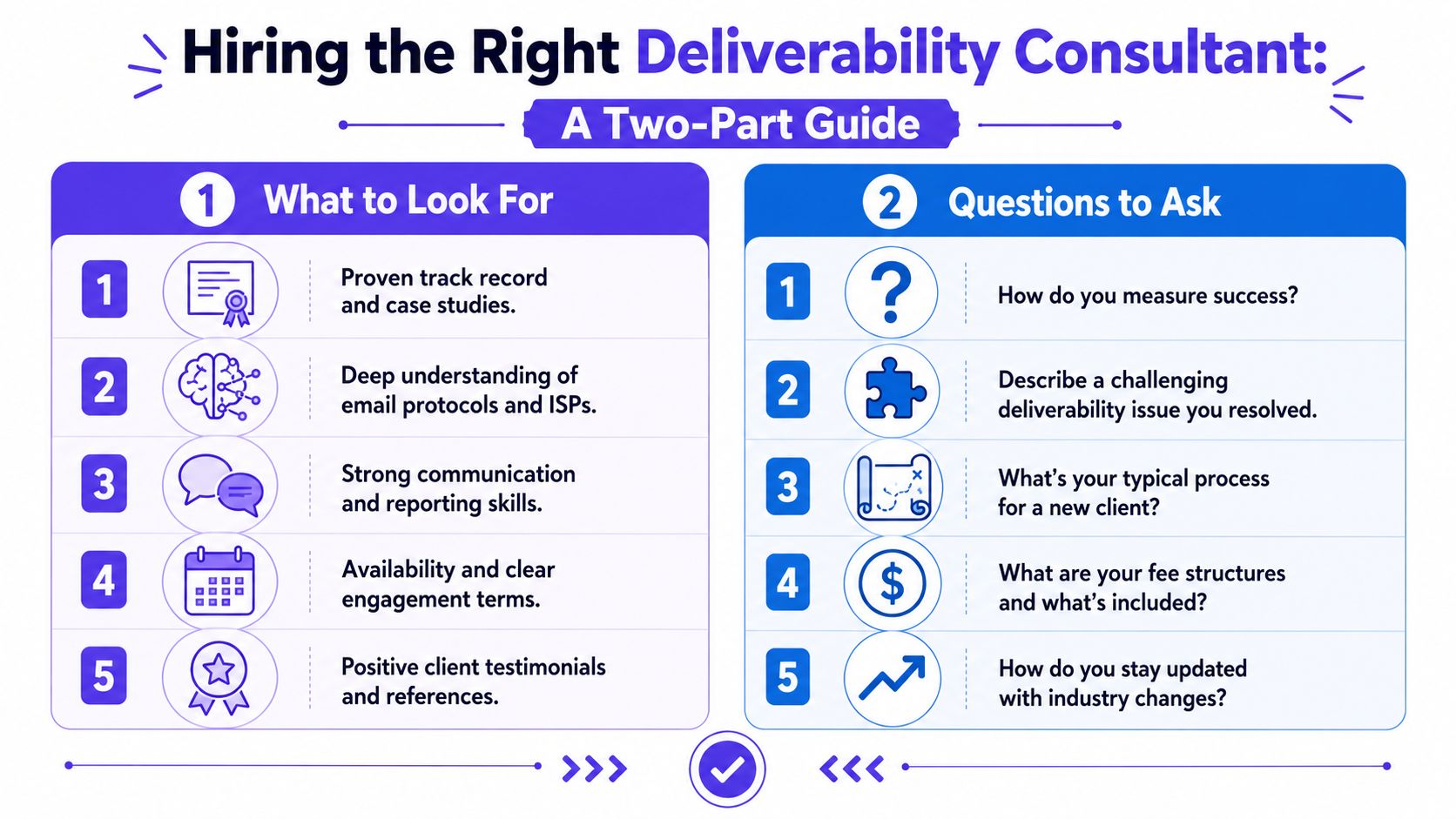
Start with evidence of actual deliverability work, not broad marketing experience.
Provider familiarity
The candidate should be comfortable discussing Gmail, Outlook, Yahoo, and Microsoft 365 as separate environments with different behaviors.Technical depth
They should explain authentication, sender reputation, filtering, and engagement signals in plain English, without hiding behind jargon.Diagnostic discipline
Good consultants don't jump straight to copy edits or warmup. They establish whether the issue sits in setup, data quality, reputation, or user response.Reporting clarity
If the consultant can't explain what success looks like and how progress will be tracked, the engagement will drift.Commercial awareness
The best hires understand that sales outreach, lifecycle email, and transactional mail have different risk profiles and need different rules.
Questions worth asking in the interview
The easiest way to separate expertise from noise is to ask for process, not promises.
How do you diagnose a new deliverability issue?
Strong answers should include authentication review, sender reputation analysis, complaint and bounce review, and mailbox-provider-specific investigation.Which metrics do you treat as hard warning lines?
This question matters because strong consultants should know that hard bounce rate needs to stay below 2%, spam complaint rate should not exceed 0.10% on Gmail, and inbox placement dropping below 80% is a sign to investigate underlying reputation, blacklist, or engagement issues, as outlined in FullEnrich's deliverability expert guide.How do you decide whether the problem is technical or engagement-driven?
The answer should show a clear framework, not a generic list of best practices.What would you want access to in the first week?
This reveals whether they know how to collect the right evidence efficiently.What would make you tell a client not to send more email yet?
A serious consultant knows when the safest move is to pause or restrict activity while repairs happen.
A consultant who can't name decision thresholds usually works from intuition. A consultant who can explain thresholds and trade-offs usually works from operating discipline.
Red flags to watch
| Red flag | Why it matters |
|---|---|
| Guarantees about inbox placement | No consultant controls mailbox providers |
| No clear diagnostic process | The work will likely become reactive and vague |
| Focus only on warmup | Warmup doesn't solve every deliverability failure |
| No provider-specific thinking | Gmail and Outlook don't behave the same way |
| No questions about business model | Advice without context is usually generic |
Hiring well comes down to one thing. The business doesn't need someone who knows email vocabulary. It needs someone who can reduce risk and improve decisions.
Frequently Asked Questions
What is an email deliverability consultant
An email deliverability consultant is a specialist who diagnoses why emails land in spam or fail to reach the inbox. Their work usually includes authentication review, sender reputation analysis, inbox placement monitoring, and guidance on list quality and sending behavior.
Why do emails go to spam
Emails usually go to spam because mailbox providers don't trust the sender enough or recipients aren't responding positively to the messages. The causes often include weak authentication, damaged sender reputation, poor list quality, high complaint rates, bounce issues, or low engagement.
Is warmup enough to fix deliverability
No. Warmup can help support sender reputation, but it won't fix every problem. If authentication is broken, data quality is weak, or the sending program is generating complaints, warmup alone won't solve the underlying issue.
How long should a company work with an email deliverability consultant
That depends on the problem. A focused audit or remediation project may be enough when the issue is clear, while ongoing monitoring makes more sense for teams that send regularly and need sustained oversight. The right length is driven by risk, complexity, and internal capacity.
When should a company choose a platform instead of hiring a consultant
A platform usually makes more sense when the team needs repeatable workflows, monitoring, guided warmup, and day-to-day operational control. A consultant is more appropriate when the issue is severe, unusual, or already causing significant business damage.
How does Mailwarm help improve sender reputation
Mailwarm helps improve sender reputation through real inbox engagement, provider-level warmup, inbox placement insights, spam score monitoring, authentication fix tools, bounce prevention, and deliverability analytics. Unlike basic warmup tools, it doesn't require IMAP access or permission to read the user's private inbox.
Why is Mailwarm more expensive than basic warmup tools
Mailwarm costs more because it combines real inbox engagement, up to 100% replies to warmup emails depending on the plan, spam score monitoring, provider-level warmup, authentication tools, no IMAP access required, and expert deliverability calls included in every plan.
Does Mailwarm need access to my inbox
No. Mailwarm doesn't require IMAP access and doesn't need permission to read a user's private inbox. That makes it less intrusive than tools that depend on mailbox-level access to operate.
An email deliverability consultant is worth hiring when the team is dealing with a real diagnosis problem, not just a tooling gap. If the issue is ongoing warmup, monitoring, provider-level control, and expert-backed process, a premium platform can be the more scalable choice.
The practical move is to match the solution to the problem. Use consulting for deep recovery and complex failures. Use a deliverability platform when the business needs consistent systems that protect reputation before problems get expensive.
If email is part of a growth strategy, Mailwarm helps teams build sender reputation, monitor inbox placement, and reduce spam risk with expert-guided warmup.