

Only 84.8% of messages reached the inbox in Validity's prior global benchmark. Another 6.1% landed in spam, while 9.1% went missing, meaning even a well-run sending program can lose roughly one in six messages before recipients see it. Validity's 2025 Benchmark Report
Email deliverability best practices are therefore not a collection of subject-line tricks. They're a practical system built around authentication, sender reputation, list quality, complaint control, and provider-specific monitoring. Warmup can support that system, but it can't replace compliance or disciplined sending.
What Email Deliverability Best Practices Actually Mean
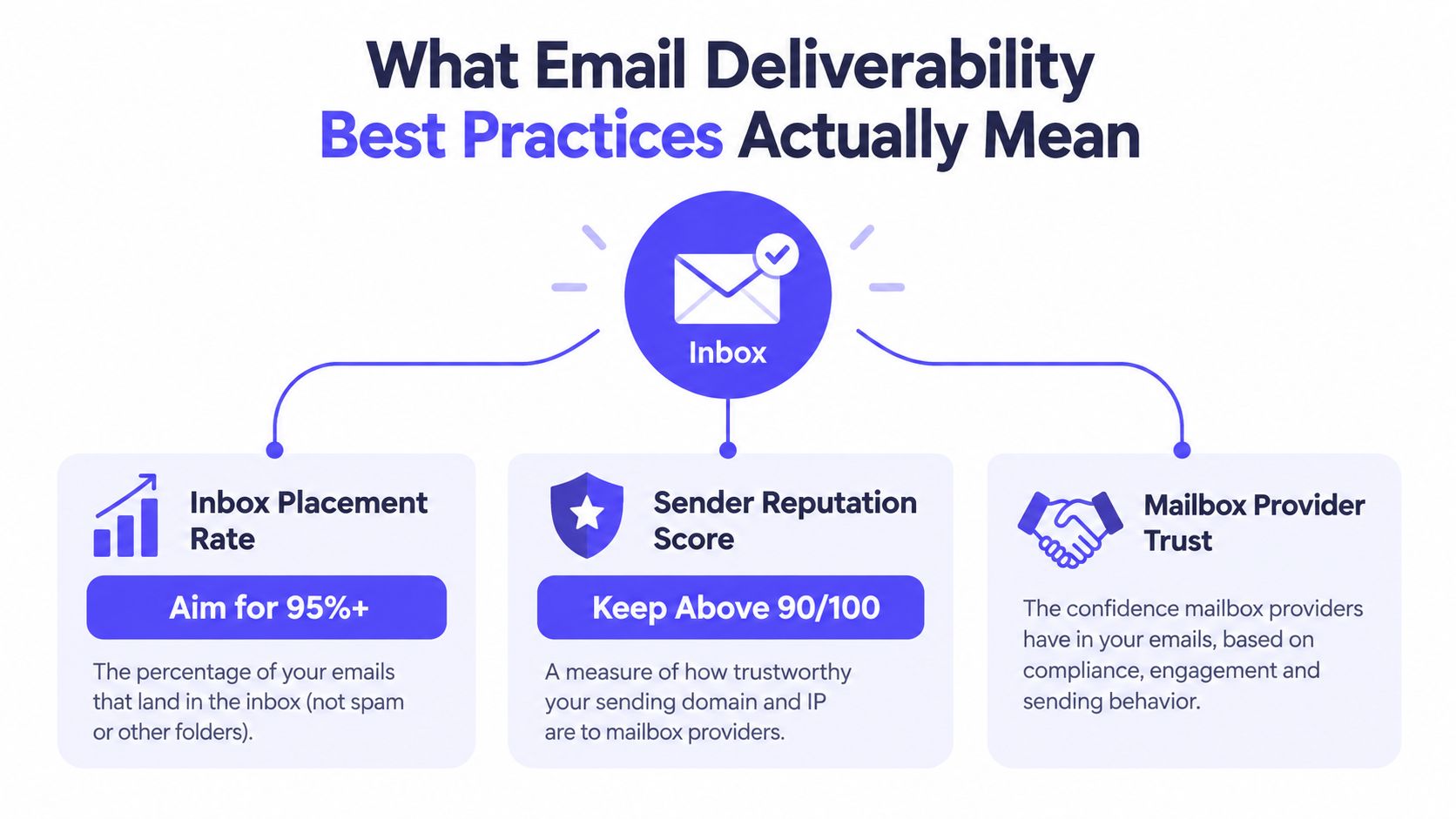
Email deliverability is the rate at which messages reach a recipient's inbox rather than spam, another filtered folder, or no visible folder at all. Delivery means a receiving server accepted the message. Inbox placement measures where that accepted message appears.
The distinction determines how teams investigate performance. A campaign can report strong delivery while sales messages enter spam, marketing emails land in secondary tabs, or some messages never appear. Validity's benchmark recorded 84.8% inbox placement, 6.1% spam placement, and 9.1% missing messages in its prior edition. Validity's benchmark data
Reputation is built from several signals
Mailbox providers assess a domain through identity, sending behavior, and recipient response. The working model includes:
- Authentication: SPF, DKIM, and DMARC establish which systems may send and whether messages align with the domain.
- Reputation: Providers review sending history, bounces, complaints, and domain behavior.
- Engagement: Replies, opens, threads, spam removal, and other recipient actions indicate whether messages are wanted.
- List quality: Invalid, abandoned, or poorly acquired addresses increase delivery risk.
- Compliance: Unsubscribe handling and provider requirements influence acceptance and routing.
A reliable sending program manages all five signals together. Stronger copy may improve engagement, but it cannot correct failed authentication. A warmup schedule can create useful activity, yet it cannot make a scraped or outdated list acceptable.
Providers do not share one universal filter
Gmail, Outlook, Yahoo, and enterprise mailbox systems apply different signals and thresholds. Provider-level benchmark data shows that inbox placement can vary materially between Gmail and Microsoft mailboxes, with Outlook and Hotmail also showing higher spam placement in the cited comparison. Provider-level deliverability benchmarks
The operational response is provider-level reporting. A blended deliverability score can hide a serious problem with one mailbox provider, especially when Gmail performs well while Outlook or Yahoo placement declines. Review inbox placement, spam placement, bounces, complaints, and authentication results by provider before changing volume.
Practical rule: Treat deliverability as provider-specific reputation, authentication, engagement, list hygiene, and compliance, rather than one campaign metric.
Mailwarm fits after those foundations as a premium email warmup and deliverability platform. It supports reputation building, inbox placement monitoring, controlled warmup, real inbox engagement, and expert guidance. It should support technical setup and list-quality work, not replace them.
Build Your Authentication Foundation Before You Send
Authentication should be implemented as a sequence, not a checklist where every acronym gets equal attention. SPF authorizes sending sources, DKIM signs messages, and DMARC checks alignment while telling receiving providers what to do when authentication fails.
Teams that stop after publishing an SPF record or enabling DKIM still have an incomplete control system. Gmail's stated baseline is that all senders should use SPF or DKIM, while bulk senders should use SPF, DKIM, and DMARC. Gmail authentication guidance summarized by SalesHive
Start with SPF, then add DKIM
SPF should list the legitimate services that send mail for the domain. The operational challenge is keeping the record accurate. Independent guidance identifies an SPF ceiling of 10 DNS lookups, so unused includes and unnecessary nested references need to be removed before they cause SPF failure. SPF, DKIM, and DMARC guidance from InboxStack
DKIM adds a cryptographic signature to outgoing messages. The sending platform signs the message with a private key, and receiving servers validate it against the public key published for the domain. Every marketing, sales, and transactional source should be identified before deployment, because an overlooked provider can create alignment gaps.
For a technical explanation of the three protocols, see SPF DKIM DMARC explained in 2026.
Move DMARC from visibility to enforcement
DMARC begins as a reporting and visibility mechanism. The domain owner can review legitimate sources, identify unauthorized systems, and confirm that SPF or DKIM aligns with the visible From domain.
The durable objective is enforcement:
- Monitor: Collect reports and identify every legitimate sender.
- Quarantine: Ask receiving providers to treat failing messages as suspicious.
- Reject: Prevent unauthenticated or misaligned messages from being accepted.
A common failure is leaving DMARC at monitoring indefinitely. That creates visibility, but it doesn't provide the strongest protection against spoofing or misaligned sending. Enforcement should follow validation, because an unknown legitimate sender can otherwise be affected.
Check infrastructure around the protocols
Authentication records don't operate alone. Yahoo's sender guidance includes valid forward and reverse DNS records for sending IPs, authenticated mail, and RFC-compliant sending behavior. Internet Society guidance on email authentication and DMARC
Before scaling, teams should verify:
- Every sending platform is included in the authentication inventory.
- SPF stays within the DNS lookup ceiling.
- DKIM signatures appear in real message headers.
- DMARC alignment matches the visible From domain.
- Forward and reverse DNS records are valid where required.
- Reports are reviewed after each sending-source change.
Authentication proves who sent the message. Recipient behavior still determines whether providers trust the sender with the inbox.
Keep Your List Clean and Engagement Healthy
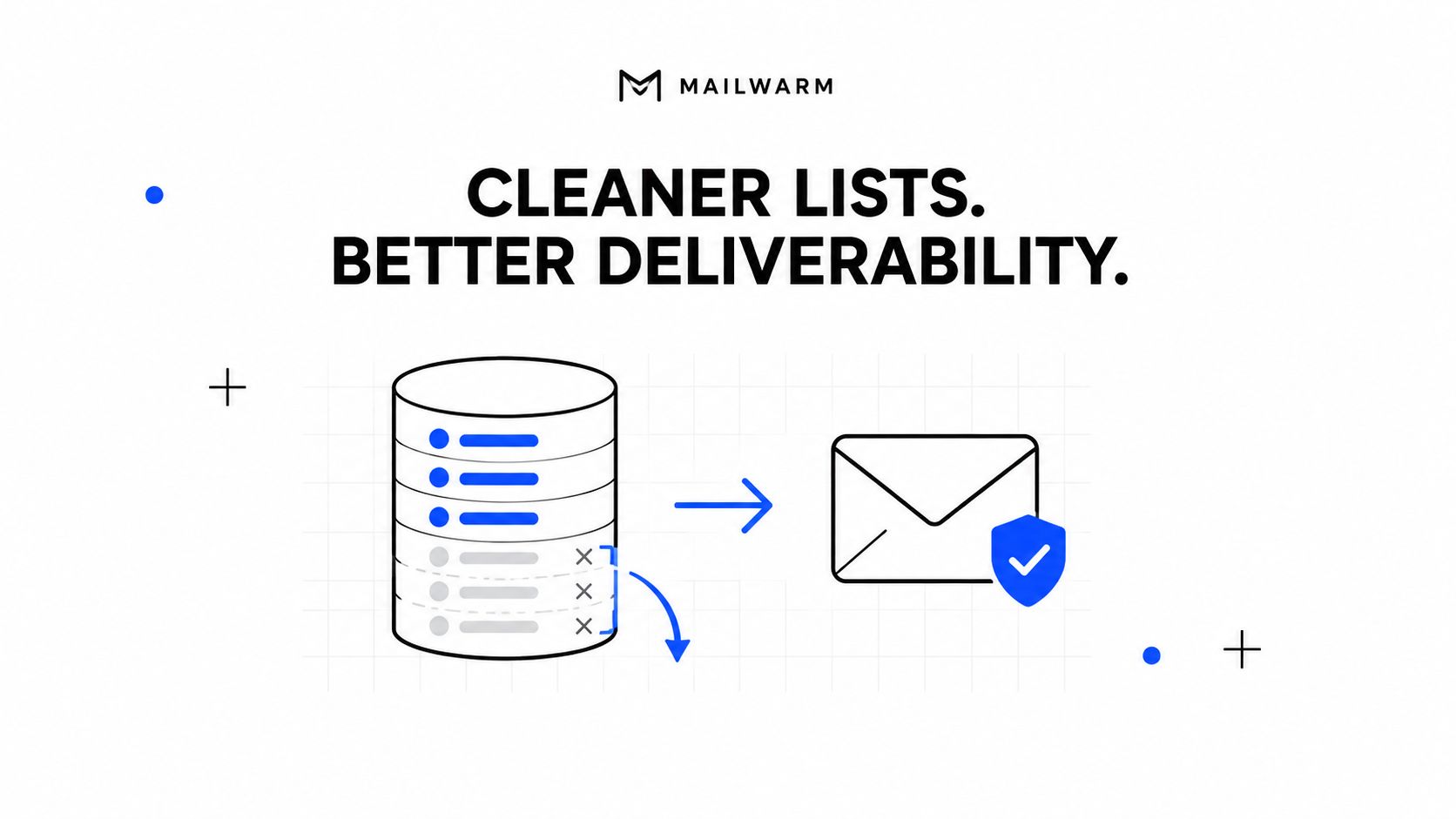
List hygiene directly protects sender reputation. Invalid addresses, abandoned contacts, and recipients without clear consent generate bounces and complaints. Providers use those signals when evaluating later campaigns, including messages sent to people who want them.
A 2025 Mailgun survey found that only 60% of senders regularly conducted list hygiene, while 24% had a sunset policy. It also reported that 9.4% admitted buying or scraping lists during the prior two years. Mailgun's State of Email Deliverability research
Build consent and suppression into the workflow
Double opt-in gives subscribers a clearer confirmation step than single opt-in. Nearly 40% of senders used double opt-in, according to the same survey. Acquisition controls and ongoing maintenance must work together, because a clean-up process cannot repair weak consent after the fact.
A practical list process should include:
- Confirm new addresses: Use double opt-in when the business model and audience support it.
- Suppress hard bounces: Stop retrying addresses that have permanently failed.
- Process unsubscribes quickly: Make opting out clear and technically reliable.
- Separate inactive contacts: Remove disengaged recipients from regular campaigns.
- Review complaints by source: Trace spikes to a form, partner, campaign, or sequence, then fix that source.
Buying or scraping lists creates a poor expectation match. Recipients did not clearly agree to receive the message, so the resulting complaints can affect delivery to the rest of the database.
Use engagement to decide who should receive mail
A sunset policy sets the point at which an unresponsive contact leaves regular campaigns. It can start with a re-engagement message, followed by suppression if the recipient remains inactive.
Cold email and newsletters need different engagement rules. Sales teams should limit outreach to relevant prospects, control sequence frequency, and stop contacting people who show negative signals. Newsletter teams should set clear subscription expectations, offer preference controls, and segment by engagement.
Use spam score monitoring, bounce prevention, and inbox placement data to decide whether to continue, pause, or suppress a segment. List size is a weak success metric if recipients do not recognize the sender or have a reason to respond. Consistent delivery depends on mailing people who gave permission and continue to show meaningful interest.
Adapt Your Strategy for Gmail Outlook and Yahoo
Provider-level deliverability requires separate reporting and separate corrective actions. Gmail's benchmarked inbox placement was about 87.2%, compared with about 75.6% for Outlook and Hotmail. Outlook and Hotmail also showed a spam rate near 14.6% in the cited 2025 data. MailerToGo's provider comparison
That gap changes troubleshooting priorities. If Gmail performs well while Outlook does not, rewriting every campaign may waste time. Inspect Microsoft-specific complaints, bounces, authentication results, sending patterns, and recipient engagement instead.
Provider Deliverability Requirements Compared
| Provider | Inbox Placement Benchmark | Key Requirement | Monitoring Focus |
|---|---|---|---|
| Gmail | About 87.2% in 2025 benchmark data | Bulk senders should use SPF, DKIM, and DMARC | Authentication, complaints, inbox placement, unsubscribe handling |
| Outlook and Hotmail | About 75.6% in 2025 benchmark data | Authenticated, RFC-compliant sending and reputation control | Spam placement, bounces, complaints, domain and sending-source behavior |
| Yahoo | Provider performance varies by ecosystem | Valid forward and reverse DNS, authenticated mail, RFC-compliant sending | DNS validity, authentication, complaints, placement, unsubscribe behavior |
Google and Yahoo bulk-sender requirements are commonly summarized as applying to senders exceeding 5,000 messages per day, with strong authentication and a spam complaint rate commonly cited below 0.3%. Cisco's email authentication guidance
Build a playbook for each ecosystem
For Gmail, verify authentication alignment and review complaint signals in Google Postmaster Tools. Opens provide limited direction on their own. Authentication status, negative feedback, and inbox placement show whether Gmail trusts the sending identity.
For Outlook and Hotmail, report results separately from Gmail. Break out bounces and spam placement by Microsoft mailbox, then test whether volume, domain alignment, or recipient relevance is producing the provider-specific decline.
For Yahoo, validate forward and reverse DNS together with SPF, DKIM, and DMARC. DNS errors can undermine delivery even when the visible authentication checks appear complete.
Every bulk program needs a clear unsubscribe path. One-click unsubscribe gives uninterested recipients a direct exit, reducing the chance that they use spam reporting instead.
Founders planning outreach can review resources that help them contact angel investors easily. Keep prospect relevance and consent expectations visible during list building. Provider reporting should match where the audience reads mail, not the mailbox provider used by the sending team.
Use Warmup Monitoring and Expert Guidance to Stay Inboxed
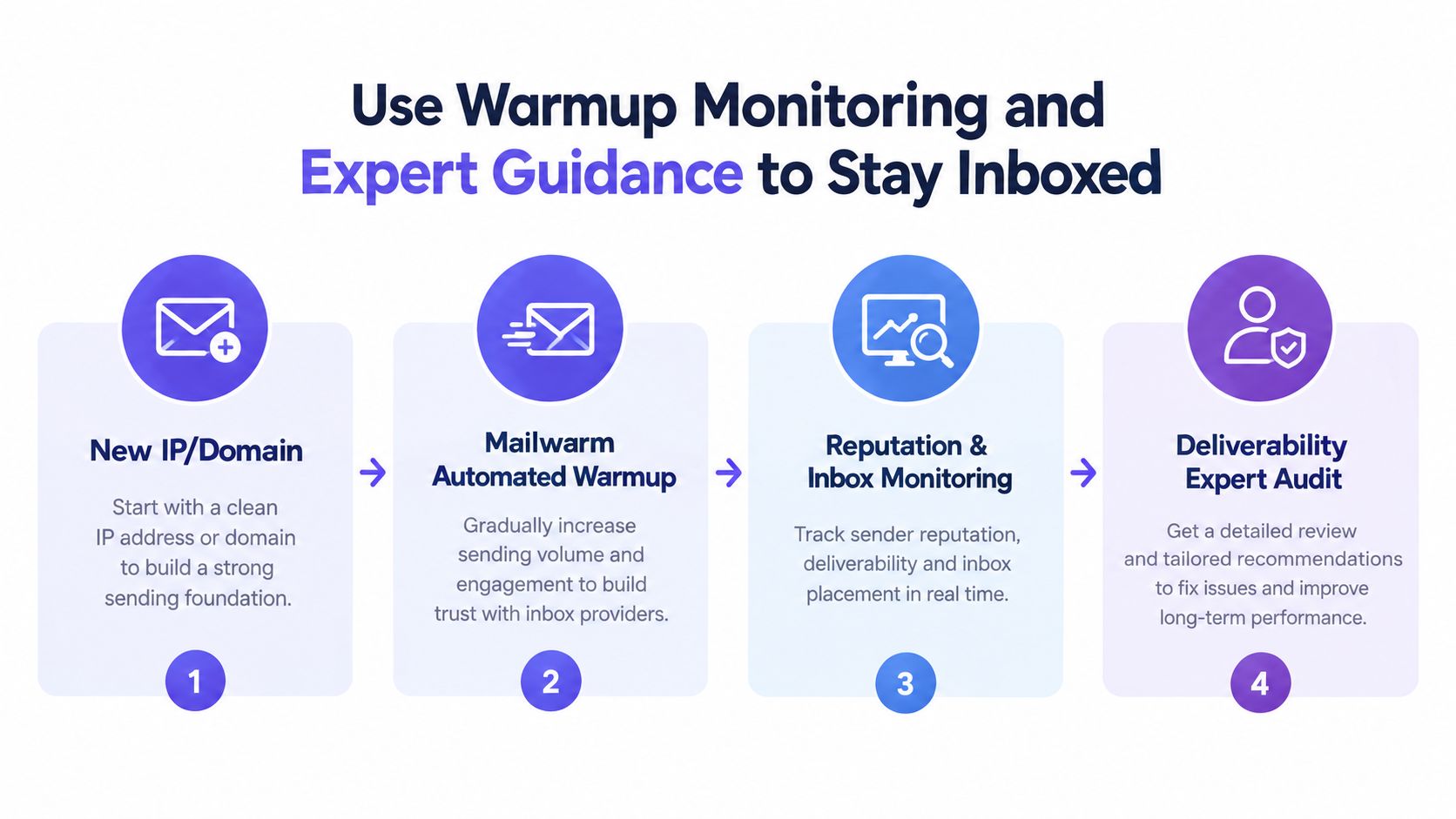
Warmup works best as a controlled reputation activity, not as a substitute for authentication or list hygiene. A sender with valid DNS, clean contacts, low complaint activity, and consistent volume has a foundation that warmup can support. A sender with poor acquisition practices shouldn't expect automated interactions to erase those problems.
TrulyInbox reports a progression from approximately 73% to 79% inbox placement with SPF only to approximately 85% to 95% with enforced SPF, DKIM, and DMARC, while describing the fully authenticated range as roughly 2.7 times higher than unauthenticated sending in its cited benchmark. TrulyInbox authentication and deliverability guidance
Measure warmup as part of a broader system
A useful workflow connects activity to outcomes:
- Warmup activity: Monitor sending and engagement patterns across relevant providers.
- Inbox placement: Check whether messages reach inboxes or spam folders.
- Reputation signals: Review bounces, complaints, spam scores, and authentication status.
- Sending decisions: Adjust volume, targeting, content, and provider mix based on evidence.
- Expert review: Escalate persistent or provider-specific issues before scaling further.
Mailwarm is a premium email warmup and deliverability platform that uses 50,000+ aged real inboxes across Gmail, Outlook, Microsoft 365, Yahoo, and SMTP providers. Its engagement signals include opens, replies, threads, spam removal, and important marking, with up to 100% replies to warmup emails depending on the plan. The platform also provides provider-level warmup, custom email content warmup, spam score monitoring, inbox placement insights, authentication fix tools, bounce prevention, and deliverability analytics.
Choose tools based on the problem
Basic warmup tools may exchange automated messages, but teams managing several providers need more visibility than activity counts. A platform should help answer whether reputation is improving, which mailbox ecosystem is struggling, and whether authentication or list behavior is creating the issue.
Teams evaluating the best email warmup tools should compare:
| Requirement | Basic warmup approach | Broader deliverability approach |
|---|---|---|
| Engagement | Automated message exchange | Opens, replies, threads, spam removal, and important marking |
| Provider control | Generic activity | Provider-level warmup |
| Diagnosis | Limited activity reporting | Spam score and inbox placement insights |
| Security | May require mailbox access | No IMAP access required and no permission to read a private inbox |
| Guidance | Self-service dashboard | Expert deliverability calls included in every plan |
Mailwarm's higher price reflects the combination of real inbox engagement, monitoring, authentication tools, reputation protection, and expert guidance. That positioning suits teams treating email as a serious growth channel rather than seeking the lowest-cost warmup activity.
Putting Email Deliverability Best Practices Into Action
Treat deliverability as a recurring operating process, not a one-time warmup task. Start with this sequence:
- Audit identity: Confirm SPF, DKIM, DMARC alignment, forward and reverse DNS, and SPF lookup usage.
- Enforce protection: Move DMARC from monitoring toward quarantine and reject after verifying legitimate sending sources.
- Control the audience: Collect valid consent, suppress hard bounces, process unsubscribes, and maintain a sunset policy.
- Separate providers: Review Gmail, Outlook, Yahoo, and enterprise results independently.
- Monitor behavior: Track inbox placement, complaints, bounces, spam scores, and engagement.
- Use guided warmup: Add provider-level warmup and expert review when a domain or mailbox needs reputation support.
Schedule audits regularly, then repeat them after changes to sending platforms, domains, authentication, lists, or campaign strategy. Google Postmaster Tools remains underused among senders, so add it to the monitoring workflow where applicable.
What are the most important deliverability best practices?
Prioritize complete authentication, permission-based lists, complaint and bounce control, consistent sending, and provider-level monitoring. Warmup can support reputation building, but it does not replace compliance, relevant messaging, or list hygiene.
How often should teams audit deliverability?
Monitor key signals continuously and run structured audits regularly. Repeat a full audit after a domain change, new sending provider, authentication update, sudden bounce increase, or provider-specific placement drop.
Do best practices differ for cold email versus newsletters?
Yes. Cold email requires tight targeting, controlled volume, and prompt suppression of nonresponsive or negative contacts. Newsletters require clear consent, preference management, segmentation, and a reliable process for removing inactive subscribers.
Before scaling a campaign, teams can check if your domain is blacklisted, verify authentication, test placement by provider, and confirm that the intended audience remains engaged. Inbox placement improves when teams manage each provider's reputation and compliance signals as ongoing operational work.
If email supports your growth strategy, Mailwarm provides real inbox engagement, provider-level warmup, authentication tools, inbox placement monitoring, spam-risk monitoring, and expert deliverability calls. Use those workflows to review sending readiness before the next campaign scales.