
In 2026, recruiter-written one-off emails produced a 6.31% reply rate, compared with 4.96% for automated recruiting emails, and 93.2% of replies arrived within the first three touches. An effective email to recruiters is short, specific, personalized to the recruiter's hiring context, and built around one clear next step.
A relevant candidate, open role, or partnership can still be ignored when the message sounds generic, vague, or difficult to answer. Recruiters scan quickly, so the subject line must establish relevance, the body must show why the contact makes sense, and the close must offer a simple response.
The eight examples below cover the relationship stages that matter in practice, from first contact and follow-up to collaboration, feedback, urgency, and post-placement referrals. They also address subject-line clarity, useful personalization, concise proof, and sender reputation. Mailwarm helps senders build reputation, monitor inbox placement, and improve deliverability through real inbox engagement, advanced warmup controls, and expert guidance.
1. Initial cold outreach email to a recruiter
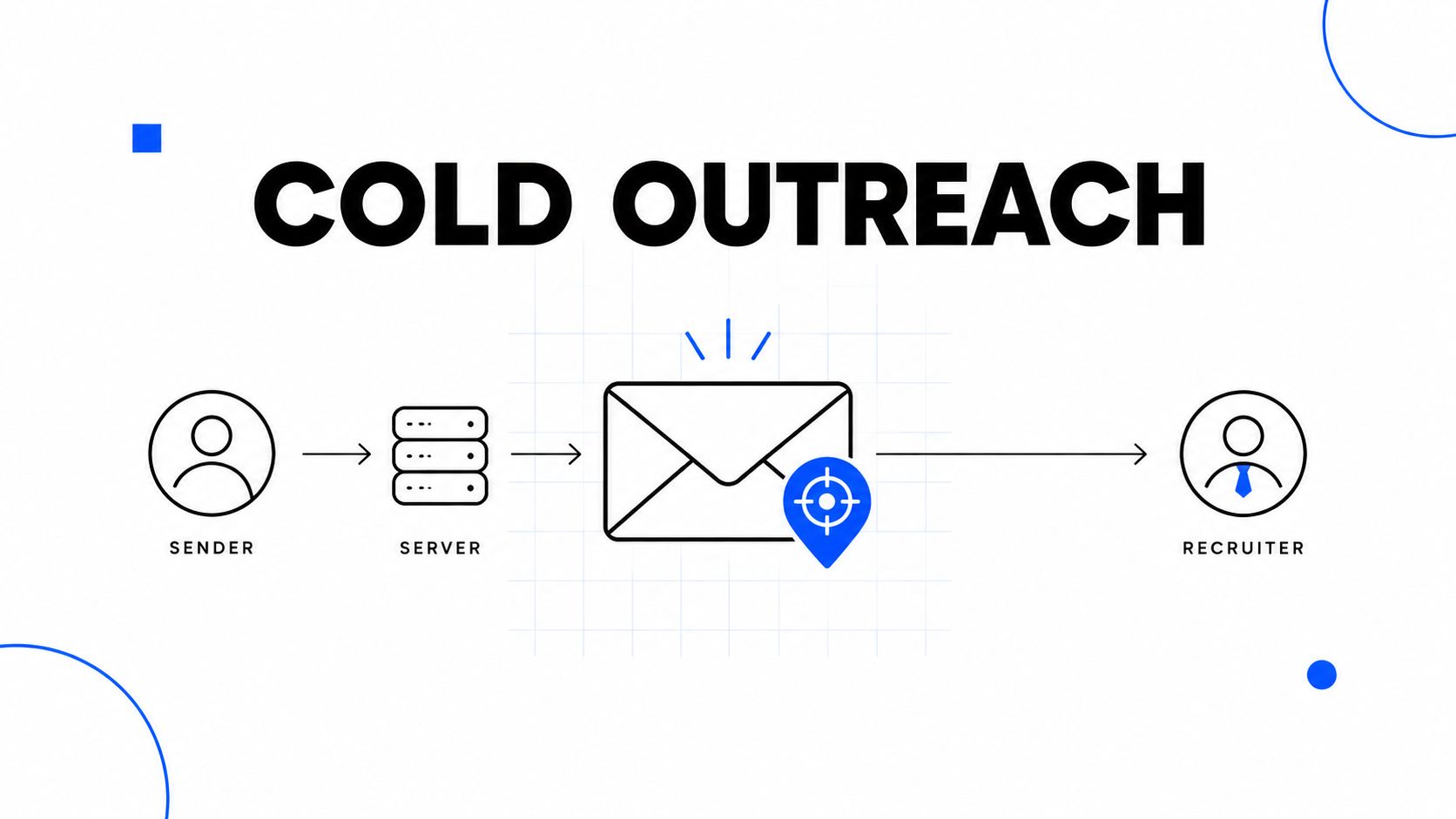
A recruiter opens a cold message between active searches, interviews, and client updates. The first line must therefore connect to a real hiring need, not explain an entire agency or candidate history.
Start with the role, company priority, or candidate profile that makes the contact relevant. “Senior platform engineer for your new infrastructure team” gives a SaaS recruiter a reason to read. “Potential partnership opportunity” does not.
Use a specific subject and a small ask
Subject lines can name the company, role, key skill, or genuine mutual connection. ZoomInfo's recruiting email guidance recommends keeping them under 50 characters, a useful limit for quick scanning.
A practical template looks like this:
Subject: Two backend candidates for [Company]
Hi [Recruiter name],
[Specific observation about the company, open role, or recent hiring activity].
[Candidate or sender] has [relevant experience] and matches [two role requirements]. The short profile is below: [one-sentence proof].
Would a 15-minute call on [day] or [day] be useful to see whether there's a fit?
Best,
[Name]
The personalization should show that the sender understands the recruiter's work. Refer to a current vacancy, recent placement, public team expansion, or the recruiter's specialty. Reuse the structure across contacts if needed, but change the reason for reaching out and the proof of relevance.
The next step should take little effort. Ask for a short call, permission to send a profile, or confirmation that the role remains active. Avoid asking the recruiter to assess an entire service before replying.
Protect the first touch
Before sending a campaign through multiple mailboxes or domains, warm up the sending domain. Tools like Mailwarm use real engagement signals and placement monitoring to support this preparation.
The guide to best email warmup tools can help teams compare basic sending activity with broader deliverability controls. Keep the first message clean: avoid attachments, excessive links, inflated claims, and vague subjects such as “Exciting opportunity.” A plain-text note with one clear request is easier to assess and less likely to create delivery concerns.
2. Follow-up email after no initial response
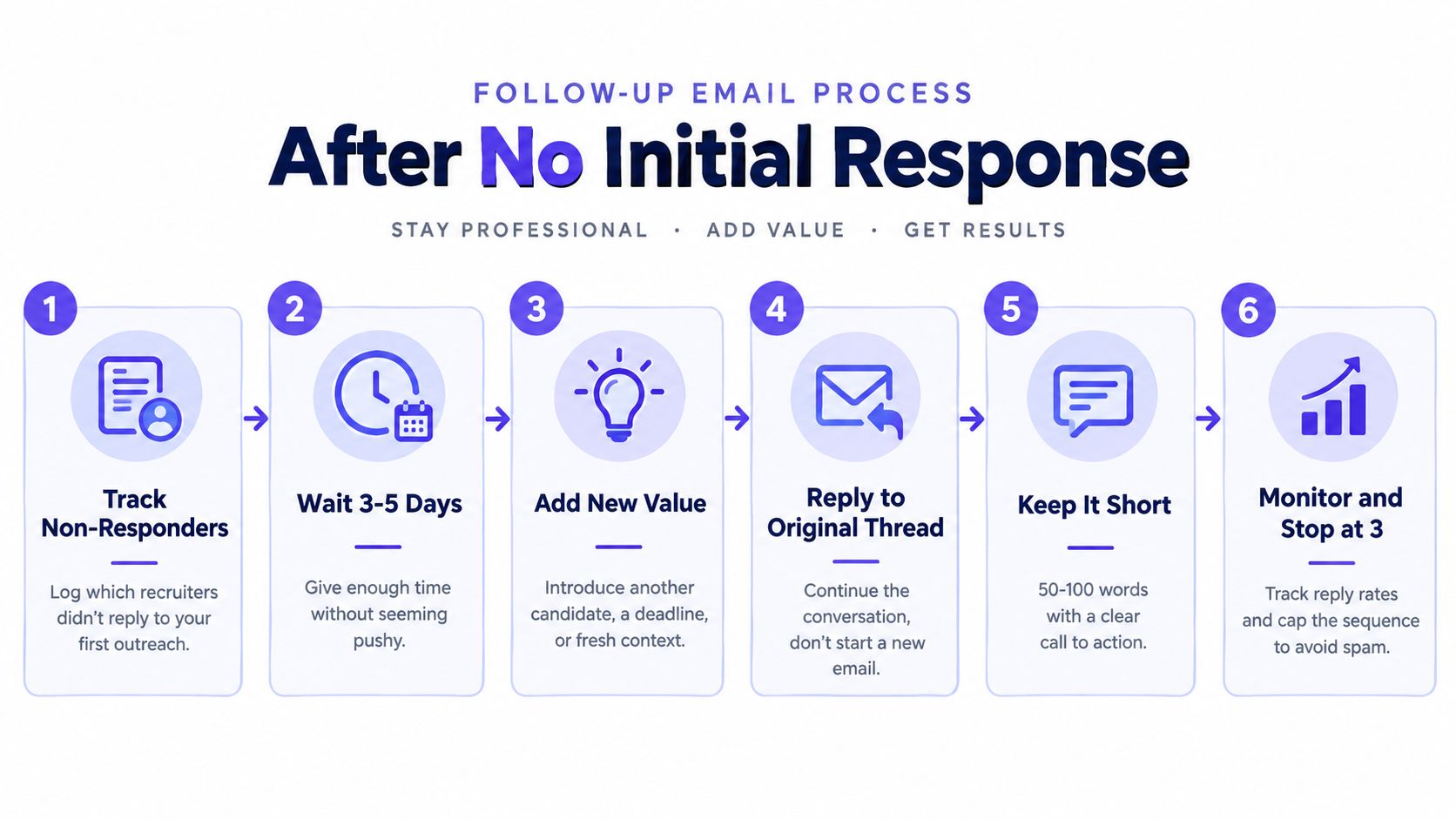
No reply doesn't always mean no interest. The recruiter may have been busy, the role may have changed, or the first message may have arrived at an inconvenient time. A follow-up works when it adds a reason to reconsider rather than repeating the same pitch.
Gem's recruiting outreach data found that the first email generated an 8.3% reply rate, cumulative replies reached 15.8% by the second email, and reached 21.3% by the third. These figures come from the Gem recruiting email benchmark, and they support a short sequence instead of a single send.
Add information, not pressure
A useful follow-up might read:
Subject: Re: [Role] at [Company]
Hi [Name],
A second candidate has become available with [specific skill or relevant background], so the match may be stronger than the profile in the first note. Is this role still active, or should the information go to someone else on the team?
Best,
[Name]
The personalization should relate to the recruiter's hiring context. Mention a new candidate, a changed availability window, a recently clarified requirement, or a relevant placement. Don't manufacture urgency, claim that a candidate has other offers when that isn't true, or use a follow-up as an excuse to resend the original paragraph.
A reply to the original thread keeps context visible and reduces friction. The sender should monitor whether messages are reaching the inbox, because low engagement can reflect deliverability problems rather than weak relevance. Before scaling messages through a new technical setup, teams may need to warm up an SMTP server.
Know when to stop
The benchmark evidence points to strong early returns from the first few touches. A practical sequence can include the initial message, a concise follow-up with new information, and a final permission-based close. After that, continuing to send the same offer risks damaging the relationship and the sender's reputation.
The next step should be easy to answer. Ask whether the role is active, whether the recruiter owns it, or whether another contact is more appropriate. A simple routing question often performs better than another paragraph of persuasion.
3. Value-add follow-up with a candidate or case study reference
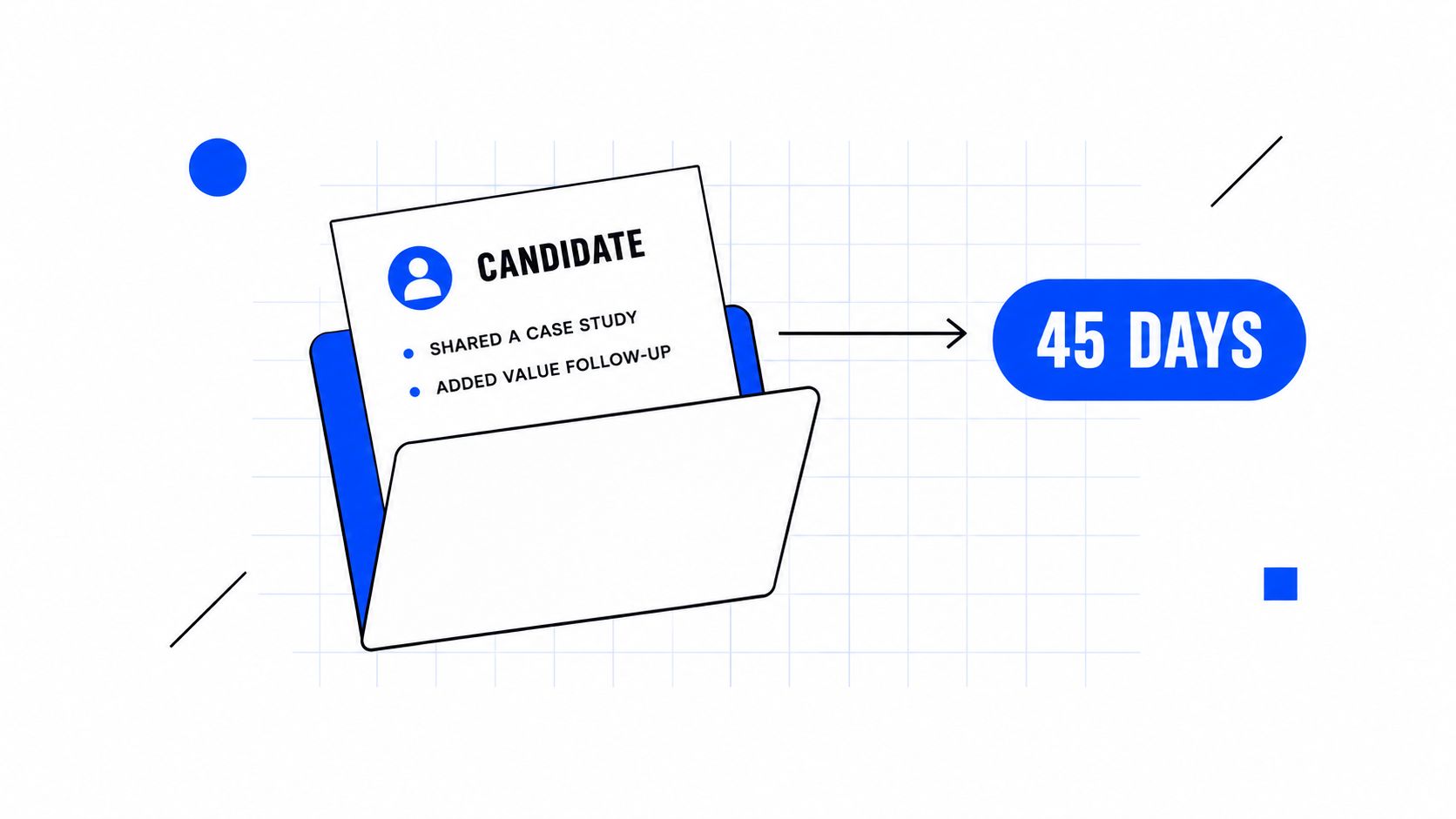
A value-add message changes the relationship from “please consider this offer” to “this information may help with a hiring problem.” That shift is useful when the recruiter is actively hiring but hasn't engaged with earlier outreach.
The sender should lead with a closely matched candidate profile, an anonymized placement example, or a concise observation about the role. The proof must be relevant, not decorative. A recruiter filling infrastructure roles doesn't need a general agency success story about administrative hiring.
Show the match inside the email
A practical example:
Subject: DevOps profile for [Company]’s platform role
Hi [Name],
The platform role mentions Kubernetes operations and cloud cost control. A candidate in the attached summary has led Kubernetes migrations, managed production reliability, and worked in a similar growth-stage environment.
The profile is included below so there's no need to open another page. If the requirements are close, would a brief introduction help?
Best,
[Name]
The personalization cues should include the recruiter's company stage, role requirements, team structure, or hiring challenge. A case study can remain anonymous, but it should still explain the industry, role type, and problem solved. Unsupported performance claims weaken trust, so the sender should use only verified internal evidence and describe the outcome plainly.
The first screen should contain enough detail to assess fit:
- Relevant capability: Name the skill that maps directly to the vacancy.
- Level and environment: Explain seniority and comparable company context.
- Availability: State when an introduction is practical.
- Next step: Ask whether the recruiter wants the full profile or an introduction.
Check the message before sending
An email spam checker can help identify risky wording or content before a recruiter campaign expands. The sender should also avoid loading the email with multiple links, oversized attachments, tracking elements, or promotional language.
Practical rule: Give the recruiter enough evidence to make a first judgment without forcing a download, form fill, or research session.
The concrete next step can be permission to forward the full candidate profile. If the recruiter says yes, the sender has earned a more detailed conversation. If not, the message still leaves behind useful proof instead of another unanswered request.
4. Recruiter-to-recruiter collaboration email
Recruiter collaboration fails when both sides discuss “partnership” without defining the opportunity. A better message identifies a specific role, candidate profile, market, or client need and makes the mutual benefit clear.
This format suits agency recruiters, staffing firms, and internal teams that need access to talent or roles outside their immediate network. The first email shouldn't attempt to negotiate every term, but it should surface the issues that could create conflict later.
Make the commercial context visible
A collaboration message might say:
Subject: Collaboration on senior engineering searches
Hi [Name],
Your focus on senior engineering placements in Austin looks complementary to our network in New York. There's a current senior platform engineering profile that may fit one of your searches, and the team can support sourcing if you have a role that matches.
Would a short call be useful to discuss candidate ownership, process, and a workable fee split?
Best,
[Name]
Personalization should reflect the other recruiter's specialty, geography, contract model, or recent placement activity. A sender offering finance candidates should not approach a recruiter without showing a relevant finance connection. A sender proposing a co-placement should name the role type and explain what each side brings.
The sender should clarify the principles early:
- Candidate ownership: Define who manages the relationship after introduction.
- Process: Agree on interview coordination, feedback, and client communication.
- Commercial terms: Put the proposed fee-sharing model in writing before submitting a candidate.
- Compliance: Confirm applicable screening, data protection, and employment requirements.
The email can point to external context on recruiting and sourcing data API when data access is part of the proposed workflow, but the message should remain focused on the immediate collaboration.
Keep deliverability and trust aligned
A collaboration email should use a real sender identity, a professional signature, and a subject that names the opportunity. It shouldn't contain a long sales deck or an unexplained candidate attachment. After the call, send a written summary of ownership, timelines, responsibilities, and fees.
The concrete next step is a short exploratory conversation. If both recruiters can't explain the role, responsibilities, and commercial logic in that conversation, the partnership probably isn't ready for a candidate introduction.

5. Recruiter feedback request email after rejection or no-hire
A failed placement can either end a relationship or improve the next search. The difference often comes down to the quality of the feedback request. “What went wrong?” invites a defensive answer. Specific, neutral questions produce more useful information.
The message should arrive soon after the decision, while the details are still available. It must thank the recruiter, avoid excuses, and ask for insight that can improve candidate selection.
Ask questions the recruiter can answer
A concise example:
Subject: Feedback on [Candidate] for [Role]
Hi [Name],
Thanks for considering [Candidate] and for the feedback shared so far. To improve the next shortlist, was the main gap technical depth, communication style, level, or team fit? If compensation expectations were outside the range, should future profiles target a different band?
Best,
[Name]
The personalization comes from the actual stage where the candidate exited. A technical-screen rejection calls for a different question from an offer decline. The sender can also refer to a requirement that appeared ambiguous, but shouldn't argue with the decision or imply that the recruiter made a mistake.
A useful response may clarify:
- Skill gap: Which capability was missing or insufficiently demonstrated?
- Level mismatch: Was the candidate too senior, too junior, or misaligned with scope?
- Communication fit: Did the interview style create concern?
- Offer context: Did compensation, location, timing, or competing priorities affect the outcome?
Specific questions create better sourcing data than general requests for feedback.
The sender should use the answer to refine future outreach. If the recruiter says the team needs deeper cloud security experience, the next email can explicitly lead with that requirement. This turns a no-hire into evidence of better fit.
The concrete next step is a brief reply with one or two reasons. The request should remain easy to answer, and the sender should accept the feedback without making the recruiter defend it.
6. Recruiter introduction and relationship-building email
Not every email to recruiters should ask for a role, candidate review, or meeting. A relationship-building message can create familiarity before a relevant opportunity appears, especially when the sender has a genuine market observation to share.
The message should be useful without pretending to be a neutral industry report. A recruiter who is scaling an engineering team may appreciate a specific observation about candidate availability, interview friction, or a recurring skill gap, provided the sender can explain why the observation is relevant.
Lead with context, not a pitch
A soft introduction could read:
Subject: Noticed your engineering hiring
Hi [Name],
The recent engineering roles at [Company] suggest the team is expanding beyond product development into platform work. That shift often changes the candidate profile, especially around production ownership and cloud operations.
The sender works with candidates in that area and wanted to introduce the firm before a relevant search appears. If useful, the company profile is available here: [LinkedIn link].
Best,
[Name]
The personalization cue should be something the recruiter can recognize as real: a current hiring pattern, a new office, a product expansion, or a repeated role requirement. “The sender helps companies hire faster” is generic. “The role mix has shifted toward platform ownership” is specific and gives the recipient something to react to.
Build recognition without forcing a meeting
The first message can end with permission to stay connected rather than a calendar request. A later touch should share another relevant observation, not resend a service pitch. Mailwarm's real inbox engagement, provider-level warmup, spam score monitoring, and expert deliverability guidance can help relationship messages reach the inbox instead of being lost in spam.
The sender should use a clear identity, a normal signature, and limited links. A relationship email is especially sensitive to deliverability because it has no immediate transactional reason to be opened. If the message arrives from an unfamiliar domain and contains several sales links, the recruiter may dismiss it before evaluating the content.
The next step is deliberately low friction. Invite the recruiter to connect on LinkedIn, confirm the hiring focus, or keep the sender in mind for a future role. That preserves the relationship without forcing a meeting before there is a practical reason.
7. Urgent candidate placement or hot opportunity email
Urgency works only when the time constraint is real. If every candidate is “hot,” recruiters quickly learn to treat the label as noise. A credible urgent email explains what is changing, why the recruiter needs to act, and what can happen next.
The message should put the match in the first lines. A recruiter shouldn't need to read a long introduction before seeing the candidate's key skills and the relevant role.
State the deadline and the fit
A practical template:
Subject: Senior engineer available before Friday
Hi [Name],
A senior platform engineer is available for [Company]’s open role and has direct experience with [skill one], [skill two], and [skill three]. The candidate is making a decision by Friday, so an initial review would need to happen before then.
Would a one-page profile today help determine whether an introduction makes sense?
Best,
[Name]
Personalization should connect three to five qualifications to the recruiter's actual role, not repeat the complete job description. The sender should name the candidate when appropriate and permitted, or use “candidate” until the recruiter confirms interest. The deadline should explain whether it comes from another offer, a closing requisition, interview scheduling, or a client decision.
Keep urgency professional
Avoid all caps, multiple exclamation marks, and dramatic phrases such as “act now.” A realistic timeline is more persuasive than hype. The sender should have the candidate summary ready and should respond quickly if the recruiter asks for more information.
The deliverability caution is important because urgent messages often include attachments, links, and compressed detail. Keep the first email plain, concise, and easy to authenticate. Mailwarm supports sender reputation work through real inbox engagement, inbox placement insights, bounce prevention, authentication fix tools, and provider-level warmup.
The concrete next step should be specific, such as reviewing a one-page profile or confirming a screening slot. If there is no reply, one same-day follow-up can restate the actual deadline without escalating the language. The outcome also provides useful process information. A recruiter who can't respond during genuine time-sensitive searches may not be the right channel for future urgent placements.
8. Post-placement thank-you and referral request email
The placement close is not the end of recruiter communication. A short thank-you message confirms that the sender values the relationship, recognizes the shared result, and creates a natural opening for future work.
The tone should be warm but restrained. The message isn't a disguised sales pitch, and the referral request should feel like an invitation rather than a demand.
Celebrate the result before asking
A practical example:
Subject: Thank you for the [Role] partnership
Hi [Name],
Thank you for the thoughtful coordination throughout [Candidate name]’s placement as [Role] at [Company]. The process stayed clear and responsive, and the candidate is pleased to be joining the team.
If another role or candidate comes up that fits the network, the sender would be glad to explore it. Please also reach out if any support is useful during the transition.
Best,
[Name]
The personalization should include the candidate's name, new role, company, and a genuine positive detail if one is available. The sender can mention strong early feedback, but shouldn't invent praise or claim an outcome that hasn't been confirmed.
The email should remain short and easy to forward. A recruiter may share it internally with a hiring manager, so the language should be professional and specific. The sender can offer continued support with onboarding questions, candidate feedback, or future searches, but shouldn't turn the thank-you into a catalogue of services.
Ask for the next opportunity gently
A referral request works best when it follows appreciation and shared success. “If another role or candidate comes up that fits, please keep the sender in mind” creates a clear opening without demanding immediate pipeline information.
The deliverability caution is simple: send from the same recognizable address used during the placement, use a direct subject line, and avoid adding unnecessary promotional links. A familiar sender and relevant context support recognition, while a sudden marketing-style email can weaken the relationship.
The concrete next step is to keep the channel open. The recruiter can reply with a future role, a candidate need, or a request for support. The sender should record the relationship context and follow up only when there is something relevant to share.
8 Recruiter Email Types Comparison
| Template | Implementation complexity | Resource requirements | Expected outcomes | Ideal use cases | Key advantages |
|---|---|---|---|---|---|
| Initial Cold Outreach Email to Recruiter | Low–Medium: straightforward template creation and personalization | Basic research, email warmup (sender reputation), scalable template system | Low initial reply rate; foundation for follow-ups and testing | First-touch with new recruiters or cold prospecting at target companies | Scalable, easy to personalize, establishes initial credibility |
| Follow-Up Email After No Initial Response | Medium: timing and tracking required | CRM/tracking, short fresh content, thread-reply practice | Significantly higher reply rate than single touch when timed well | Re-engaging non-responders 3–7 days after first outreach | Increases engagement without being pushy; resurfaces prior outreach |
| Value-Add Follow-Up with Candidate or Case Study Reference | Medium–High: needs curated content and relevance matching | Case-study/candidate library, metrics, deeper research per recipient | Higher engagement and trust; better conversion for active hiring roles | Recruiters actively hiring who need proof of success or specific candidates | Demonstrates credibility and results; builds trust through evidence |
| Recruiter-to-Recruiter Collaboration Email | Medium: requires clear terms and negotiation readiness | Defined fee structures, agreement templates, research on partner specialties | Access to broader talent pools and joint placements if aligned | Agencies or in-house teams seeking referrals, co-placements, or partnerships | Expands reach and creates recurring placement opportunities; mutual benefit |
| Recruiter Feedback Request Email After Rejection or No-Hire | Low: brief, targeted follow-up | Timing rules, ability to log and act on feedback | Actionable intelligence to improve sourcing and preserve relationships | After candidate rejection, failed offer, or late-stage fall-through | Gathers insights for improvement; shows professionalism and learning orientation |
| Recruiter Introduction and Relationship-Building Email | Low: soft-touch, low-pressure outreach | Market insight or resource to share, sender warmup, ongoing touch plan | Slow-burn relationship growth and improved brand recognition over time | Building long-term relationships with target or niche-market recruiters | Low-risk approach that positions sender as a helpful resource, not a seller |
| Urgent Candidate Placement or "Hot" Opportunity Email to Recruiter | Medium–High: must be accurate and fast | Up-to-date candidate summaries, rapid follow-up capability, clear deadlines | Faster decision-making and potential rapid placements | Time-sensitive roles or candidates with competing offers | Drives quick action and higher response rates when urgency is genuine |
| Post-Placement Thank You and Referral Request Email | Low: simple, timely follow-up after success | Tracking of placements, short personalized note, referral ask | Strengthened relationships and increased chance of referrals/repeat business | After confirmed successful placement or candidate start | Reinforces goodwill, encourages referrals, positions you for repeat work |
Make every recruiter email easy to answer
A strong email to recruiters doesn't depend on a clever template alone. It depends on whether the recipient can understand the purpose, judge the relevance, and respond without doing unnecessary work.
Before sending, check five elements:
- One clear purpose: Decide whether the message introduces a candidate, requests feedback, proposes collaboration, shares an opportunity, or thanks the recruiter.
- A specific subject line: Reference the role, company, skill, candidate, or real relationship context. Avoid vague phrases that could apply to anyone.
- Relevant personalization: Show why this recruiter, this company, and this hiring situation make sense. Personalization should change the substance, not just insert a first name.
- Concise proof: Include the experience, candidate detail, market observation, or result that supports the message. The recruiter shouldn't have to open several links to understand the fit.
- A low-friction next step: Ask for one action, such as confirming ownership, reviewing a profile, answering a specific question, or choosing a short call.
The benchmarks point to the value of disciplined early follow-up. Pin's 2026 dataset covered more than 4,000,000 messages sent through more than 1,500 recruiting organizations, with automated recruiting emails producing a 4.96% reply rate and recruiter-written one-off emails producing a 6.31% reply rate. The same dataset found that 93.2% of replies arrived within the first three touches. See the Pin recruiting outreach benchmark report for the full context.
This doesn't mean every sender should copy one fixed sequence. A candidate introduction, collaboration proposal, urgent placement, and post-placement thank-you each need different timing and tone. It does mean that the first message and early follow-ups deserve the most attention, because long, repetitive sequences rarely rescue weak targeting.
Personalization also has limits. A carefully researched sentence won't compensate for the wrong recruiter, an inactive vacancy, a poor role match, or messages that land in spam. Deliverability, targeting, and relevance work together. If a sender measures only replies, a low result may reflect any of those problems.
Sender reputation should be protected before outreach is scaled. Mailwarm goes beyond basic warmup by combining warmup automation, real inbox engagement, spam score monitoring, inbox placement insights, authentication fix tools, bounce prevention, provider-level controls, and expert deliverability guidance. It doesn't require IMAP access or permission to read a private inbox, which makes it suitable for teams that want stronger controls without intrusive mailbox access.
Teams can also connect recruiter outreach with tools such as AIApply when they need help organizing job-search or application workflows. The technology matters less than the operating discipline: send relevant messages, use honest urgency, stop when the relationship signals disinterest, and learn from every reply.
For a practical final review, ask whether the recipient can answer the email in one sentence. If the answer is no, remove detail, clarify the request, or replace the generic opening with a fact that proves the message belongs in that recruiter's inbox.
If email is part of your growth strategy, Mailwarm helps you build sender reputation, monitor inbox placement, and reduce spam risk with expert-guided warmup.
FAQ
What makes an email to recruiters effective?
An effective message is short, specific, personalized to the recruiter's hiring context, and built around one clear next step. It should explain the relevant role, candidate, collaboration, or relationship reason without forcing the recruiter to research the sender.
Should a recruiter email include a follow-up?
Yes, a relevant follow-up can recover attention when it adds new information or clarifies the request. The follow-up should stay in context, avoid pressure, and stop when the sequence no longer adds value.
How specific should the subject line be?
The subject line should identify the role, company, candidate, skill, or genuine connection. A recruiting guide recommends keeping subject lines under 50 characters so they remain easy to scan and search, as explained in ZoomInfo's subject-line guidance.
Is personalization enough to improve recruiter replies?
No. Personalization helps only when it reflects a real hiring context and a relevant offer. Contact quality, role-market fit, deliverability, timing, and the clarity of the next step can matter just as much.
Why do recruiter emails go to spam?
Messages can be filtered because of weak sender reputation, authentication problems, risky content, excessive links, poor engagement, or sending patterns that resemble unwanted bulk mail. A deliverability platform can help monitor spam signals, inbox placement, authentication, and bounce risk.
How does Mailwarm help with recruiter outreach?
Mailwarm helps senders build reputation through real engagement signals from 50,000+ aged real inboxes, provider-level warmup, inbox placement insights, spam score monitoring, authentication tools, bounce prevention, and deliverability analytics. Depending on the plan, it can generate up to 100% replies to warmup emails, and every plan includes expert deliverability guidance calls.
Does Mailwarm need access to a private inbox?
No. Mailwarm doesn't require IMAP access or permission to read a user's private inbox. The platform is designed to provide warmup and deliverability controls without intrusive mailbox access.
Is email warmup enough to fix deliverability?
No. Warmup is one part of deliverability management. Senders also need accurate authentication, valid addresses, controlled volume, relevant content, bounce prevention, inbox placement monitoring, and appropriate targeting.
Mailwarm helps recruiter outreach reach the inbox through real engagement, provider-level warmup, inbox placement insights, spam monitoring, authentication tools, and expert guidance. Visit Mailwarm to prepare sender reputation before scaling an email to recruiters and other outbound campaigns.