
Why professional email sign-offs matter in business communication and deliverability
Professional email sign-offs do much more than simply conclude your message, they set the tone, foster trust, and guide what happens next. A strong sign-off reduces uncertainty about your identity and the appropriate way to respond. When teams maintain consistency with closings, recipients more easily recognize your brand and are more likely to reply promptly. Email filters analyze both the structure and content of a message, so well-structured, concise endings contribute to the legitimacy of your message, supporting credibility and ultimately improving deliverability.
Think of your sign-off as the final handshake in your business communication. It should reflect the relationship, clarify your objective, and respect the context and potential risks involved. When your closing line and signature are aligned, response rates improve and conversations remain productive. The most effective sign-offs are natural, respectful, and set up clear next steps.
How to choose a professional email sign-off for different business contexts
- Match your level of formality to the relationship: New contacts usually prefer formal or neutral closings.
- Consider the stakes: Reserve formal sign-offs for contracts, finance, or legal matters.
- Mirror the recipient’s tone: If their communication is formal, keep your sign-off formal as well.
- Consider cultural differences in business communication. For instance, in professional settings, some cultures may perceive casual closings as disrespectful or unprofessional.
- Keep your main request clear: Use a succinct closing line before your sign-off if additional clarity is needed.
- Promote consistency within your team: Document approved closings and train new hires to prevent mixed messages.
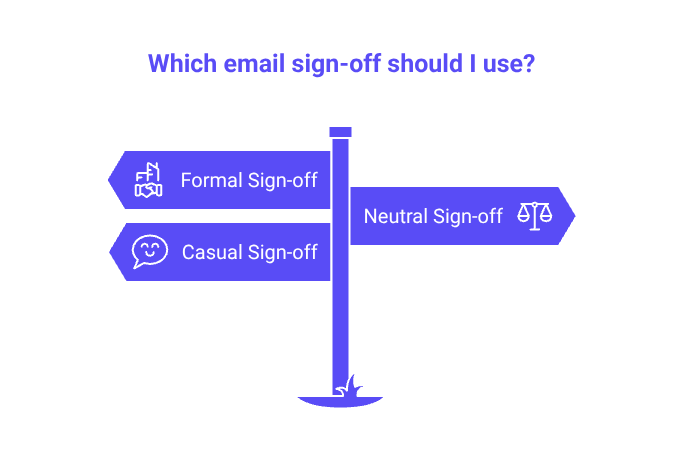
When in doubt, choose a neutral, professional sign-off. Relax your tone only after building trust and familiarity. Maintain a repository of approved closings in your playbooks to standardize communication and avoid confusion. Also learn and train your team about the sales process and latest pitching tactics to get more accurate results.
Professional email sign-offs list for formal, neutral, and warm tones
Formal sign-offs for high-stakes business emails
- Sincerely,
- Respectfully,
- Kind regards,
- Best regards,
- Yours sincerely,
- With appreciation,
Neutral professional sign-offs for everyday business emails
- Best,
- Regards,
- Many thanks,
- Thanks,
- Warm regards,
- Appreciate your time,
Closing lines that support your sign-off
- Happy to share details if helpful.
- Open to a quick call this week.
- Looking forward to your feedback.
- If this works, I will send the invoice.
- Please confirm the timeline you prefer.
Use a relevant closing line to clearly state the desired action. Then include your chosen sign-off, followed by your name on a new line. Keep this pair brief and relevant to the email’s purpose.
Formatting rules that keep professional email sign-offs compliant and credible
- Separate the body of the email from the sign-off by a single line gap for better clarity and readability.
- Place a comma after the sign-off, then start your name on the next line.
- Avoid using emojis and slang in business closings.
- Minimize promotional language near the sign-off. Keep your closing human and specific.
- Keep your email signature concise, two to six lines are typically sufficient.
- Limit yourself to one or two links in the signature. More links can appear suspicious to spam filters.
- Ensure your 'From' name, sign-off name, and signature details are all aligned and consistent.
Legal disclaimers should be included in the signature footnote, not the sign-off itself. They should remain brief and easily readable; overly lengthy disclaimers can clutter your footer and detract from your message’s clarity.
How professional email sign-offs interact with deliverability signals and spam filters
Email filters assess structure, language, and identity. Well-organized and concise endings help present your message as genuine and consistent. Refrain from using hype or marketing-heavy language near your sign-off. Stick to standard fonts, minimal colors, and lightweight images. For maximum deliverability, all elements, personal name, display name, and your signature block, must be aligned, reinforcing your legitimate identity.
Your technical infrastructure is equally crucial. Protocols such as HELO/EHLO, SPF, DKIM, and DMARC validate your sender identity. Weakness at this level can undermine even the best-crafted sign-off. Learn about the importance of identity alignment in this explanation of how the HELO greeting affects sender reputation. Consistency in both your sender identity and professional closings gives spam filters fewer reasons to question your emails.
Using an email signature generator to align sign-offs with your brand
A well-designed email signature supports your sign-off by clearly stating who you are and how recipients can reach you. Email signature generators can help teams maintain consistent formatting and fields. Include your name, title, company, website, and a primary phone number.
If you want a more polished and branded look, you can also use tools that let you design an Apple Mail email signature online with consistent formatting across devices and email clients. A creative asset toolkit can also help keep logos, icons, and other brand elements consistent across signatures and marketing materials.
Add a single professional social profile link if appropriate. Some teams also include a single link or QR code that leads to a page with full contact details, profiles, or key resources.
Using a qr code business card can make this process even more seamless, allowing recipients to instantly access up-to-date contact information and professional resources from their smartphones.
Tools like Uniqode’s QR Code Generator make this easy to set up.
Keep the design light and simple: use just one logo, compress images, and host them on reliable servers. Refrain from embedding tracking pixels in your signature. Choose accessible colors and maintain strong contrast for readability. Avoid repeating calls to action that already appear in your main email content.
Before rolling out a new email signature, test it by sending messages to different email providers and devices. Check how it displays, how links behave, and its appearance in dark mode. A clean, functional signature allows your sign-off to stand out without any distractions.
Advanced workflows: professional email sign-offs for follow-ups, referrals, and sensitive messages
Follow-up threads
As email conversations progress, you can shorten your sign-off. For example, start with “Kind regards,” and transition to “Best,” after establishing rapport. Keep each closing line focused on the main action you’re requesting. For effective timing and tone, refer to this guide to writing polite follow-up messages. Match a polite closing with a clear call to action.
Referrals and introductions
Show appreciation and provide context. For example: “Thanks again,” followed by your professional details and the reason for the introduction or referral. Include contextual lines just above the sign-off so the new contact knows exactly how to respond.
Sensitive or corrective emails
Opt for closings that communicate empathy and a sense of responsibility. Consider options like “Thank you for your patience,” or “Appreciate your understanding.” Avoid humor, and keep your signature straightforward and factual.
When to support a sign-off with authentication and warm-up
Email sign-offs alone cannot alleviate the issues caused by a weak sender reputation, which may result from factors like complaint rates, bounce rates, and spam traps. To improve your sender reputation, pair thoughtful sign-offs with email best practices like sender authentication, maintaining list hygiene, and sending emails consistently. New domains and inboxes in particular require a gradual warm-up before you scale outreach.
Starting from February 2026, Mailwarm will step into a new era as an advanced email warm-up solution. The platform will offer multi-account management, comprehensive deliverability and reputation tracking, multi-provider warm-up, and provider-level spam score reporting designed for high-volume operations. It exchanges positive engagement signals with a network of over fifty thousand real inboxes, each regularly maintained and refreshed. Interactions include message opens, human-like replies, removal of spam labels, and tagging messages as primary, not as marketing outreach, but as technical preparation to establish a trustworthy sender reputation and ensure your real campaigns are delivered to the inbox.
If you send cold outreach, combine a respectful sign-off with a careful warm-up routine. For insights on performance, review inbox placement benchmarks for cold emails and best practices alongside your own test results across providers.
Professional email sign-offs checklist you can ship today
- Choose a sign-off that matches the relationship’s formality and risk level.
- Include a short closing line that clarifies your primary request.
- Use a comma after the sign-off, and place your name on a new line.
- Keep your signature section compact, consistent, and accessible.
- Limit the number of links and images near the end of your emails.
- Ensure alignment between the From name, sign-off, and signature details.
- Test your email’s appearance across different providers and devices before scaling up outreach.
- Warm up new inboxes prior to campaigns, and maintain a steady sending cadence.
Refine your email sign-off today, send your next message, and let a clear, professional close do its work.
FAQ
Why is a professional email sign-off important for business communication?
A professional email sign-off sets the tone for how your message is received and responded to, often determining whether you're viewed as credible. It's not just about politeness but about presenting a unified brand image and ensuring that your emails avoid getting filtered as spam.
How does a well-structured email sign-off influence email deliverability?
Email filters scrutinize every bit of your email for credibility, and a poorly structured sign-off can raise flags. By maintaining a clear, concise, and consistent sign-off, you contribute to your message's trustworthiness, thereby enhancing deliverability.
What role does cultural context play in selecting an email sign-off?
Ignoring cultural differences can make your sign-off come off as inappropriate or disrespectful. What might seem casual in one culture could be deemed unprofessional in another, risking relationships and responsiveness.
Can email sign-offs alone ensure my message lands in the recipient's inbox?
While sign-offs add to credibility, they can't mitigate poor email practices like high complaint rates or spam traps. Employ a thorough email warm-up process, as detailed by platforms like Mailwarm, to boost sender reputation and ensure inbox placement.
What are the best practices for formatting email sign-offs to avoid spam filters?
Maintain a clean, minimalistic format—avoid emojis, slang, excessive links, and promotional language. Stick to standard fonts and ensure your email elements are in alignment with your sender identity to avoid the red flags raised by suspicious email structures.
How can Mailwarm assist in optimizing email deliverability connected to sign-offs?
Mailwarm enhances email deliverability by managing warm-up routines and tracking sender reputation metrics, which complements tactical sign-offs. Its platform optimizes identity signals and ensures positive engagement, reducing the likelihood of emails being flagged as spam.
When is it appropriate to adjust a sign-off for ongoing email threads?
In follow-ups, gradually shorten your sign-offs as familiarity increases to keep interactions efficient without compromising professionalism. Adjust according to the tone and context, ensuring each closing evolves with the relationship dynamic.
Is it necessary to include legal disclaimers in sign-offs?
Avoid embedding legal disclaimers in sign-offs; instead, place them in the email's footer where they don't detract from the message's clarity. Overly lengthy disclaimers can clutter your email, distracting from your sign-off's intended professionalism.
How do professional sign-offs contribute to brand consistency?
Consistent sign-offs reinforce brand recognition, making it easier for recipients to identify and trust your communications. Inconsistent closings can confuse recipients and weaken your brand's perceived reliability.