
A campaign can have strong copy, a clean offer, and a carefully selected audience, yet still vanish into spam. An IP reputation threat is often the hidden reason. It occurs when mailbox providers and security systems judge the sending IP as untrustworthy, increasing the likelihood that messages are filtered, rejected, or dropped.
IP reputation isn't a simple blacklist status. Providers combine sending history, complaints, bounces, authentication, engagement, and unusual activity to decide whether an IP deserves delivery. A sender can therefore lose visibility without seeing an obvious technical failure.
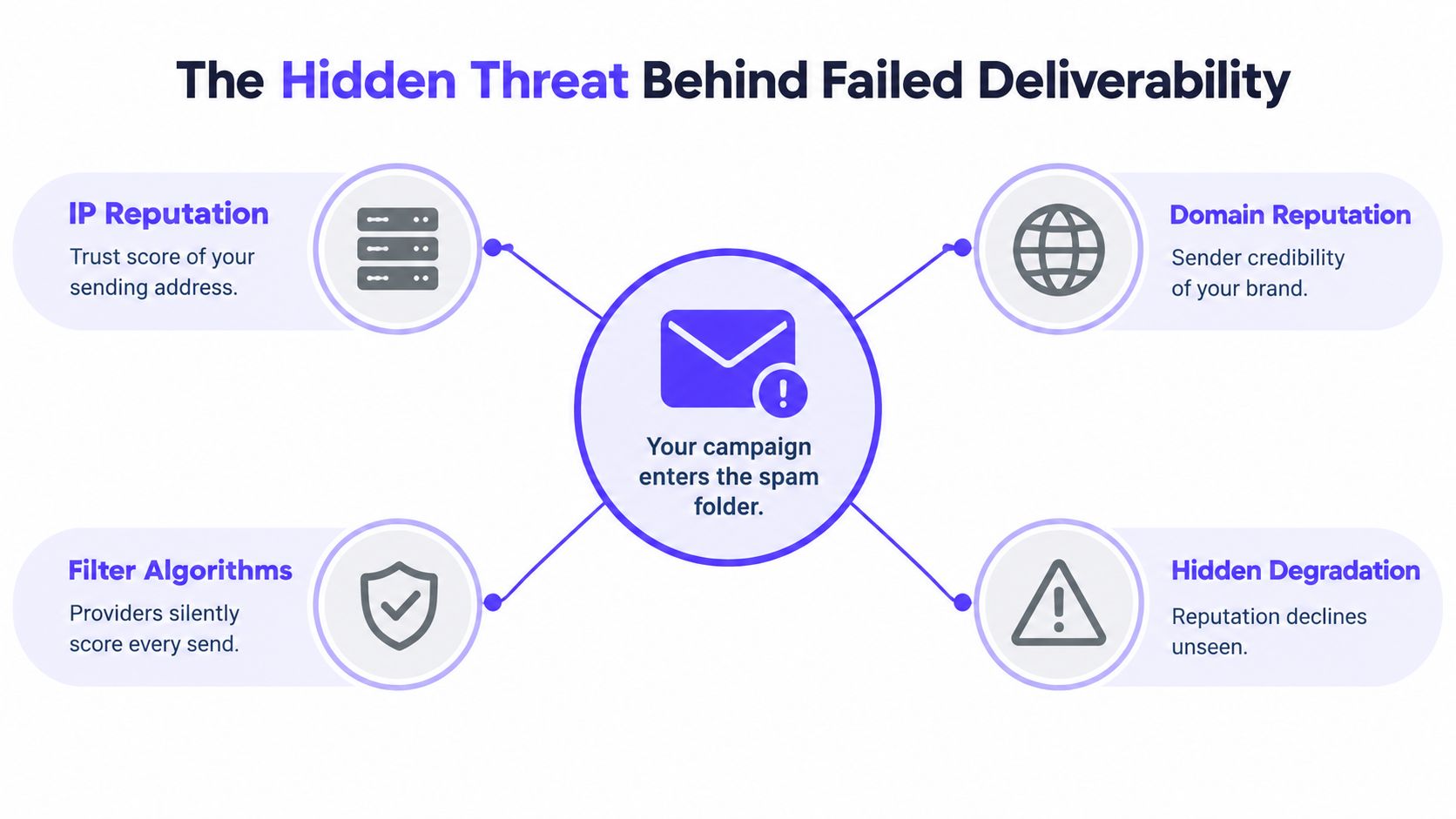
The Hidden Threat Behind Failed Deliverability
A sales team launches a campaign after testing the subject line, checking the links, and reviewing the audience. Early results look healthy. Then replies slow down, campaign activity becomes inconsistent, and messages stop appearing in recipient inboxes. The sending platform reports successful handoff, so the team blames the copy or assumes recipients aren't interested.
Often, the problem began earlier at the infrastructure level. Mailbox providers assign trust to the IP address that sends the message. When that trust declines, the provider can route messages to spam, throttle delivery, reject them, or drop them without a visible bounce.
Spamhaus describes reputation systems as large-scale intelligence networks that continuously assess IP addresses and changing adversary behavior. Its public work illustrates the scale of this process, with one vendor system analyzing 7,500,000 IPs every 24 hours and protecting 4.5 billion mailboxes (Spamhaus threat intelligence). The practical lesson is simple. Provider decisions are based on ongoing observation, not on a one-time approval.
Why the failure appears invisible
IP reputation is commonly represented as a risk score rather than a yes-or-no blacklist result. One established model uses a scale from 1 to 100, with 1 to 20 representing high risk and 81 to 100 representing trustworthy status (Spamhaus reputation guidance). A score can deteriorate before a sender receives a clear warning.
That makes reputation a central delivery control point. A provider can accept the SMTP connection while still placing the message in spam, or it can throttle traffic until the campaign becomes commercially ineffective.
Practical rule: A successful handoff doesn't prove successful inbox placement.
The risk is greater on shared infrastructure. Gmail warns that senders sharing an IP address or domain can affect one another's reputation (SMTP.com explanation of IP reputation). A legitimate campaign can therefore inherit problems from another sender, a compromised account, or a poorly managed sending pool.
What Causes IP Reputation to Deteriorate
An IP reputation threat usually follows a recognizable behavior pattern. Providers don't need to inspect every message manually. They can infer risk from recipient reactions, sending consistency, authentication, and the history attached to the infrastructure.
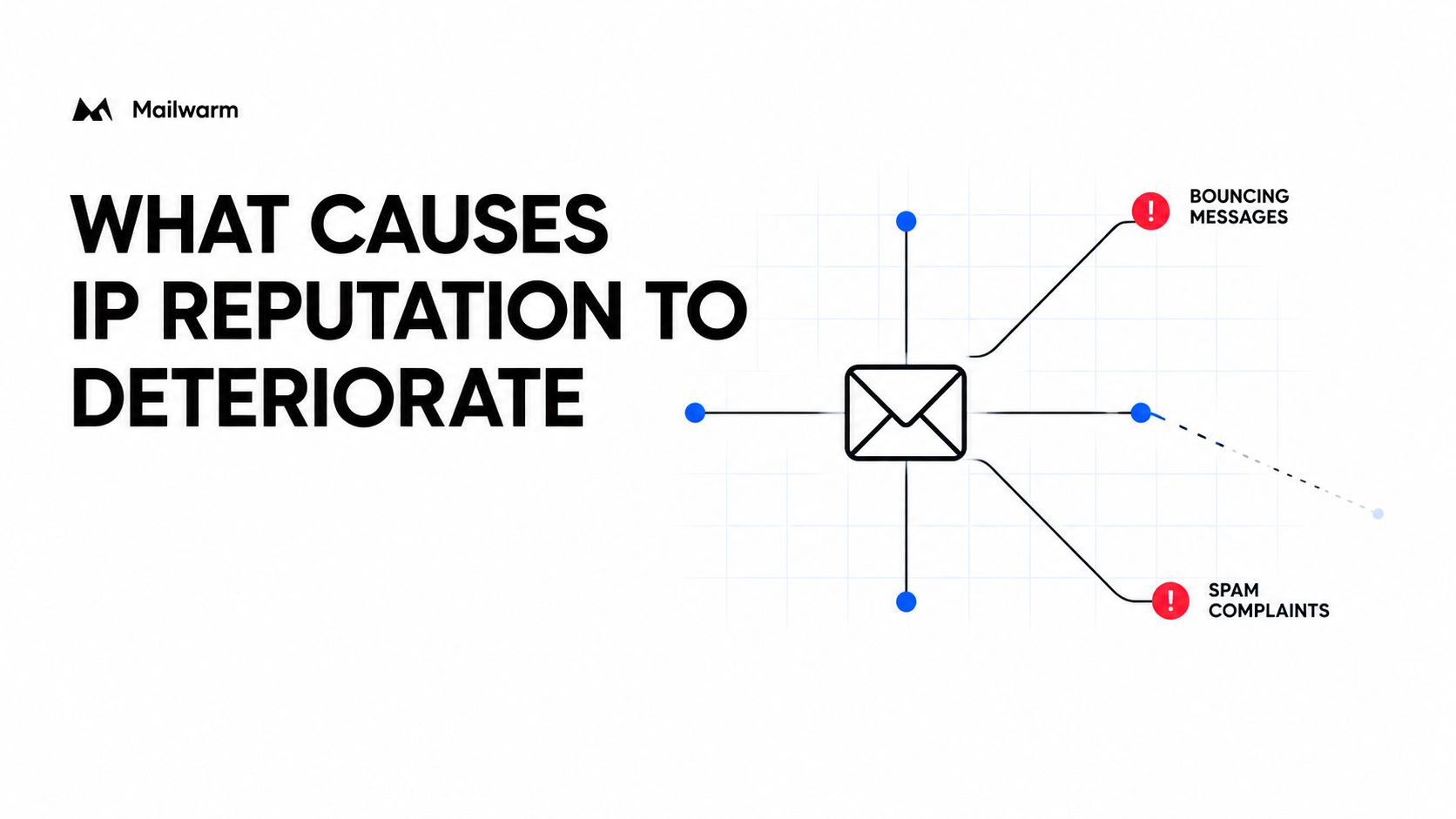
Poor list quality is one of the fastest ways to create that pattern. Hard bounces indicate that addresses don't exist or can't accept mail. Spam complaints show that recipients consider the traffic unwanted. Repeated failures and complaints tell providers that the sender is either careless, compromised, or targeting people without sufficient permission.
A email spam checker can help identify content and message-level risks, but content review won't repair an IP that has already accumulated poor behavioral signals.
The main deterioration triggers
- Uncontrolled list growth: Purchased, scraped, or stale contacts create bounces and complaints. Even a well-written message can damage trust when recipients don't recognize the sender.
- Compromised accounts: An attacker can use a valid mailbox or sending credential to distribute spam, phishing, or malware. The owner may notice only after providers have already associated the IP with abuse.
- Sudden volume changes: A sharp increase from a previously quiet sender looks unlike normal behavior. Providers often treat consistency as a trust signal, so abrupt scaling creates additional scrutiny.
- Shared IP contamination: Another tenant's abuse can affect every sender using the same IP. This is a structural trade-off of shared infrastructure, lower operational cost in exchange for pooled reputation.
- Missing authentication: SPF, DKIM, and DMARC help providers verify who is authorized to send. AWS identifies authentication, engagement, complaints, bounces, and spam-filter outcomes as parts of sender reputation evaluation (AWS email reputation guidance).
Teams often treat a reputation decline as a platform malfunction. That response delays the actual investigation. The better approach is to compare recent volume, bounce behavior, complaints, authentication results, account activity, and infrastructure history before changing message copy.
IP Reputation vs Domain Reputation
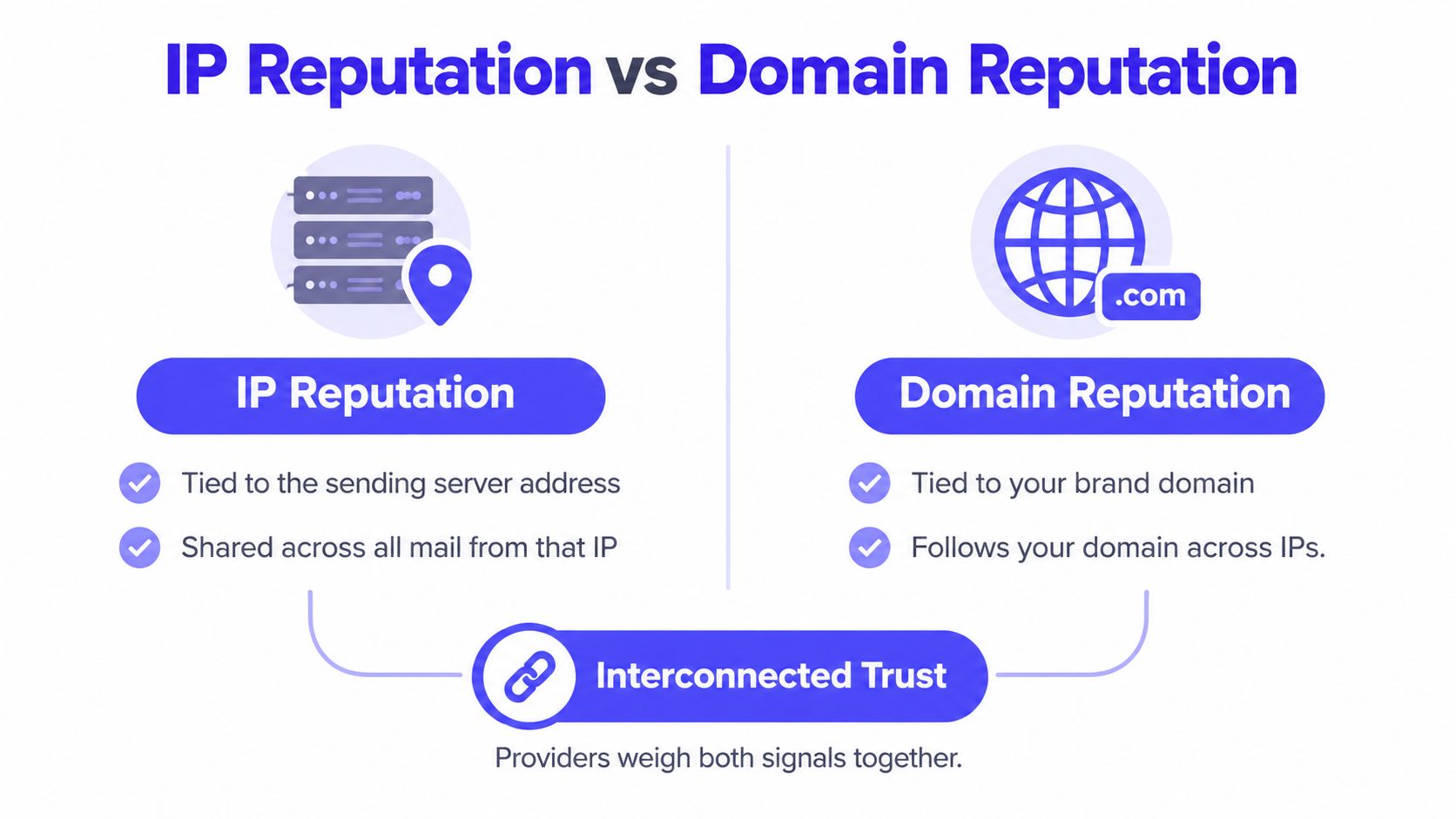
IP and domain reputation are connected, but they answer different questions. IP reputation reflects the history of the sending infrastructure. Domain reputation reflects the credibility associated with the sender's brand and domain.
A clean domain doesn't automatically protect traffic sent from a harmful IP. The reverse is also true. A clean IP can't fully compensate for a domain that repeatedly produces complaints, suspicious engagement, or authentication problems.
| Signal | What it represents | Where it matters most |
|---|---|---|
| IP reputation | The history of the sending server or address | Shared infrastructure, sudden volume changes, severe abuse, and blocklist exposure |
| Domain reputation | The credibility attached to the sender's domain | Brand identity, cold outreach patterns, authentication, and ongoing recipient response |
| Combined assessment | The provider's overall trust decision | Inbox placement, throttling, rejection, or spam filtering |
Recent 2026 commentary argues that domain reputation generally carries more weight for cold email, while IP reputation remains especially important during sudden volume spikes, complaint bursts, or severe historical abuse (InboxKit's IP reputation and deliverability analysis). The same source reports that blacklisted IPs represented 2% of tested senders in 2025 and 6% in 2026, while domain listings remained at 0.3%. Those figures suggest that IP exposure deserves more attention than many domain-focused guides give it.
The diagnostic distinction that prevents wasted effort
A threat reputation flag doesn't automatically prove that a marketing campaign is causing poor inbox placement. The IP may have a previous tenant, a compromised service, or a security history unrelated to current email activity. MailGenius separates email-sending reputation from security and threat reputation, a useful distinction when deciding whether to change behavior or investigate infrastructure (MailGenius IP reputation checker).
The practical decision is to diagnose both signals:
- If the IP is the problem, review infrastructure, shared hosting, abuse history, and volume behavior.
- If the domain is the problem, review audience quality, complaints, authentication, content, and engagement.
- If both are weak, changing domains alone won't solve the underlying behavior.
Key Metrics That Signal a Reputation Threat
Reputation monitoring works only when teams track the signals providers use to judge trust. A weekly review is more useful than waiting for a campaign to fail, because early deterioration is easier to correct than a prolonged filtering event.
Google's sender guidance requires bulk senders to Gmail to keep spam complaint rates below 0.1% and never exceed 0.3%. Google also requires SPF, DKIM, and DMARC for bulk mail, along with one-click unsubscribe for marketing messages (Google sender requirements summarized by Braze).
A practical diagnostic checklist
Separate hard and soft bounces. Hard bounces usually point to invalid or unavailable addresses. Soft bounces can indicate temporary provider limits, mailbox problems, or a sending pattern that triggers throttling. The distinction tells the team whether list hygiene or infrastructure behavior needs attention first.
Track complaint rate by provider. A blended complaint figure can hide a serious problem at Gmail, Outlook, Yahoo, or another provider. Provider-level analysis shows where trust is declining.
Compare delivery with inbox placement. Delivery means the receiving system accepted the message. It doesn't prove that the message reached the inbox. Placement reporting should distinguish inbox, spam, rejection, and unknown outcomes where available.
Review opens, clicks, replies, and forwards. Providers use recipient interactions as behavioral evidence. Low engagement isn't automatically an IP failure, but a sustained decline alongside complaints and bounces deserves investigation.
Run an email blacklist check. Blocklist status provides an external view of infrastructure reputation. A listing doesn't explain every delivery problem, but it gives the team a concrete lead.
Check authentication and unsubscribe behavior. SPF, DKIM, DMARC, and one-click unsubscribe remove avoidable trust friction. Missing or misaligned controls can make legitimate traffic look less credible.
The strongest monitoring routine combines metrics instead of relying on one dashboard number. A complaint increase with stable authentication points to recipient or targeting problems. A placement decline with clean engagement may justify checking IP history, shared infrastructure, or a security incident.
How to Recover a Damaged IP Reputation
Recovery starts with containment, not another campaign. Continuing the same volume while investigating gives providers more negative evidence and makes it harder to identify the original trigger.
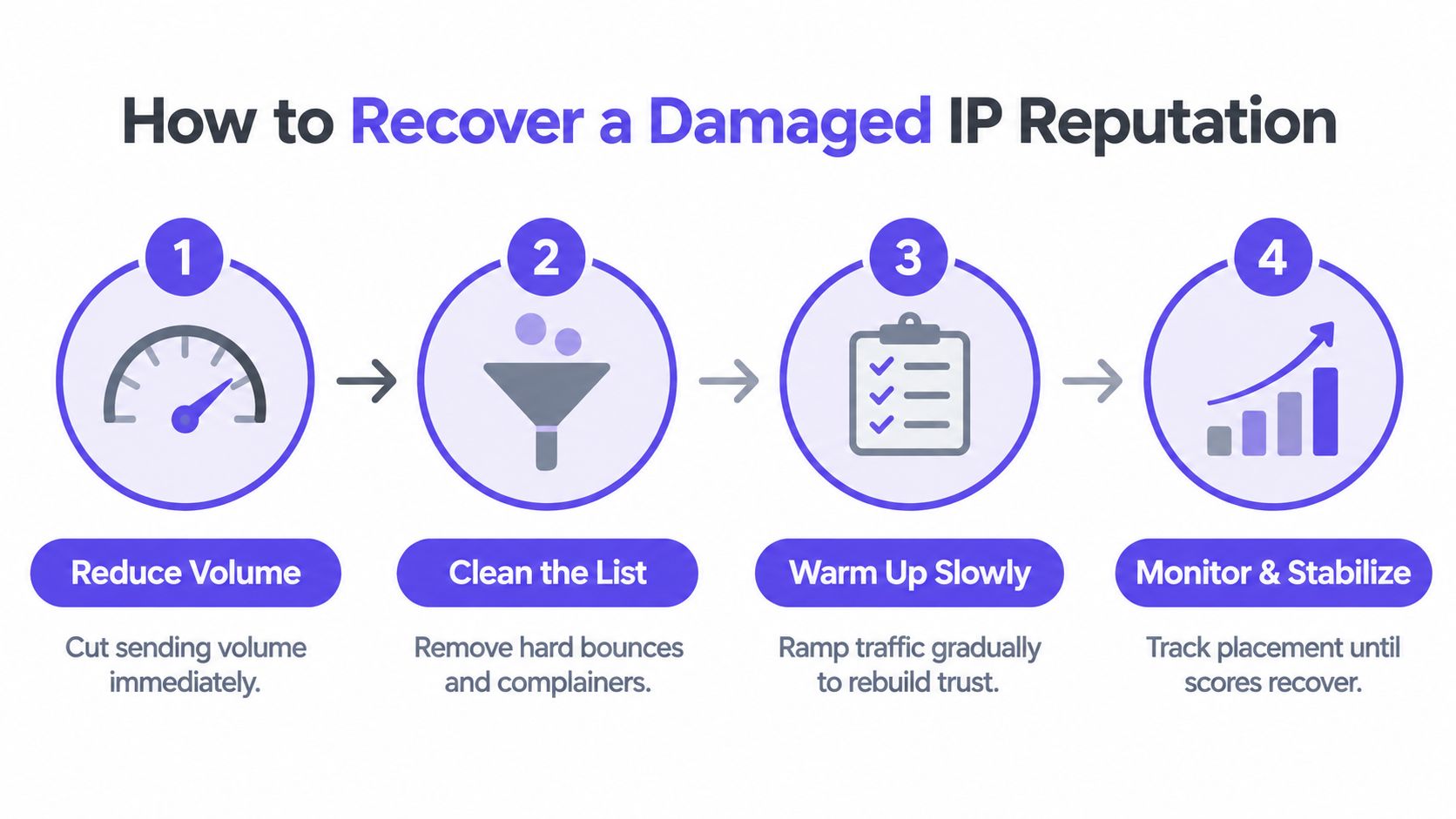
Four steps for incident response
Reduce volume immediately. Pause the riskiest campaigns and stop sending to unengaged or uncertain contacts. The aim is to prevent additional complaints, bounces, and suspicious spikes while the team verifies the cause.
Clean the list. Remove hard bounces, known complainers, invalid addresses, and contacts without a credible relationship to the sender. Don't use a new domain as a substitute for list hygiene. The same behavior can damage the replacement infrastructure.
Verify authentication and account security. Confirm SPF, DKIM, and DMARC alignment, then review sending credentials, mailbox access, integrations, and unusual activity. A compromised account must be contained before any warmup or volume increase begins.
Ramp traffic gradually and monitor placement. Providers need consistent evidence that the sender is behaving differently. Throttle by provider when necessary, send to responsive recipients first, and compare placement, complaints, bounces, and engagement during each stage.
Shared infrastructure needs a separate decision
A shared IP can be appropriate for smaller or less predictable sending programs, but it also pools risk. If another tenant has caused the problem, list cleaning alone won't remove the external association. The sending provider may need to investigate abuse history, isolate the account, or move the sender to dedicated infrastructure.
Teams that need to warm up an SMTP server should treat warmup as controlled reputation building, not as permission to resume full volume immediately. Warmup can't compensate for unresolved complaints, compromised credentials, broken authentication, or poor targeting.
Recovery principle: Stop the harmful behavior first, then rebuild trust with consistent traffic and measurable recipient response.
Some IP reputation threats are security incidents rather than marketing failures. A sender should involve the email service provider, hosting provider, security team, or deliverability specialist when the IP shows threat intelligence associations that current sending behavior can't explain.
Building Long-Term Monitoring and Support Habits
A reputation recovery plan is temporary. Sender reputation needs an operating routine that continues when campaigns are performing well, because the most expensive failures often begin during periods of apparent normality.
Teams should assign ownership for the signals that matter. A marketer may watch complaints and engagement, while an infrastructure owner handles authentication, account security, and provider communication. Without clear ownership, each team assumes someone else is checking the warning signs.
Make monitoring part of campaign operations
A useful routine begins before launch. The sender checks authentication, audience quality, recent volume, content risk, and provider-level placement. After launch, the team reviews performance by provider rather than relying only on an aggregate delivery figure.
The review should ask practical questions:
- Did volume change sharply from the established pattern?
- Did complaints or hard bounces rise after a new audience source was added?
- Did one provider filter more aggressively than the others?
- Are replies and meaningful interactions consistent with the campaign's audience?
- Does the IP appear on a blacklist or threat-intelligence feed?
- Is an authentication failure affecting only one stream or the whole domain?
Historical behavior matters because reputation systems evaluate patterns over time. Webroot's BrightCloud summary found that 97.3% of the top 50,000 IP addresses that reappeared on its malicious list showed at least four distinct risk factors. It also reported that 45% reappeared in at least two different months and 25.8% were observed doing something malicious every month (Webroot IP reputation glossary). The figures reinforce a practical point. Repeated abuse is easier for filtering systems to recognize, and recovery requires sustained behavioral change.
Know when internal fixes aren't enough
A sender shouldn't keep changing copy when the evidence points to infrastructure. Escalation is appropriate when:
- the IP remains filtered after volume and list changes;
- threat intelligence flags activity the team can't identify;
- authentication passes technically but provider placement keeps declining;
- a shared IP appears contaminated by another sender;
- the team lacks provider-level placement data;
- a campaign depends on reputation-sensitive cold outreach.
Mailwarm is a premium email warmup and deliverability platform that combines real inbox engagement, advanced warmup controls, spam score monitoring, inbox placement insights, authentication fix tools, bounce prevention, deliverability analytics, provider-level warmup, B2B and B2C warmup, and expert guidance. Its network includes 50,000+ aged real inboxes, with engagement signals such as opens, replies, threads, spam removal, and important marking. Depending on the plan, it can generate up to 100% replies to warmup emails, and it doesn't require IMAP access or permission to read a user's private inbox.
That model addresses a limitation of basic warmup activity. Automated exchanges may show that messages were sent, but they don't necessarily reveal whether traffic reaches the intended provider's inbox or whether authentication, content, bounce, and reputation risks remain. Expert deliverability calls included in every plan add a human review path when a dashboard can't explain the decline.
A premium platform isn't a replacement for consent, list hygiene, security controls, or sensible volume management. It becomes useful when a team needs structured reputation building, provider-specific observation, and support that connects campaign behavior with infrastructure signals.
The durable habit is to treat reputation as a daily operating condition. Teams that monitor placement, investigate unusual behavior, maintain authentication, and escalate early give providers consistent evidence of legitimate sending. Teams that check only after a campaign collapses are forced into recovery under pressure.
Mailwarm helps senders build reputation, monitor inbox placement, and reduce spam risk through real inbox engagement, provider-level warmup, authentication tools, and expert deliverability guidance. Visit Mailwarm to assess the controls and support available for protecting sending infrastructure before an IP reputation threat disrupts the next campaign.