
Why Email Warmup Tools are Essential for Protecting Sender Reputation in the Digital Age
Mailbox providers now evaluate sender trustworthiness in a matter of minutes instead of months. New domains and IP addresses start at square one, with no established reputation. An abrupt or “cold” start frequently results in messages being filtered, rate limited, or marked as spam. Email warmup tools play a critical role by creating regular, genuine-looking activity that demonstrates trustworthiness. These tools imitate authentic threads, consistent replies, and inbox corrections, signaling to filters that your emails belong in recipients’ inboxes.
It’s important to understand that warmup tools are not a fix for fundamental problems like a spoofed identity or a disreputable sending domain. However, they do help illustrate healthy engagement patterns to providers during the crucial early phases of ramping up sending volume. That early demonstration of positive behavior helps protect your sender reputation, especially during periods of transition, such as changing platforms or rotating domains.
Email warmup allows you to demonstrate intent and steady practices to mailbox providers before you scale your outreach.
If you want an in-depth explanation of the underlying processes, consult this essential guide discussing how email warmup improves inbox placement, which breaks down the signals filters assess and why consistent activity matters so much.
How Email Warmup Tools Protect Domain and IP Reputation During Early Sending
Email warmup tools operate through steady, low-volume exchanges across a distributed network each day. They ensure messages are opened, replies are given within natural conversation threads, and emails erroneously marked as spam are recovered and moved to the primary inbox. This pattern establishes a trail of positive engagement across all major email providers.
Quality email warmup platforms support message distribution via Gmail, Microsoft 365, Yahoo, and even custom SMTP routes. They diversify thread depth, subject lines, and reply timings to closely simulate real user behavior. The objective is straightforward: build a credible history of legitimate human interactions from your domain.
Effective email warmup platforms monitor exactly where each message lands, track instances of spam placement, soft blocks, and shifts in your sender reputation. They proactively adjust the daily email volume to prevent sudden, suspicious spikes. This process is designed to safeguard your reputation in parallel with preparing for your actual email campaigns.
Authentication is crucial, and SPF, DKIM, and DMARC alignment are fundamentally important checks at all stages. Warmup activities will often highlight any issues with these records, allowing you to address them before scaling up sending, thereby reducing risk while you complete technical setup and governance.
Criteria to Evaluate the Best Email Warmup Tools for Sender Reputation Protection
- Network quality and maintenance: Active, verified inboxes that are frequently rotated and updated.
- Cross-provider distribution: Broad coverage, including Gmail, Microsoft 365, Yahoo, and regional ISPs.
- Spam recovery workflows: Automated systems that remove messages from spam folders and correct mailbox placement issues.
- Adaptive ramp logic: Gradual, performance-based adjustments to daily sending volume.
- Thread realism: Natural, conversational replies with varying conversation depth and timing.
- Reputation telemetry: Clear, relevant metrics on placement, complaint rates, and blocking signals.
- Provider-specific scoring: Detailed tracking to understand your current standing with each provider.
- Multi-account control: Centralized management across domains, users, and seats for scalability.
- Authentication checks: Built-in diagnostics for SPF, DKIM, DMARC, and MX records.
- Blacklist and spam-trap awareness: Real-time alerts when risk indicators appear.
- Privacy posture: Transparent data handling, with options for content redaction.
- API and audit trails: Programmatic control with detailed logs, ensuring compliance and traceability for teams.
When selecting a vendor for email warmup tools, insist on seeing evidence rather than accepting promises. Always require access to provider-level placement data and actual remediation results. This data will indicate how well the system is able to adapt to provider feedback without the need for intensive manual tuning.
Types of Email Warmup Tools and When Each Fits Your Sender Reputation Needs
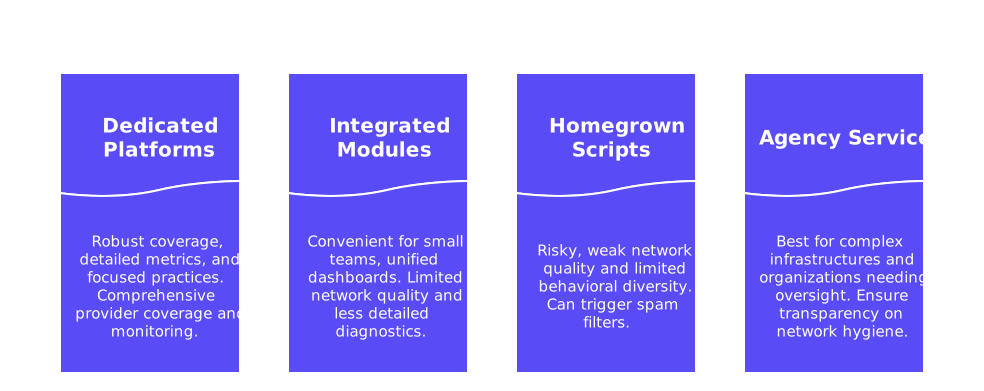
- Dedicated warmup platforms: Ideal for teams needing robust coverage, detailed metrics, and focused warmup practices. These generally offer the most comprehensive provider coverage and monitoring.
- Integrated warmup modules within outreach tools: Convenient for small teams preferring unified dashboards. However, keep in mind that these might have limited network quality and less detailed diagnostics.
- Homegrown scripts and manual exchanges: Generally risky, as weak network quality and limited behavioral diversity can trigger spam filters.
- Agency-managed services: Best for complex infrastructures and organizations needing oversight. Ensure full transparency on network hygiene and the methodology used for provider-level scoring.
Match your choice to your risk level and scale requirements. Centralized management is key if you must oversee multiple domains or users. If executives monitor deliverability closely, prioritize tools with detailed, provider-level reporting.
Selecting the Best Email Warmup Tool for Google Workspace, Microsoft 365, and Custom SMTP
Every major email ecosystem has unique traits that can affect warmup outcomes. Google assigns sender reputation at the domain, IP, and specific route level. Microsoft 365 factors in tenant-wide health, individual user trust, and the history of prior conversations. Custom SMTP environments face additional challenges with shared IPs, authentication records, and reverse DNS checks.
Choose email warmup tools that natively support your particular technology stack. If your organization relies heavily on Microsoft 365, refer to this tailored resource outlining the best email warm-up tools for Outlook and Microsoft 365 to understand provider-specific behavior and important selection criteria.
Always demand provider-level spam score reporting as well as clear, domain-wide trends. This level of visibility guides your ramp-up strategies and pinpoints where to focus improvement efforts, by route, tenant, or workspace.
A Next-Generation Email Warmup Platform Designed for Scalable Sender Reputation Protection
As of February 2026, Mailwarm has evolved into an advanced email warm-up solution. The platform supports multi-account management, comprehensive deliverability monitoring, warmup across multiple providers, and granular spam score tracking, offering robust support for high-volume operations.
This strategic approach makes Mailwarm a strong fit for agencies, sales teams, and operations groups. Centralized oversight minimizes errors and keeps all domains healthy, while provider-specific insights help teams make informed decisions about volume and routing.
Safety Measures to Prevent Email Warmup Process from Damaging Sender Reputation
- Authenticate first: Verify your SPF, DKIM, DMARC, and HELO configuration before starting the warmup process.
- Use a clean domain: Start with domains that have no previous record of complaints or blocks for best results.
- Control sending cadence: Let algorithms control gradual increases in send volume; avoid abrupt jumps.
- Focus on inbox placement rather than large send numbers: Prioritize where your emails land over how many are sent.
- Keep threads human and concise: Simple, engaging, and conversational threads are most effective.
- Separate testing from production: Do not mix warmup activities with live campaign sending.
- Rotate sender identities carefully: Maintain consistent sender names and job roles to build credibility.
- Document all changes: Keep records of DNS updates, routing changes, and throttling settings to streamline troubleshooting.
Following these safety measures prevents unnecessary reputation setbacks and provides documentation for team members and stakeholders, facilitating easier review and incident response if challenges arise.
Recommended Reading on Email Warmup Tools and Sender Reputation
Broaden your expertise with further reading to supplement your choice of email warmup solutions. For a full exploration of the impact on campaign results and channel performance, refer to this comprehensive study on inbox placement benchmarks and best practices for cold emails. Agency professionals should review this detailed comparison of the best email warm-up tools for marketing agencies in 2026. Both guides offer valuable perspectives to reinforce the evaluation checklist above.
Final Thoughts: Choose an Email Warmup Tool That Truly Safeguards Your Sender Reputation
Your sender reputation is a vital asset, treat it as such. Select an email warmup tool that can demonstrate tangible improvements in inbox placement and deliver provider-specific reporting. Demand gradual ramp-up logic, verifiable spam recovery, and transparent metrics. Choose systems that evolve based on feedback and can clearly show the impact of their processes on your domain’s reputation.
FAQ
Why are email warmup tools necessary?
Email warmup tools are crucial for establishing a positive sender reputation quickly. Without them, new domains can face deliverability issues, with emails often landing in spam folders.
Do email warmup tools fix all issues with sender reputation?
No, they do not fix fundamental issues like a spoofed identity or poor domain reputation. Warmup tools only aid in establishing trustworthy behavior patterns.
How do email warmup tools work to improve deliverability?
They mimic genuine email activity, including message exchanges, replies, and inbox corrections, signaling to email filters that messages aren’t spam.
Can email warmup tools detect issues with authentication protocols?
Yes, they can highlight problems with SPF, DKIM, and DMARC setups, allowing you to resolve these issues before scaling your email activities.
What should you consider when selecting an email warmup tool?
Look for features like cross-provider distribution, spam recovery, adaptive sending logic, and robust reputation telemetry to ensure comprehensive reputation management.
Is it better to use dedicated warmup platforms or integrated modules?
Dedicated platforms typically provide more detailed metrics and robust coverage, making them ideal for larger teams needing in-depth insights.
Why is Mailwarm considered a next-generation warmup platform?
Mailwarm offers advanced features like multi-account management and detailed spam score tracking, essential for high-volume operations and strategic oversight.
Can poor email warmup practices harm your sender reputation?
Absolutely, incorrect practices can trigger spam filters, causing more harm than good. Always follow best practices to maintain your reputation.
Is it risky to mix email warmup activities with live campaigns?
Yes, combining these activities can confuse deliverability signals, leading to unwanted deliverability issues.