
Tuesday through Thursday at 10:00 a.m. local time is the strongest baseline for opens, but clicks and conversions often peak later, between 5:00 p.m. and 8:00 p.m. on Thursday or Friday. The best day and time to send newsletter campaigns depends on whether the goal is visibility or action, and those are not the same problem.
That split matters because send time changes what the inbox is doing for you. Morning sends catch people during routine email checks, while later sends can win when readers finally have time to click, compare, and act.
What the Data Says About Newsletter Send Times
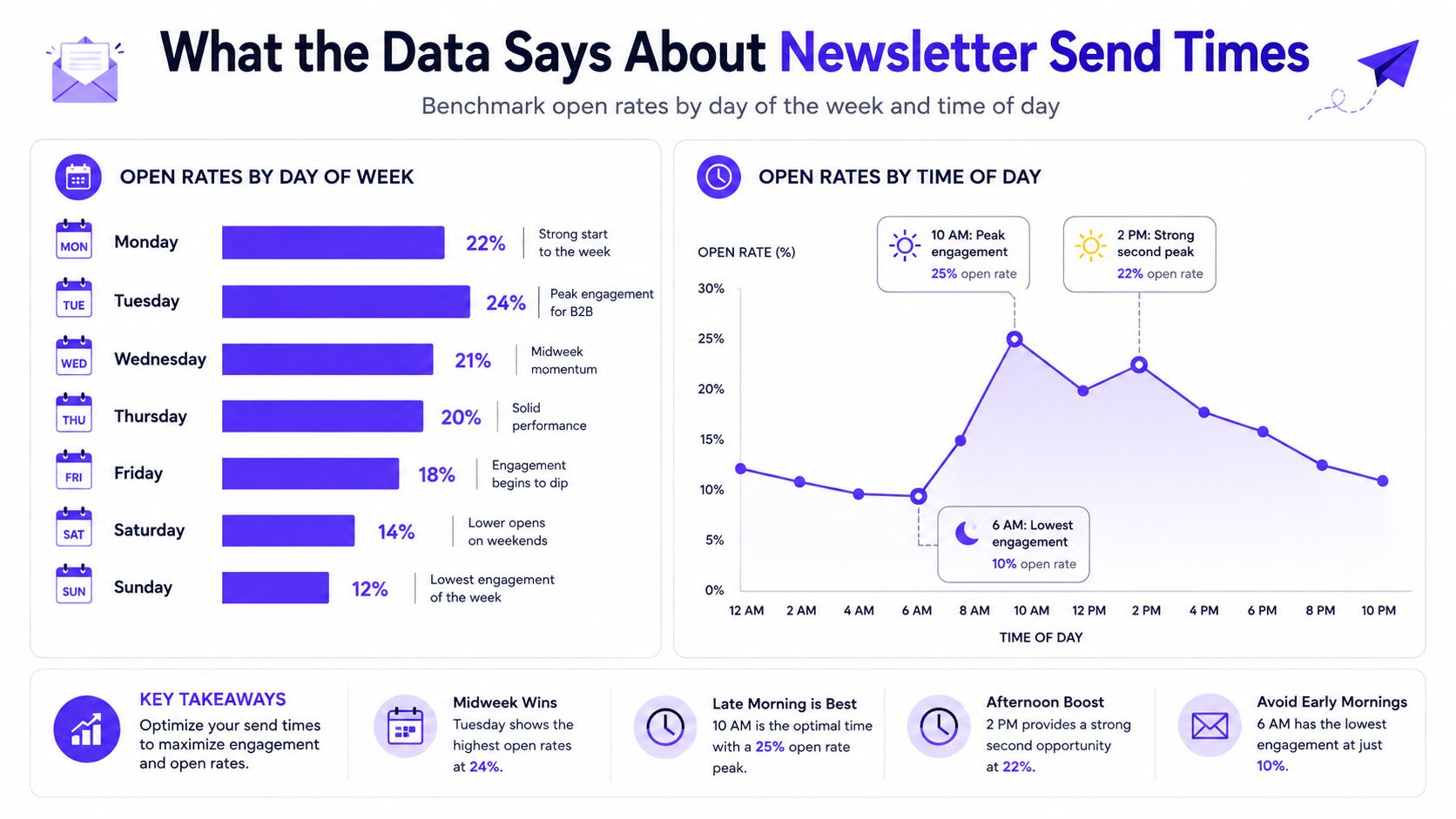
The strongest historical benchmark points to a midweek, late-morning baseline. In Campaign Monitor's day-of-week table, Monday had the highest open rate at 22.0%, with Tuesday and Wednesday close behind at 21.8%, Thursday at 21.7%, and Friday at 21.6%. Weekend performance trailed, with Saturday at 20.5% and Sunday at 20.3%. Campaign Monitor's newsletter timing benchmark
That same dataset shows why time matters as much as day. 53% of opens happen between 9:00 a.m. and 5:00 p.m., excluding lunchtime, while only 16% occur overnight from midnight to 8:00 a.m., 7% during lunchtime, and 24% in the evening from 6:00 p.m. to 11:00 p.m. The pattern is uneven, and it puts most attention in standard working hours, especially early to mid-morning.
What that baseline really means
Practical rule: start with the workweek and test around the morning inbox check, because that's where attention is already concentrated.
Independent platform guidance aligns with that pattern, with multiple recommendations clustering around Tuesday through Thursday and an opening window of roughly 8:00 a.m. to 11:00 a.m. in the recipient's local time zone. For teams building a benchmark, the message is simple, timing is not random, and weekends are usually a weaker starting point than the workweek.
One useful way to think about this is that the inbox behaves like a queue. Messages that arrive during active working hours are more likely to be seen near the top of that queue, while messages sent late at night or on the weekend have to wait until attention returns. For a deeper look at how that pattern shows up in cold outbound, see Mailwarm's cold email open rates industry benchmarks.
Open Rate Versus Click Rate Optimization
Open-rate optimization and click-rate optimization pull in different directions. Mailchimp says the strongest send time across its system is 10:00 a.m. local time, with Tuesday, Wednesday, and Thursday performing best across industries. That fits the morning inbox-check pattern, but it doesn't fully answer when people are ready to act. Mailchimp's send-time optimization analysis
The behavioral split is the key. People often open in the morning and click later, after work, when they have more uninterrupted time to read, compare, and decide. Nutshell Newsletter's 2026 analysis points to Tuesday or Thursday at 10:00 a.m. local time as the strongest window for opens and readership, while clicks and conversions often peak later, between 5:00 p.m. and 8:00 p.m. on Thursday or Friday. MailerLite's 2026 data separates the metrics even more clearly, with click rates peaking between 8:00 p.m. and 9:00 p.m. Nutshell Newsletter's timing guide, MailerLite's 2026 email timing analysis
| KPI Goal | Best Days | Best Time Window | Why It Works |
|---|---|---|---|
| Open rate | Tuesday, Wednesday, Thursday | Around 10:00 a.m. local time | Matches morning inbox checks and routine workday attention |
| Clicks and conversions | Thursday, Friday | Roughly 5:00 p.m. to 8:00 p.m. local time | Readers have more time to read, compare, and act after work |
Why the split happens
A newsletter can be excellent at getting opened and still underperform on clicks if it lands when the reader is busy. The morning slot usually wins on visibility, because it catches the inbox early. The evening slot often wins on action, because the reader has time to follow through.
That distinction matters more for teams selling high-consideration products, promoting long-form content, or sending newsletters with one clear conversion goal. A send time that lifts opens but suppresses clicks is not automatically a success. The right KPI has to decide the timing strategy first.
A separate data-backed guide cites beehiiv timing analysis showing 34.9% engagement for 9:00 a.m. to 12:00 p.m., versus 27.6% for 12:00 p.m. to 3:00 p.m. and just 1.3% for 9:00 p.m. to 12:00 a.m. beehiiv timing analysis summarized in CleanMyList's guide. That spread reinforces the same point, late-morning sends are usually a safer starting point than late-night sends when the goal is broad engagement.
Factors That Shift Your Ideal Send Time
The benchmark is a starting point, not a universal answer. Audience type, timezone spread, device habits, content format, and engagement history all shift what effective timing looks like for a specific list. A B2B audience checking email during the workday will not behave like a consumer list browsing in the evening.
The six variables that matter most
- Audience type. Professionals usually check email at the start or end of the workday, while consumers often engage later in the day.
- Timezone distribution. A global list needs segmented send times, not one blanket schedule.
- Device behavior. Mobile-heavy audiences often open earlier and more often during commute or lunch windows.
- Email client patterns. Gmail and Outlook can shape visibility through tabs, filters, and inbox organization.
- Content type. Transactional messages, long-form newsletters, and promotional sends can each deserve a different timing hypothesis.
- Seasonality. Holiday periods change how and when people read email, so historical send behavior can shift.
A single hour can work for one audience and fail for another. The clearest example is a list that mixes office-based readers with people checking on mobile after work. One group sees the message during active work sessions, while the other is more likely to read, click, or act later. That is why send-time rules should be tied to behavior, not broad averages.
The practical move is to score each factor before choosing a test window. If a list is mostly B2B, the morning baseline deserves more weight. If the audience is consumer-heavy and mobile-first, later-day engagement may matter more than opens alone.
A mixed audience usually needs segmentation before timing optimization works well. A single send time for North America, Europe, and APAC almost always hides more than it reveals. For related list-structure thinking, Mailwarm's email grouping vs individual sending is a useful companion read. For a parallel question on audience behavior in another channel, when to post for higher engagement shows the same pattern. Timing only works when the audience context is clear.
How to Run a Send Time A/B Test
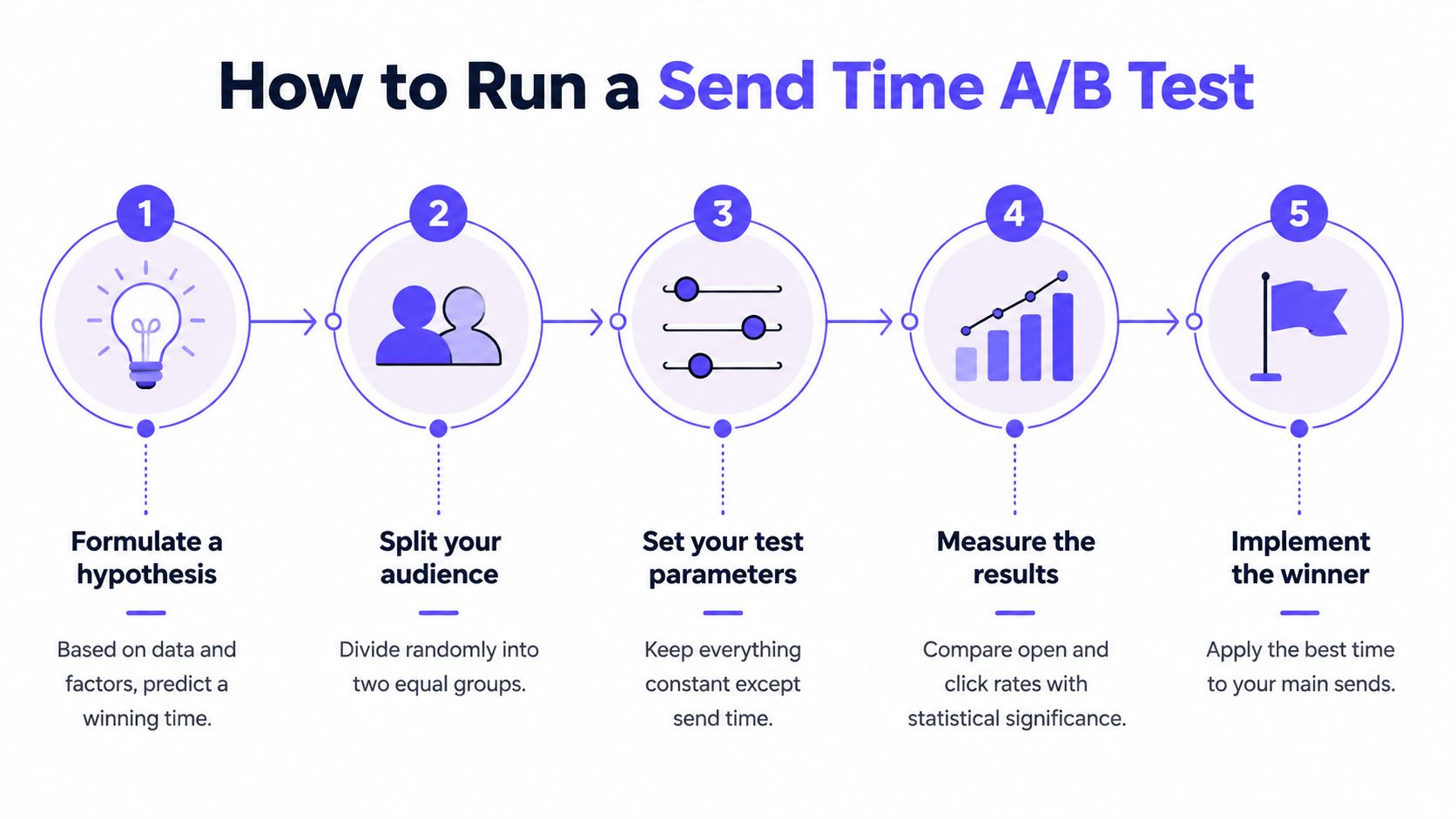
A send-time test only works if everything except time stays constant. That means one subject line, one sender name, one content version, and two send windows that differ only by day or hour. If those variables change together, the result won't tell the team anything useful.
A clean test structure
- Formulate a hypothesis. Start with the benchmark. For example, a B2B list may be expected to respond better on Tuesday morning, while a conversion-focused campaign may do better later in the week.
- Split the audience randomly. Keep the groups as similar as possible so one side doesn't get a stronger segment by accident.
- Hold the content steady. Use the same creative, subject line, and sender identity in both sends.
- Measure the right KPI. Open rate, CTR, and downstream conversions are different outcomes, so the winner depends on the goal.
- Apply the winner. Use the strongest window for the next main send, then keep testing against it.
For a practical comparison of list handling methods before testing, Mailwarm's email grouping vs individual sending can help teams decide how to structure the audience first.
A simple four-week cadence works well for many organizations. Week one can test a morning slot against a later morning slot. Week two can repeat the winner against an afternoon alternative. Week three can compare the strongest daytime slot with an evening send. Week four can confirm the pattern before it becomes the default.
Testing rule: if the sample is too small or the test ends too early, the result is a guess dressed up as data.
Teams often make the same mistake here, they change the offer, the subject line, and the send time all at once. That creates noise, not insight. A disciplined test tells the strategist whether time itself is helping or hurting performance.
For teams comparing send-time experiments with other engagement tactics, when to post for higher engagement is a useful parallel framework, because the logic is similar, timing should match the audience's attention window.
Deliverability Foundations Before Timing Optimization
Send time does not matter if the email never reaches the inbox. Sender reputation, authentication, warmup status, and spam score shape whether a timing test is measuring true engagement or just inbox placement problems. Timing optimization only becomes meaningful after the delivery foundation is stable.
What has to be in place first
- Sender reputation. A healthy domain and sending identity give the message a chance to be seen.
- Authentication. SPF, DKIM, and DMARC need to be in place and working.
- List health. Inactive or invalid addresses weaken engagement and distort results.
- Spam risk. If messages keep landing in spam, timing data becomes unreliable.
- Warmup status. A newly activated or cold sending domain can't be judged on the same timeline as an established one.
- Inbox placement visibility. Teams need to know whether the message reached inbox, promotions, or spam before drawing conclusions.
Mailwarm is a premium email warmup and deliverability platform that helps senders build reputation, monitor inbox placement, and improve deliverability through real inbox engagement and expert guidance. It uses 50,000+ aged real inboxes, real engagement signals like opens, replies, threads, spam removal, and important marking, plus spam score monitoring and provider-level warmup. Unlike basic warmup tools, it doesn't require IMAP access or permission to read a private inbox.
The deliverability layer is what makes send-time testing trustworthy. Mailwarm's how to avoid spam folder guide is a relevant next step for teams that need to clean up the foundation before they start timing experiments.
Send Time Scenarios by Audience Type
A newsletter that targets professionals should not use the same starting window as a consumer brand. B2B SaaS newsletters usually fit the workweek morning pattern, while B2C e-commerce newsletters often do better later in the day, when readers have more space to browse and click.
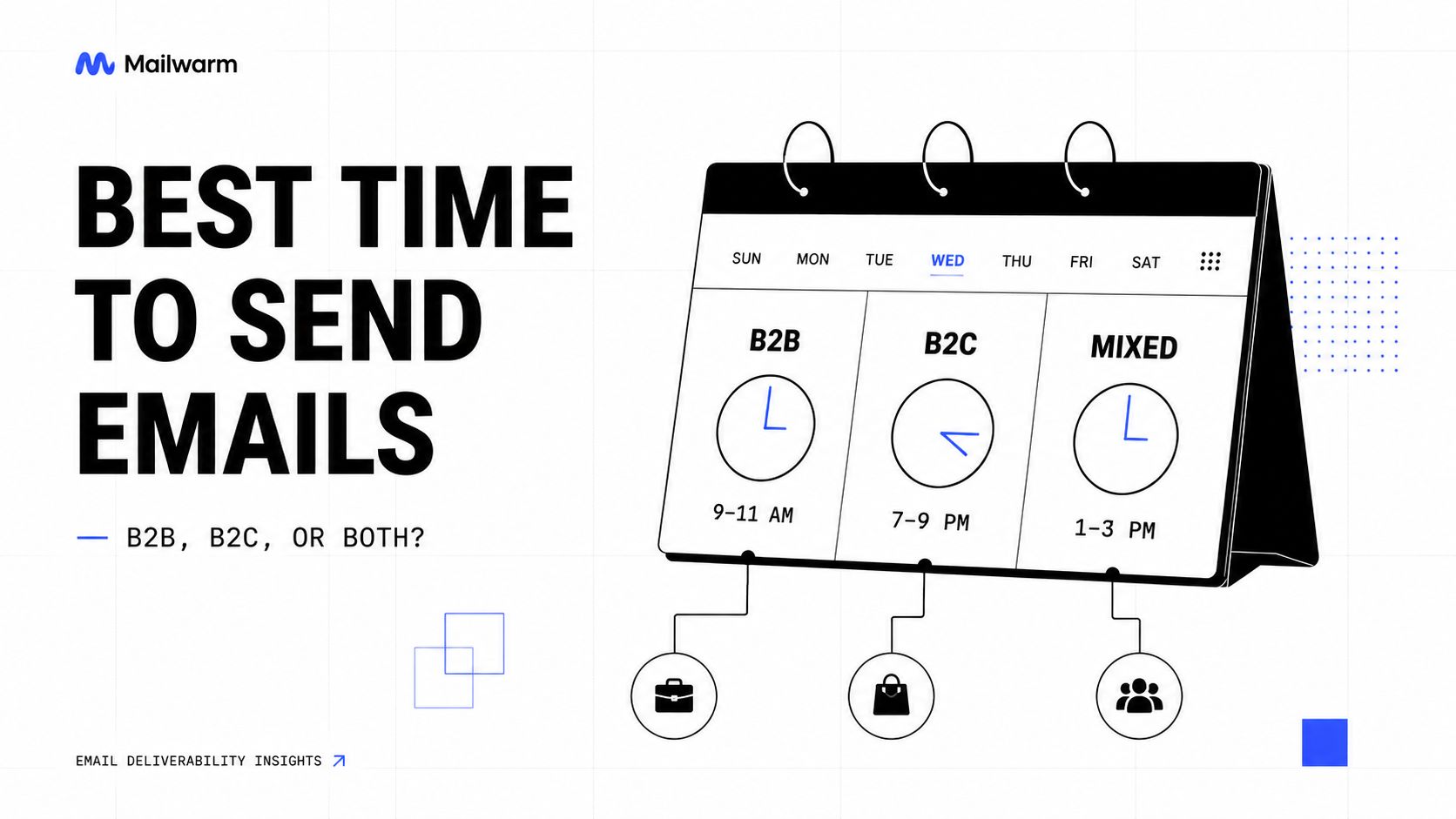
For B2B SaaS, Tuesday or Thursday at 10:00 a.m. local time is a strong starting point. That lines up with the midweek open-rate pattern and with the way professionals usually scan inboxes during the workday. A useful test variation is a later-morning send against an early afternoon send.
For B2C e-commerce, the strongest starting window often shifts later. A Thursday or Friday evening send can be a better test if the goal is clicks, product browsing, or promotions that benefit from after-work attention. Mixed audiences need segmentation first, because one global send time usually favors one group at the expense of another.
The embedded video below gives a quick visual overview of how timing strategy differs across audience types.
Global audiences need one extra layer of discipline. Local time zone scheduling matters more than a single “best” hour on the clock, especially when the list spans regions with different work habits. Agencies managing multiple client lists usually get better results by separating benchmarks by audience, not by forcing one universal rule.
Your Newsletter Timing Action Plan
Start with the deliverability basics, because timing can't fix inbox placement problems. Then use the midweek morning benchmark as the default, with click-focused campaigns shifted later in the day when action matters more than opens. After that, segment by audience type and time zone, then run a clean A/B test with one variable changed at a time.
Keep these bookmarks in mind. Midweek mornings are the best starting point for opens, late-day Thursday or Friday can be stronger for clicks, and your own list data should eventually override the benchmark. For teams building repeatable send strategy, Mailwarm's browse author email tactics can be a useful source of adjacent ideas around newsletter execution.
The best send time is not a one-time decision. It's a moving target shaped by audience behavior, list quality, and what the campaign is trying to achieve.
Mailwarm helps teams treat send time as part of a larger deliverability system, not an isolated tactic. It supports sender reputation, inbox placement monitoring, and warmup with real inbox engagement, which gives newsletter tests a cleaner foundation. If email is part of the growth plan, visit Mailwarm to see how its premium warmup and deliverability platform fits into that workflow.
FAQ
What is the best day and time to send a newsletter?
A strong baseline is Tuesday through Thursday at around 10:00 a.m. local time. That window lines up with the strongest open-rate pattern in the benchmarks and is a practical starting point for most lists.
Is morning better than evening for newsletters?
Morning is usually better for opens, especially during the workweek. Evening can be better when the goal is clicks or conversions, because readers often have more time to act after work.
Why do clicks and opens peak at different times?
People check inboxes in the morning, but they often click later when they are not rushing. That is why open-rate optimization and click-rate optimization should be tested separately.
Should newsletters be sent on weekends?
Weekends are usually a weaker starting point than weekdays for most newsletters. The benchmark data shows weekend open rates trailing the workweek, so weekend sends should be used only when audience behavior justifies them.
Does list type change the best send time?
Yes. B2B, B2C, and mixed audiences behave differently, and timezone spread matters too. A global list should usually be segmented before any timing decision is treated as final.
Is Mailwarm useful before testing send times?
Yes, if deliverability is still unstable. Mailwarm helps teams build sender reputation, monitor inbox placement, and improve deliverability through real inbox engagement, which makes timing tests easier to trust.