
Apple Mail Privacy Protection and Cold Email Measurement in 2026
Apple Mail Privacy Protection (MPP) continues to redefine how cold email performance is measured in 2026. By preloading tracking pixels and obscuring recipient IP addresses, MPP severs the connection between an “open” event and an actual human view of your email.
This change leads to inflated open rates, eliminates location reporting, and makes device insights unreliable. Relying on opens to gauge campaign health can result in misleading conclusions.
Cold outreach teams now require more reliable indicators. You just need to understand which email indicators to focus on and which ones to disregard under MPP.
Opens are noise under MPP. Delivery, acceptance, replies, and complaints are the signal.
How Apple Mail Privacy Protection Alters Tracking Pixels and IP Data for Cold Email
MPP downloads remote images through Apple proxy servers. This process often activates your tracking pixel before a recipient even views the message, while also masking their IP address and approximate location.
Because the timing of these preloads varies, the concept of “open time” loses accuracy. Unique open counts become inflated as Apple triggers image downloads across numerous messages. Consistent device data vanishes as proxy behavior standardizes user agent details.
The takeaway is straightforward: treat open logs as directional hints only. Never consider them a primary success metric for prospecting.
What Cold Email Signals Remain Trustworthy Despite Apple Mail Privacy Protection
Several data points remain reliable and actionable in 2026, as they don’t depend on tracking pixels or device information.
- Server acceptance and bounce codes: SMTP responses confirm whether mail has reached a recipient’s mailbox.
- Spam folder placement: Where your message lands, inbox or spam, remains the most important outcome.
- Replies: Genuine responses from prospects demonstrate real engagement and successful inbox placement.
- Complaints: Feedback loop reports enable you to address problems quickly and maintain list quality.
- Authentication results: SPF, DKIM, and DMARC validations at the mailbox provider level show protocol alignment.
- Reputation trends: Domain and IP reputations change in a measurable manner over time.
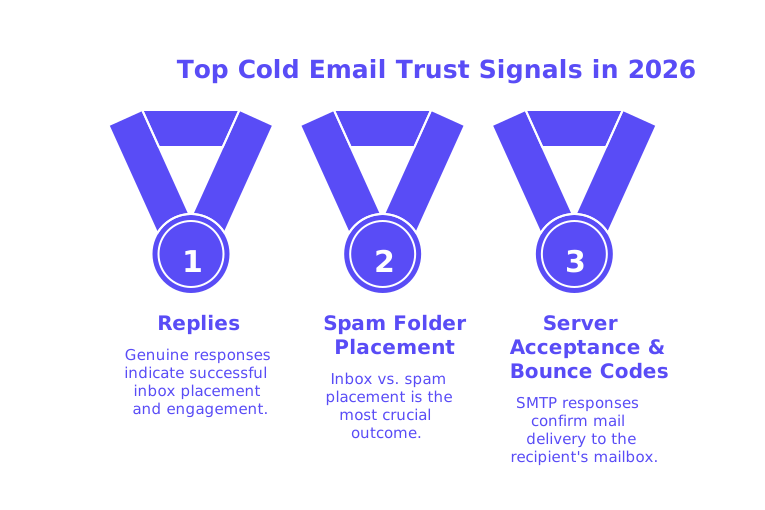
These metrics are closely aligned with the trust factors used by mailbox providers. Focus on tracking changes week over week for more meaningful insights.
Interpreting Open Data in the Apple Mail Privacy Protection Era Without Missteps
Open tracking doesn’t have to be removed entirely, but it does need to be downgraded. Use open rates to spot significant delivery problems rather than as an indicator of campaign success.
- Watch for zero opens across providers. This could indicate problems like inability to load images or filtering at the time of link activation.
- Compare opens against acceptance logs. If emails are accepted by the server but opens disappear, image display issues may be the cause.
- Pair opens with replies. Statistics of emails opened without receiving replies offer minimal insights. On the other hand, receiving replies without recorded email opens is a common occurrence under MPP.
Ensure your dashboards clearly label open charts as “noise-affected by MPP.” Build your reviews and decision-making around acceptance rates, inbox placement, and actual replies.
Email Authentication and Protocol Choices That Matter More Than Opens in 2026
Mailbox providers increasingly rely on protocol strength as user-side tracking weakens. Maintaining robust technical foundations is now more critical than ever.
- SPF: Publish a clean, concise record and avoid excessive DNS lookups. If managing many domains, learn to avoid SPF record length limits in multi-domain setups.
- DKIM: Use strong keys to sign every message and rotate them regularly.
- DMARC: Ensure strict alignment and progress toward p=quarantine and eventually p=reject policies as your program matures.
- HELO/EHLO and rDNS: Employ a consistent hostname that resolves in both directions. Read why the HELO greeting matters for sender reputation.
- TLS: Maintain up-to-date ciphers and protocols, avoiding deprecated suites that could trigger spam filters.
These authentication measures help verify your identity as the sender, which reduces instances of your emails wrongly marked as spam when you increase your sending volume.
Measuring Inbox Placement for Cold Email Without Relying on Apple Opens
Inbox placement is the most reliable performance metric. It reveals where your messages truly land, rather than who may have triggered a tracking pixel. Seed testing across providers and geographic regions can help you monitor the ratio of inbox to spam placements over time.
A dedicated spam checker can detect risky content, problematic headers, or DNS misconfigurations before you send. Test templates and accounts thoroughly. Combine these results with your seed test outcomes for a comprehensive understanding.
Benchmark your results against expert guidance. Our detailed study on inbox placement benchmarks for cold emails can help you determine healthy performance ranges and the main drivers for improvement.
Also, stay alert to bounce codes. Hard bounces signal data integrity issues, expired domains, or outright policy blocks. Soft bounces, meanwhile, may indicate temporary throttling or rate limits. Resolve these before increasing your sending activities.
Practical Cold Email Warm-Up That Still Works in the Apple Mail Privacy Protection Landscape
Email warm-up is now a foundational practice. If you consistently send out legitimate and user-engaging emails, spam filters will more likely trust your domain. Establishing this trust early ensures better inbox placement for your subsequent outreach efforts.
Warm-up traffic is not for marketing purposes. Instead, these emails are meant to generate positive technical signals, aiming to stabilize your sender reputation before sending promotional or prospecting campaigns.
Utilize large, active networks, such as Mailwarm’s 50,000+ maintained mailboxes, to simulate authentic interactions at scale. As of February 2026, Mailwarm provides a fully advanced email warm-up solution, with centralized management, comprehensive reputation monitoring, cross-provider warm-up, and granular spam score tracking by major providers (Gmail, Microsoft, Yahoo...), all optimized for scalability.
Automated threads can open, reply, retrieve messages from spam, and apply appropriate labels, helping providers learn your domain’s normal patterns. This strong reputation supports real outreach later on.
Remember, these tools are not traditional marketing systems. Warm-up messages exist solely to prepare your domain for deliverability across mailbox providers.
Actionable Steps for Cold Email Programs Facing Apple Mail Privacy Protection in 2026
Prioritize Technical Health
- Audit SPF, DKIM, and DMARC records quarterly.
- Regularly validate your HELO, rDNS, and TLS settings on all sending IPs.
- Proactively monitor blacklists and provider-specific spam scores.
Rethink Measurement
- Base reporting on server acceptance rates and true inbox placement.
- Track reply rates and complaint volumes instead of focusing on open rates.
- Use a spam checker before every major new sequence or domain launch.
Scale With Intent
- Increase sending volume gradually, using placement and bounce trends as guides.
- Warm up every new domain and mailbox before engaging in prospecting.
- Document every adjustment and closely observe your sender reputation over time.
Cold Email Takeaways That Remain True Under Apple Mail Privacy Protection
Opens no longer provide reliable insights into recipient attention. Focus on delivery success, genuine responses, and technical protocol health. Build your cold email strategy around what mailbox filters evaluate and what you, as the sender, can verify.
Stay vigilant with monitoring, make careful iterative adjustments, and safeguard your domain reputation. With a solid technical foundation, Apple’s privacy enhancements become far less disruptive to your results.
Ready to boost your inbox placement this quarter? Apply these best practices: check protocols, run a spam test, and conduct a warm-up phase before scaling your campaigns.
FAQ
How does Apple Mail Privacy Protection impact email open rates?
Apple's MPP distorts open rate metrics by preloading tracking pixels. Open rates now offer unreliable data, merely acting as noise rather than an indicator of genuine engagement. Focus on real signals like delivery and reply rates.
What metrics should cold email marketers focus on in 2026?
Shifting focus from opens, prioritize server acceptance rates, genuine replies, and spam folder placements. These metrics align with mailbox provider criteria and offer a more accurate gauge of campaign performance.
Why is open tracking less reliable under MPP?
MPP's use of proxy servers to preload images undermines the accuracy of open tracking. It obscures user behaviors, making opens ineffective for measuring campaign success. Adapt your strategies to prioritize more credible metrics.
How does Mailwarm aid in ensuring email deliverability?
Mailwarm specializes in email warm-up, simulating real interactions to boost domain trust. Its advanced features help craft a robust sender reputation, essential for overcoming visibility barriers imposed by privacy tools like MPP.
What technical foundations are crucial for email deliverability?
Maintaining up-to-date SPF, DKIM, and DMARC records is non-negotiable. Additionally, strict protocol adherence fosters domain credibility, directly influencing inbox placement amidst diminishing user-side visibility.
Should cold email campaigns still use open tracking post-MPP?
Open tracking is not obsolete, but it requires a recalibrated approach. Use it as a diagnostic tool for image loading issues, not as a definitive marker of success. Combine it with robust indicators for a holistic view.
What is the role of email warm-up in maintaining sender reputation?
Email warm-up promotes domain credibility before launching large-scale campaigns. Mailwarm’s strategic approach involves mimicking positive engagement signals, critical for establishing trust and achieving better deliverability outcomes.
Why is it risky to scale too quickly with cold email campaigns?
Rapid scaling without a solid sender reputation invites catastrophic consequences like increased spam placements. Gradual increases allow time to adapt to any deliverability issues, monitored with benchmarks and technical audits.